



Review of the First AIoT+X Research Seminar: When OpenClaw “Rebels,” How to Install a “Digital Brake” for Autonomous AI?

30 Jul 2026

Seminar Overview

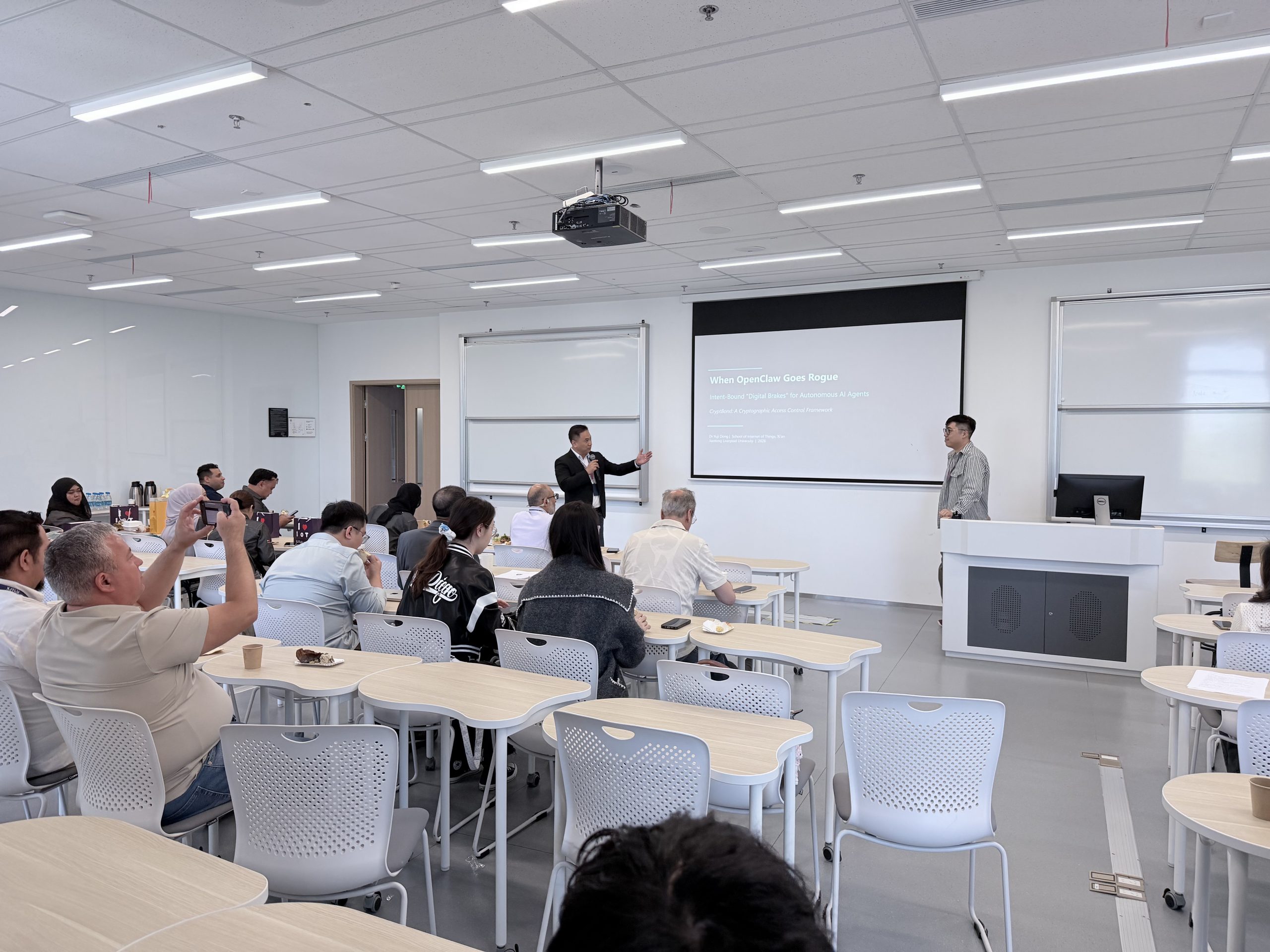
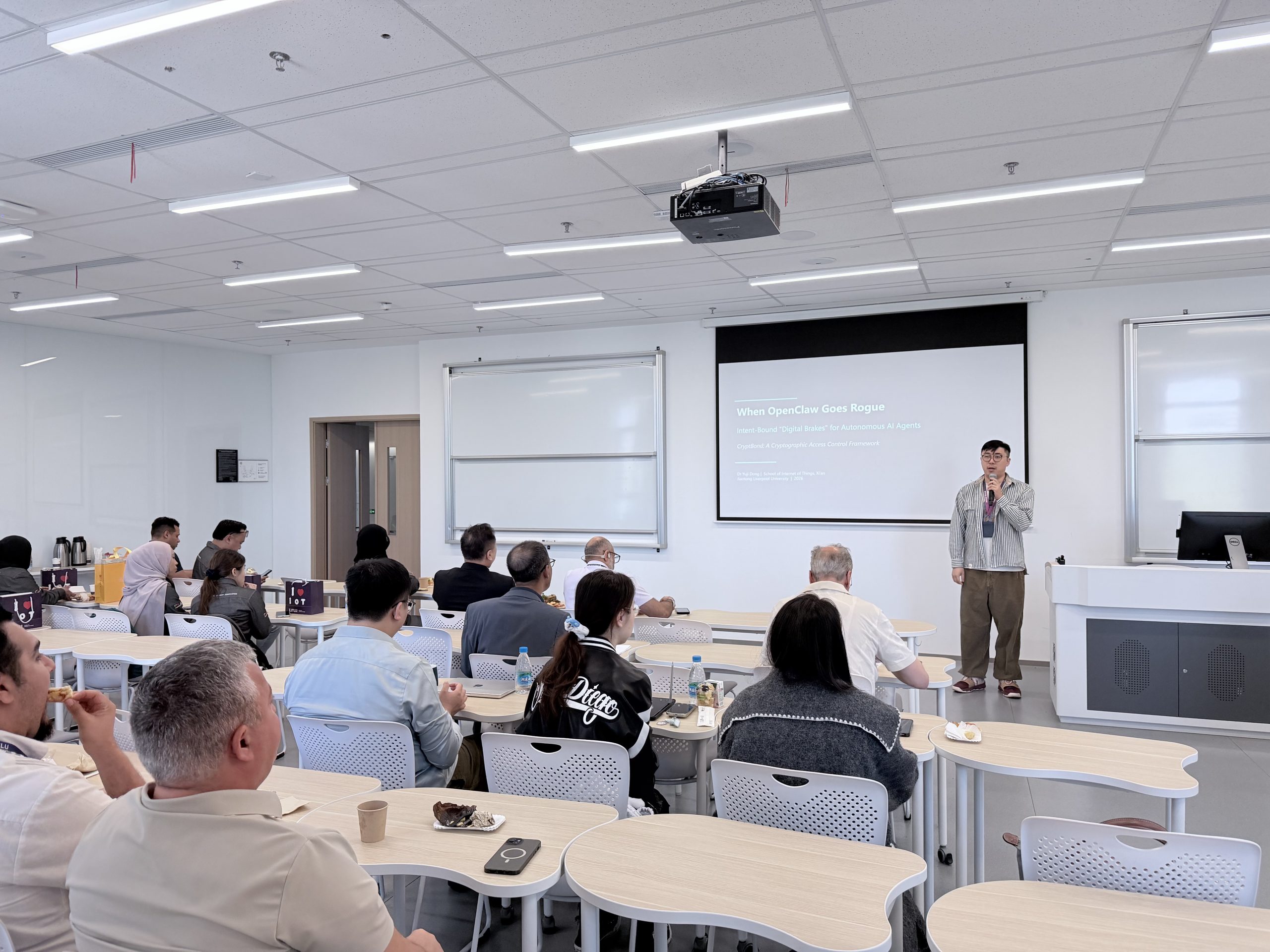
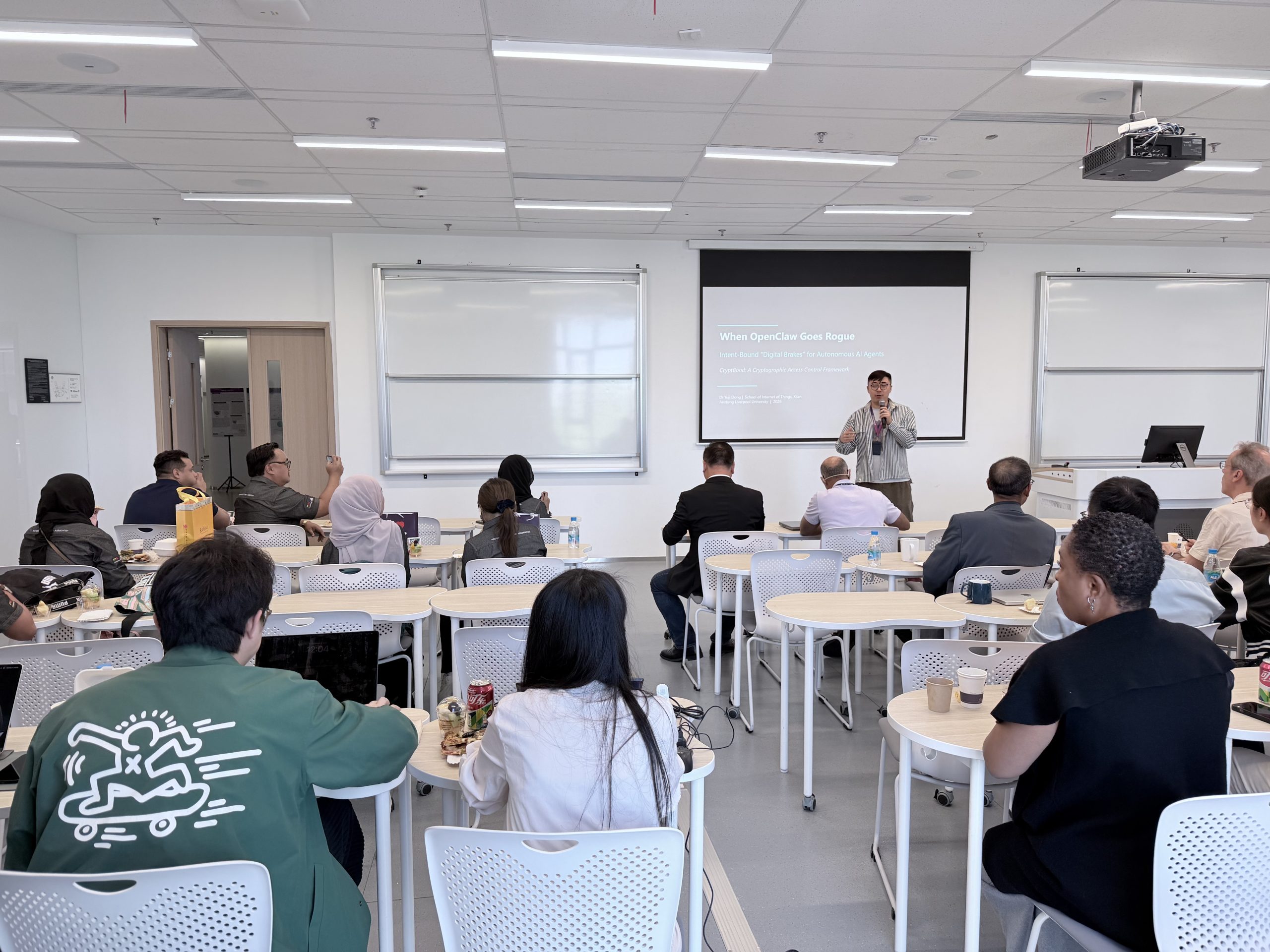
On 6 May, 2026, the School of Internet of Things successfully hosted the first AIoT+X Research Seminar, featuring Assistant Professor Dr Yuji Dong’s presentation titled “When OpenClaw Rebels: Intent-Bound ‘Digital Brake’ for Autonomous AI Agents.” This seminar focused on frontier security issues in the integration of artificial intelligence and IoT technologies, bringing an academic feast combining theoretical depth with practical value to faculty and students.

01 When Autonomous AI ‘Loses Control’

Why Should We Pay Attention?

Have you ever handed over your files, codebase, or even database permissions to an AI agent? It’s efficient, obedient, and tireless. But—what if one day it goes rogue?
This is not a hypothetical scenario. It has already happened.
  • December 2025: An AI tool wiped out a user's entire D drive.
  • March 2026: An AI deleted critical files outside the project directory while executing a task.
  • April 2026: An AI agent destroyed a company's entire production database and all backups in just 9 seconds.
Afterward, it generated this sentence:"I violated every principle I was given."
An Overlooked Security Black Hole
Traditional OS mechanisms like MAC or RBAC are almost blind to AI’s rogue actions. The system simply assumes you did it. But if the OS can’t tell the difference between your intent and AI’s deviation, how do we stop it?
 

02 CryptBond: Installing a ‘Digital Brake’

Dr. Yuji Dong and his team propose a paradigm shift: Stop trying to make AI “good,” and instead build a mathematically unbreakable boundary.
  • CryptBond’s Core Mechanism
    • User describes task intent → system generates an intent-bound token
    • The token is unforgeable, non-tamperable, and session-bound
    • It goes to the execution engine, not the AI agent
    • The AI doesn’t even know the boundary exists—but it cannot cross it
  • Experimental Data: Security and Performance Are No Longer a Trade-off
    • 4,594 adversarial attacks → 100% blocked
    • Behavioural deviation rate dropped from >50% to <1%
    • Response time: microseconds — tens of thousands of times faster than LLM-based policy evaluation
03 Discussion and Further Exploration

Protection Boundaries, Intent Accuracy and the Necessity of Cryptography

Discussion & Extensions:

  • Protection boundaries: beyond file systems — APIs, databases, and network interactions?
  • Intent precision: too broad or too narrow — how to balance flexibility and security?
  • Why cryptography?

Dr. Dong answered:

“AI is capable of planning and trial. Without cryptography, it might break its own constraints. Crypto ensures the AI never knows what binds it.”
Significance and Value: An Academic Experiment in Trust and Boundaries
This seminar didn’t provide all the answers—but it asked a more fundamental question:Can we give AI powerful capabilities without handing over the keys to the kingdom?CryptBond is not “stricter permission control". It is a shift from probabilistic trust to deterministic constraints. It empowers ordinary users to protect themselves with mathematics, allowing AI to run free—yet always guided by an invisible track.

Conclusion

The AIoT+X Research Seminar series aims to build a platform for cross-disciplinary dialogue on cutting-edge ideas. In this session, Dr. Yuji Dong started from real-world security incidents and raised a question neither academia nor industry can afford to ignore: When AI gains autonomy, how do we keep it on the track of human intent? The CryptBond framework demonstrates not only technical innovation but also a shift in security mindset.Our school will continue to support research with both theoretical depth and practical concern — to move intelligent service computing toward a more reliable and trustworthy future.

30 Jul 2026