




20 Jul 2026


Connection of Industry Wisdom, Reshaping the Educational Ecosystem — the Industry Education Platform of XJTLU Entrepreneur College (Taicang) actively responds to the innovative educational demands of the digital intelligence era, exploring a two-way co-creation model that deeply integrates global higher education with industrial development. On 11 June, EMBA participants from FIA Business School (Brazil), guided by the Industry Education Platform of XJTLU Entrepreneur College (Taicang), embarked on an immersive journey to explore China's smart manufacturing, cross-border commerce, and innovation ecosystem. From the cutting-edge pulse of the Shanghai FANUC intelligent factory to the Syntegrative Education classrooms at XJTLU Entrepreneur College (Taicang), the visit bridged "global perspectives" with local innovation, fully demonstrating the vibrant ecosystem of Syntegrative Education.
Visiting Shanghai FANUC: Experiencing the Frontiers of Smart Manufacturing
As one of the most influential business schools in Latin America, FIA Business School has a strong interest in China and Chinese enterprises. In recent years, it has regularly organised study tours for its participants to Chinese cities including Beijing, Shanghai, Shenzhen, and Hong Kong, fostering business and cultural exchanges between Brazil and China.
The first stop of the visit was Shanghai FANUC Robotics Co., Ltd. (headquarters). As one of the world's top four robotics companies (China region), Shanghai FANUC has kept pace with China's rapid manufacturing development and grown into a leading provider of intelligent manufacturing solutions in the country.
The company deeply inherits FANUC's globally leading technological expertise, showcasing over one hundred robots and dozens of advanced automation systems covering more than 20 industry application scenarios, including vehicle manufacturing, laser processing, chip manufacturing, parts assembly, and smart logistics. Participants observed first-hand the collaborative operations and automated production processes of robots across various fields. They engaged in exchange and discussion on topics such as industrial robot development trends, smart manufacturing technology evolution, and industry application cases, exploring the latest achievements and practical experience in robot control technology, visual perception, AI applications, and flexible production.
Beyond the Classroom: How Large Can a Classroom Be? Seeing Another Way a University Grows
Stepping onto the campus of XJTLU Entrepreneur College (Taicang)—a "university of the future" spanning approximately 546 mu (about 90 acres)—the participants, guided by Xiangxue Song, Business Development Manager of XJTLU Entrepreneur College (Taicang), toured the advanced teaching facilities and research environment. They explored XJTLU's innovative educational philosophy that integrates Chinese and Western approaches and its industry-education Syntegrative Education model. They visited sustainable student entrepreneurial projects under the "student-as-partner" model and tasted the Cozy Coffee , a student-run brand. They experienced how the campus, in its ever-growing ecosystem, offers open, empowering, and extended "classrooms" everywhere—truly embodying the educational philosophy of XJTLU's Syntegrative Education: beyond the classroom, there are classrooms everywhere.
Engaging in XJTLU Classrooms: Decoding the Culture of "Guanxi" and the Art of Negotiation
Dr Joseph Seet from XJTLU Entrepreneur College (Taicang) and a transnational entrepreneur with extensive management experience and global business practice, introduced the participants to the cultural codes embedded in the real Chinese business environment. He pointed out that paying attention to the Chinese market inevitably involves its massive scale—1.44 billion people, provincial economies comparable to mid-sized developed countries, and policy dividends from over 23 free trade agreements.
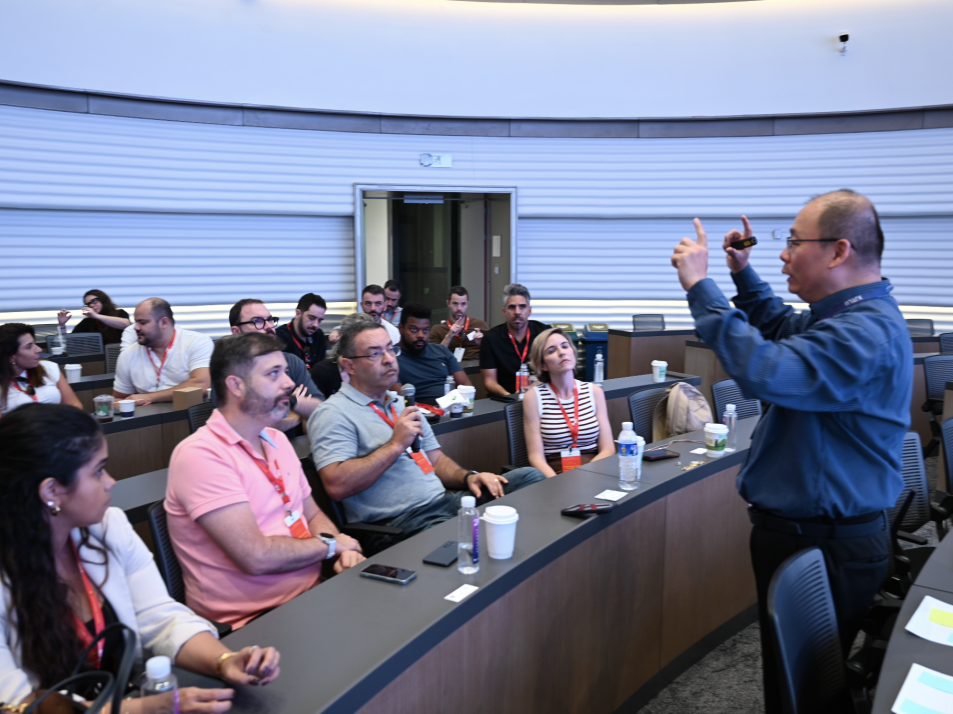
From a macro perspective, Joseph Seet systematically elaborates on the unique scale, policy dividends, and business ecosystem of the Chinese market. He unpacks this subject along two dimensions—cultural insights and practical methodologies—offering an in‑depth analysis of the distinctive logic that governs business in China: where trust often precedes transactions, and where building relationships comes before closing deals. Drawing on his hands‑on experience in cross‑border investment, financing, and manufacturing, he dissects the strategic wisdom of negotiation with layered precision. From cultural codes to actionable frameworks, he constructs for his audience a genuine, multi‑dimensional, and highly pragmatic cognitive map of doing business in China.
From SaaS to AI Agents: Redefining Cross-Border Business Rules
Dr Yicheng Wang, from the School of Intelligent Finance and Business at XJTLU, turned the lens to technological frontiers. He noted that China has been Brazil's largest trading partner since 2009, with bilateral trade volume reaching US$160 billion in 2024, and that Chinese manufacturing is expanding overseas on an unprecedented scale. However, traditionally, cross-border teams still spend 3–5 days and costs ranging from US$500 to US$2,000 on tasks such as tax compliance and supplier vetting.
To address these pain points, Dr Yicheng Wang presented the IFB Going-Global Intelligent Solution developed by his team: through AI agents, it upgrades traditional "click-based" SaaS into an "intent-based" business operating system. Users only need to ask questions in natural language, and the backend automatically performs parallel retrieval and cross-verification. In a real-scenario demonstration, for a complex question regarding "actual import tariffs on EV cells in Bahia, Brazil" for a Chinese battery company, the AI agent completed cross-verification of the Mercosur tariff schedule and Brazilian federal and state-level tax rates within 5 minutes, directly outputting conclusions with supporting evidence and multilingual memos—compressing a process that used to take days into just 5 minutes, and reducing costs to US$5–20.
Dr Yicheng Wang offered three core conclusions: the China-Brazil axis is the most promising emerging-market trade corridor today; China has moved from exporting products to exporting platforms and standards, and AI agents are the next core track for going global after new energy; and intelligent agent technology is boosting cross-border decision-making efficiency by dozens of times, vividly demonstrating how Chinese innovation is reshaping global business rules.
From FANUC's smart workshops to the endlessly extended Syntegrative classrooms within the XJTLU ecosystem, this China tour for the EMBA participants of FIA Business School was both an in-depth exploration of the global frontiers of smart manufacturing and a panoramic insight into China's innovation ecosystem and the future of cross-border commerce. XJTLU Entrepreneur College (Taicang), with its unique "education + industry" model, is building a bridge across the ocean, enabling business elites from around the world to decode China and engage with the future here. The open vision of XJTLU's Syntegrative Education is not only a campus or a university, but also a global platform where the world and China can see and understand each other.
20 Jul 2026