





XJTLU conference to put AI and social transformation in focus

02 Sep 2026


Nearly 100 scholars to gather at XJTLU, Sept. 4-5, to examine AI’s growing influence on communication, media and society.
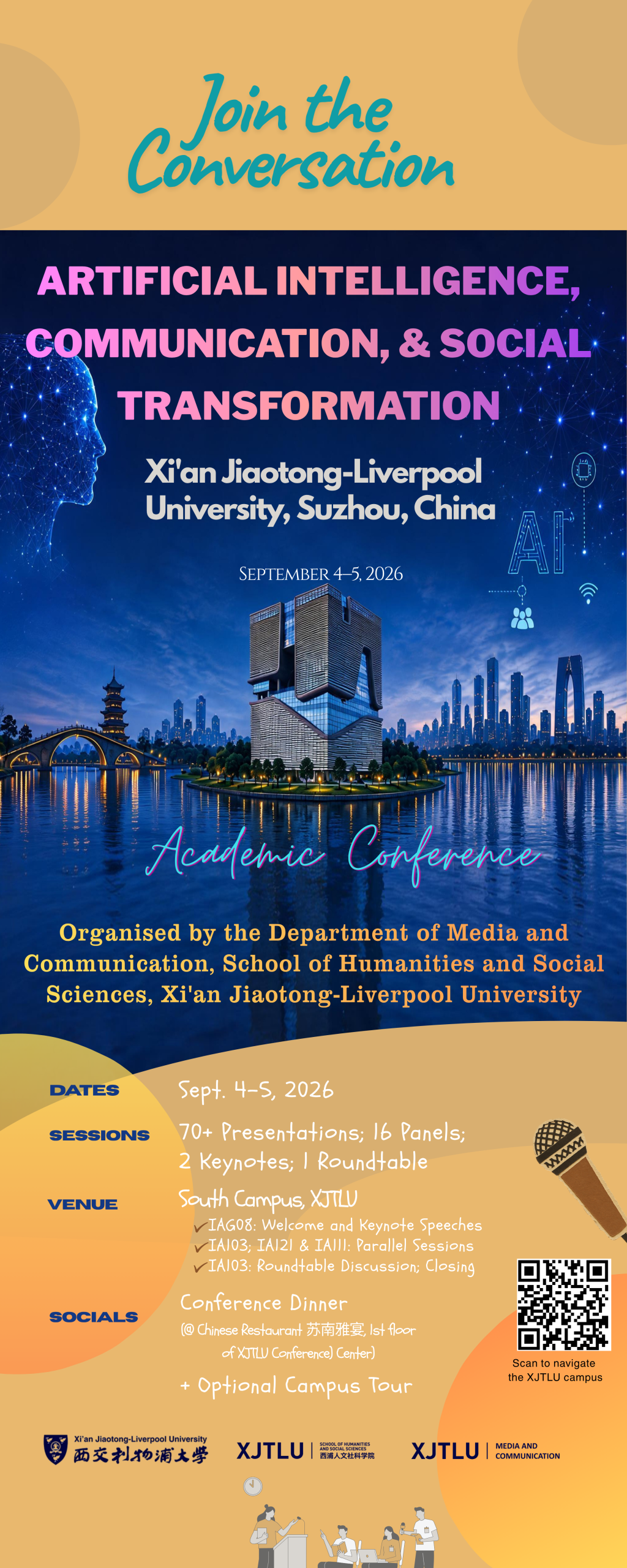
Nearly 100 scholars, PhD students, early career researchers and practitioners will join the conference, “Artificial Intelligence, Communication, and Social Transformation,” to be held at XJTLU’s SIP South Campus in Suzhou.
Across four research clusters, Digital Technology and Changing Society; Culture, Creativity and Communication; Journalism and Society; and Screen Studies and Popular Culture, the event will explore AI’s influence on media, journalism, education, creative industries and everyday life.
Two keynote addresses will further frame the discussion. Professor Kay O’Halloran of the University of Liverpool will speak on “Multimodal AI: Opportunities and Challenges for Communication and Media Studies,” while Professor Dianlin Huang of Communication University of China will address “AI and the Paradigmatic Change of Communication Research.”
Professor Michael Prieler, lead organiser of the conference and Research Director and Deputy Head of the DMC, said the event comes at a time of rapid development in artificial intelligence.
“This conference is particularly timely because of the rapid development of AI and its growing impact on media, communication, journalism, culture, education, and society more broadly,” he remarked. “The conference will examine these developments from both academic and practical perspectives, highlighting not only the opportunities created by AI but also the challenges and risks that come with them.”
Discussions will cover topics including AI in everyday life, pedagogy, journalistic practices, industrial labour rights, emotions and human-machine communication. Professor Prieler said he hopes the event will encourage interdisciplinary perspectives and inspire new ideas for future research and collaboration.
For PhD students and early career researchers, he said, the conference will provide opportunities to present their work, receive feedback and build academic connections with established scholars and other emerging researchers.
“Most importantly, the conference will provide opportunities to network and exchange ideas with leading scholars as well as with other emerging researchers in the field,” Professor Prieler said. “This can help them develop new academic connections, identify potential collaborations, and gain inspiration for their own future research.”
The two-day event will feature 16 parallel sessions with 72 papers across the four thematic clusters, with online participation available for those unable to attend in person. The conference will conclude with a roundtable discussion led by prominent scholars. Selected papers may be considered for future research outputs, including a special issue or edited volume, according to the organisers.
Courtesy of the Scholastic Journalism Team, Department of Media and Communication, XJTLU.
02 Sep 2026