





30 Oct 2026


Recently, representatives from the Regional Centre of Expertise on Education for Sustainable Development in Suzhou (RCE Suzhou), recognised by the United Nations University, attended the 17th Asia-Pacific Regional Meeting of the Global RCE Network. The delegation included Dr Yameng Zhang, President of RCE Suzhou and Director of Responsible and Sustainable Business Education at International Business School Suzhou (IBSS); Dr Yi Luo, a member of the IBSS Sustainability Committee; and Ms Huan Ni, Chair of Green Light-Year, together with her team.
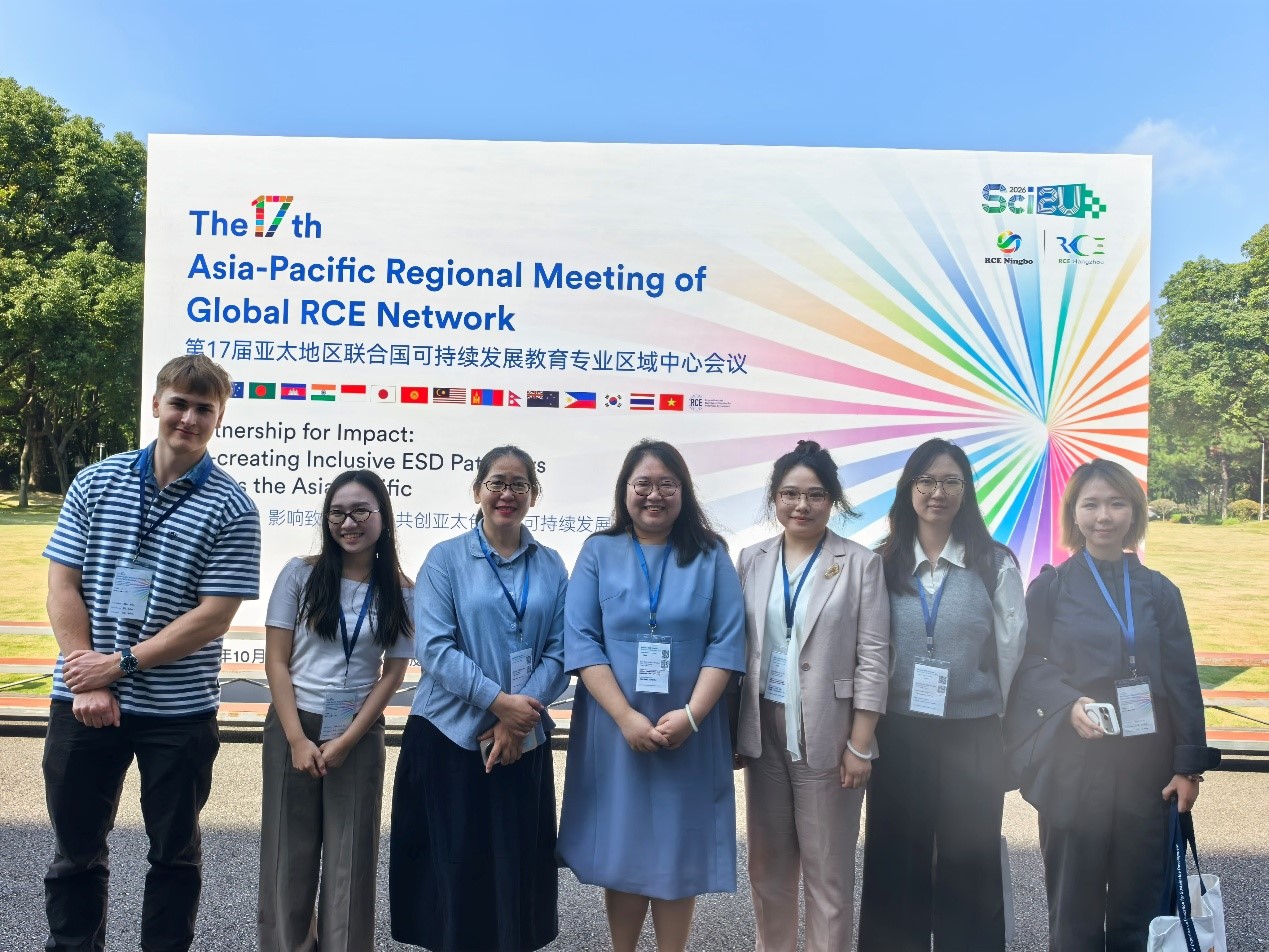
The representatives exchanged experiences with education for sustainable development (ESD) practitioners from across the Asia-Pacific region, exploring how RCEs can move sustainability education beyond knowledge dissemination towards meaningful action through multi-stakeholder collaboration, youth development, and community engagement.
From Campus to Community: RCE Suzhou’s Vision for Education for Sustainable Development
During the meeting, Dr Yameng Zhang introduced RCE Suzhou’s vision and its two flagship educational initiatives. Officially recognised in January 2022 and hosted by IBSS at Xi’an Jiaotong-Liverpool University (XJTLU), RCE Suzhou aims to empower citizens to integrate sustainability into their everyday lives, making education for sustainable development more relevant and accessible to individuals, communities, and urban life. To advance this vision, RCE Suzhou is implementing two complementary educational initiatives.
The first is the Sustainable Lifestyle Festival, which brings sustainable lifestyle brands, community organisations, businesses, and other stakeholders onto campus, creating a platform for dialogue and engagement between the university and wider society. Through interactions with businesses and community partners, students and members of the public can learn about sustainable products, services, and business practices while exploring different possibilities for sustainable living. The Festival also facilitates knowledge exchange and collaboration among education, business, and community stakeholders.
The second is the Sustainable Future Talent Education Programme, which adopts a project-based learning approach to encourage students to transform sustainability knowledge into educational experiences for the wider public. For example, students design sustainability-themed CityWalk routes that integrate local culture, community spaces, and everyday urban experiences, with the ambition of extending these educational initiatives beyond campus to local communities and the general public.
Dr Zhang highlighted that these two initiatives create a two-way connection between the university and society. On the one hand, they bring real-world experiences and insights from businesses, communities, and the public into the university, enriching sustainability education. On the other hand, they take innovative student-designed educational projects beyond campus, embedding sustainability learning in urban spaces and everyday life. Through these efforts, RCE Suzhou aspires to serve as a connector between education and action, local communities and global sustainability goals, and diverse stakeholders working together to create sustainable social value.
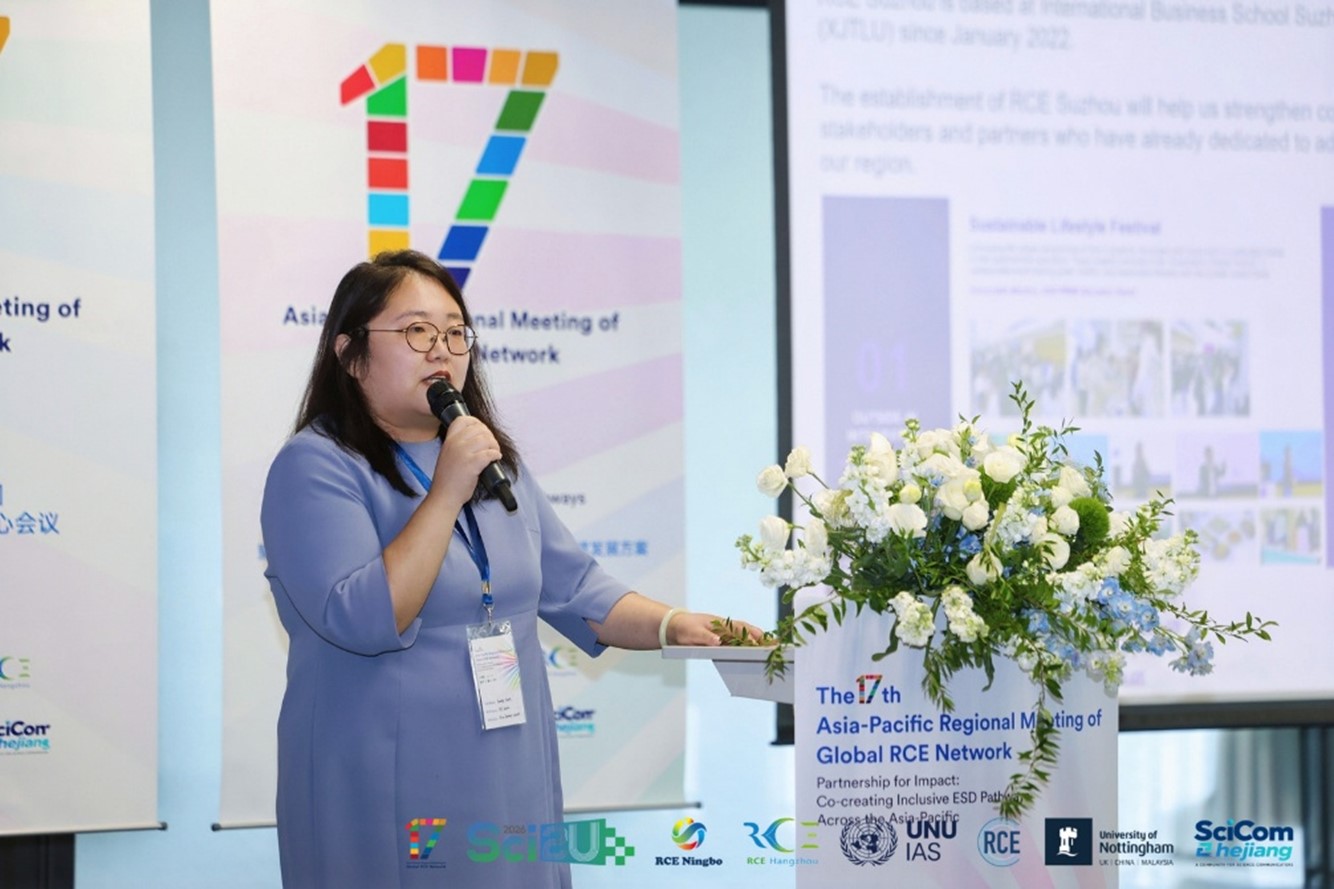
Exploring Jiangnan through CityWalk: Connecting Suzhou’s Local Culture with the Global Sustainable Development Goals
During the project-sharing session, Dr Yi Luo presented “Walking Jiangnan: Sustainable Lifestyle CityWalks in Suzhou”, a public social science education project supported by the Suzhou Social Science Public Benefit Programme. Using this initiative as a case study, she illustrated how RCE Suzhou integrates sustainability education with Suzhou’s local culture, urban spaces, and everyday life through student-led participatory design.
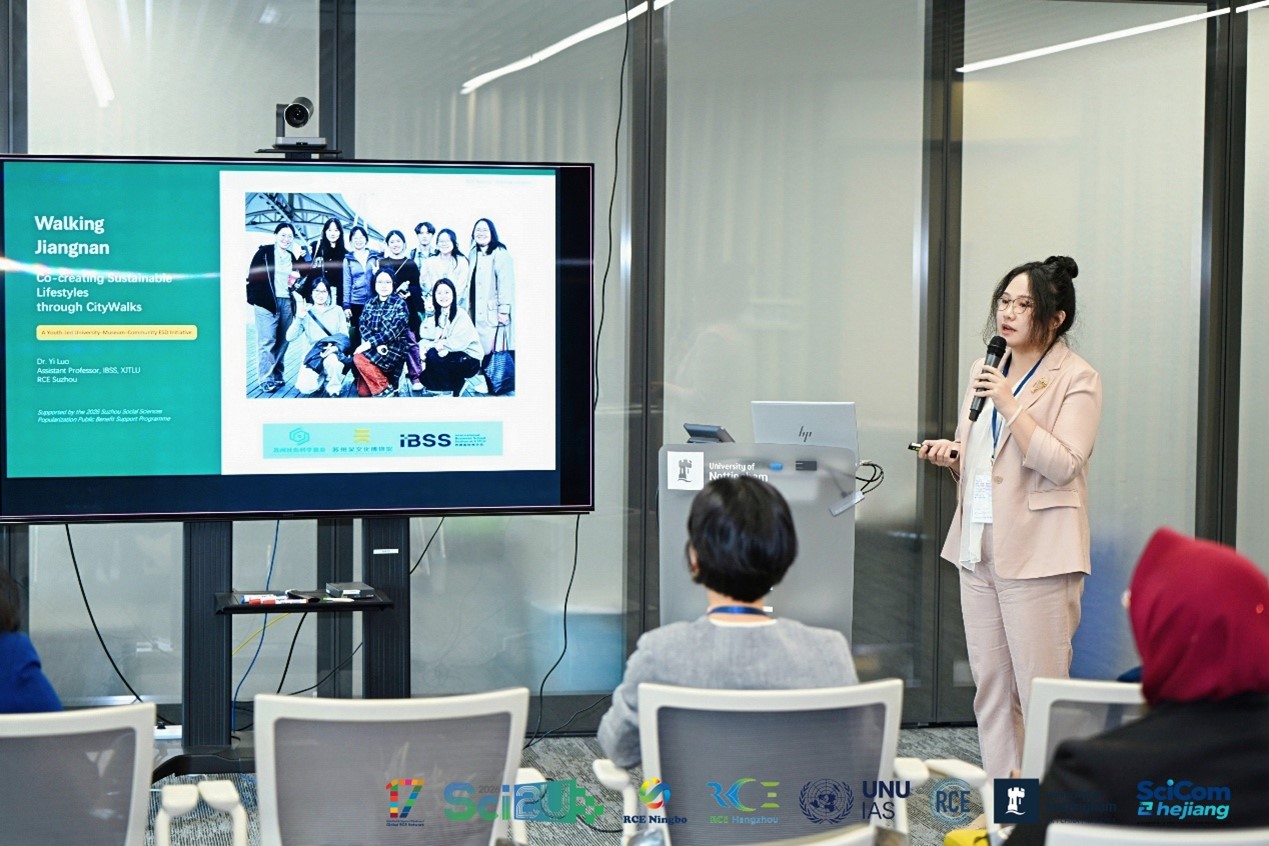
The project encourages students to move beyond the classroom and identify opportunities for sustainability education within Suzhou’s cultural heritage, natural environment, urban lifestyles, and community resources. By doing so, it translates the abstract United Nations Sustainable Development Goals (SDGs) into accessible and engaging CityWalk experiences in which members of the public can actively participate.
Student teams developed four distinctive CityWalk routes, each addressing different dimensions of sustainable development. These routes explore self-reflection and sustainable lifestyle choices; personal well-being and urban experiences; gamified learning and sustainable consumption; and ancient tree conservation and human–nature coexistence. Beyond environmental protection, the routes incorporate themes such as personal well-being, responsible consumption, sustainable cities, cultural heritage, and biodiversity. Through observation, walking, interaction, and reflection, participants are encouraged to recognise the interconnected nature of the SDGs and their relevance to everyday urban life.
Dr Luo also shared RCE Suzhou’s practical experience in fostering value co-creation among universities, communities, and businesses. The project positions students as designers of educational experiences and uses Suzhou’s urban spaces and cultural heritage as learning environments. Through collaboration with the Museum of Wu, local communities, and business partners, the initiative explores models of public engagement and long-term operational sustainability for ESD programmes.
This initiative illustrates RCE Suzhou’s efforts to extend sustainability education from campus-based learning to broader social participation. Students are not only learners of sustainability knowledge but also creators of educational content and facilitators of community action. Meanwhile, local culture and everyday urban life become valuable resources for connecting global sustainability goals with practical action at the individual and community levels.
Participating in the Asia-Pacific RCE Roundtable: From Collaborative Governance to Impact Assessment in Sustainability Education
On the second day of the meeting, Dr Yameng Zhang was invited to participate in the Regional RCEs Roundtable Panel Discussion, joining representatives from across the Asia-Pacific region to discuss multi-stakeholder collaborative governance, youth development, scaling and impact assessment, and ways to transform local initiatives into regional collaborative action.
Regarding multi-stakeholder governance, participants explored how RCEs can establish durable partnerships among local governments, universities, schools, businesses, and communities, while clarifying responsibilities for convening, financing, implementation, and accountability. The discussion also addressed how institutionalised partnerships can reduce dependence on individual leaders and how RCEs can effectively fulfil their roles as conveners, brokers, and capacity builders.
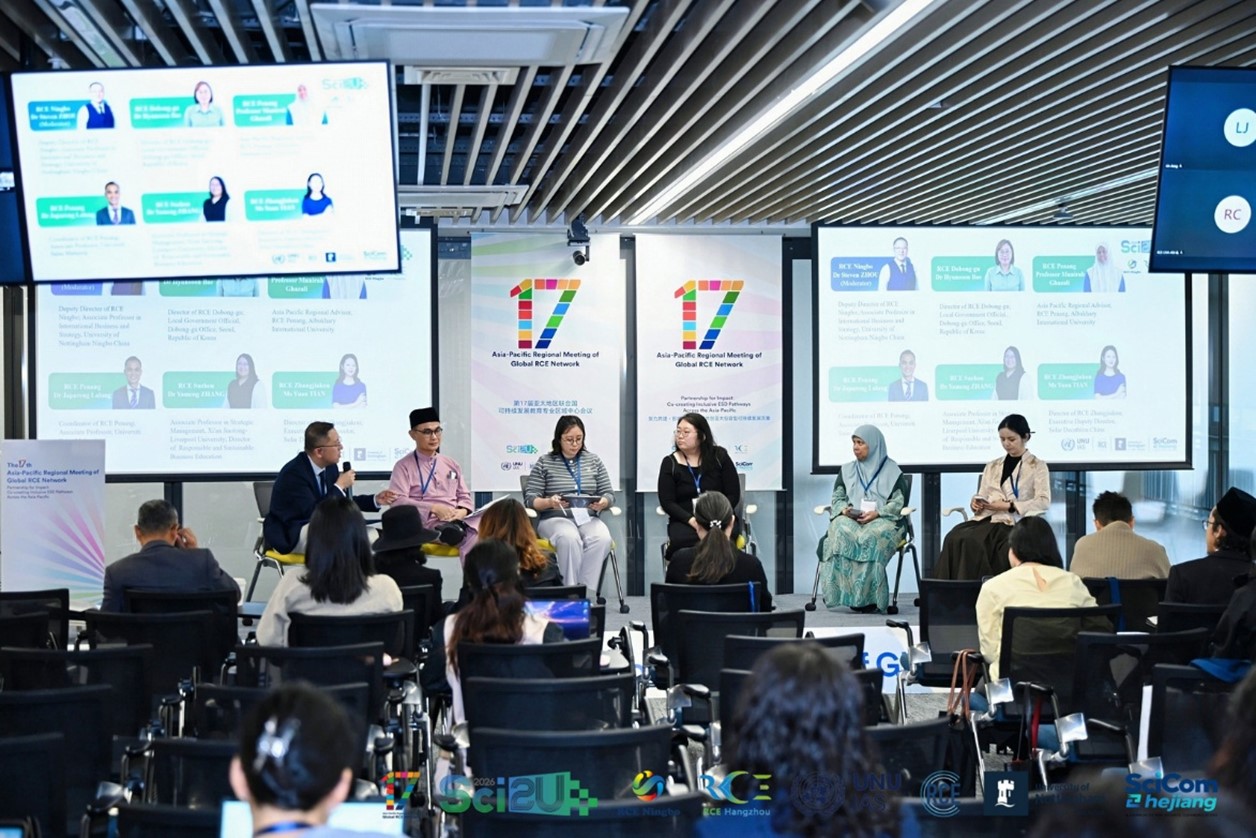
Regarding youth development, Dr Yameng Zhang particularly emphasised that the first priority of education for sustainable development is to reignite young people's interest and enthusiasm for the Sustainable Development Goals (SDGs), helping them recognise the connections between their personal development and broader societal sustainability. Today, young people face multiple challenges, including intense competition in the job market, career pressures, and uncertainty about the future. Against this backdrop, the SDGs can appear distant and abstract. Students often struggle to see how these global goals relate to their everyday lives and future aspirations. They may also lack the competencies needed to balance their personal development with the needs of society, the environment, and other stakeholders.
Therefore, sustainability education should go beyond knowledge dissemination and raising awareness. It should begin by sparking students' curiosity and helping them discover the relevance of sustainability to their own lives through meaningful, real-world experiences. By achieving small, tangible outcomes through practical activities, students can gradually develop a sense of achievement, self-efficacy, and motivation for continued engagement.
Universities should serve as platform builders and connectors, creating opportunities for experiential learning, independent exploration, and interdisciplinary collaboration that resonate with young people's interests and everyday experiences. Guided by UNESCO's framework of key competencies for sustainability, universities can develop a series of educational activities to strengthen students' systems thinking, anticipatory thinking, collaboration, and integrated problem-solving competencies. Ultimately, the goal is to empower young people to explore how they can pursue personal growth while responding to broader societal needs, enabling them to move from understanding sustainability to becoming active contributors and creators of sustainable value.
The roundtable also explored opportunities for knowledge sharing and joint action among RCEs in the Asia-Pacific region, including the development of common evaluation indicators, open educational resources, and cross-regional collaboration mechanisms. Participants discussed how locally developed ESD initiatives could be adapted and replicated in other contexts, contributing to shared regional learning and collective impact.
Building on IBSS Strengths to Advance Sustainability Education and Regional Collaboration
Officially recognised by the Global RCE Network of the United Nations University in January 2022, RCE Suzhou is hosted by IBSS at XJTLU. As a business school committed to responsible and sustainable business education, IBSS has long integrated business ethics, corporate social responsibility, and sustainability into its teaching, research, and community engagement activities.
RCE Suzhou builds on IBSS’s strengths in responsible management education, interdisciplinary talent development, and university–industry collaboration, while connecting these academic resources with Suzhou’s local communities, businesses, and cultural institutions.
Participation in the 17th Asia-Pacific Regional Meeting of the Global RCE Network provided an opportunity for IBSS and RCE Suzhou to showcase their locally grounded educational innovations, learn from ESD practices across the Asia-Pacific region, and explore opportunities for international collaboration. Looking ahead, RCE Suzhou will continue to strengthen its role as a bridge connecting universities, businesses, communities, and governments, advancing innovative educational practices that reflect local characteristics, encourage public participation, and generate meaningful and lasting social impact.
30 Oct 2026