





Students from the Department of International Studies at HSS Connect Sustainability Research with Industrial Practice

12 Oct 2026


A research and consultancy project based in XJTLU’s Department of International Studies, within the School of Humanities and Social Sciences (HSS), is bringing students into direct collaboration with industry to address sustainability challenges in China.
The project, titled “The Sustainability & Compliance Business Intelligence Platform” is commissioned by Trelleborg Sealing Solutions, that is, a Swedish multinational group, supplies sealing solutions and components for industries including automotive, pharmaceuticals and aerospace. The project focuses on its aerospace business and the relationship between its operations in China and international supply chains.
As China advances its green transition, companies must understand changing expectations around emissions reduction, resource efficiency and recycling.
Against this background, the project maps differences between Chinese regulatory requirements and the supplier standards expected by aerospace customers. Understanding these differences can help companies operating in China align their production and business strategies with sustainability objectives while maintaining their competitiveness. Meanwhile, students are trained to conduct research into regulation, industrial change and supply chains, with opportunities for them to apply their knowledge to practical business problems.
From research findings to the factory floor
On 22 September 2026, the student research team visited Trelleborg’s Suzhou manufacturing site for discussions with senior management and a factory tour.
Managers introduced the company’s development, business activities and the strategic role of its Suzhou operations. Their presentation also addressed emissions reduction, resource recycling, employee wellbeing, community responsibility and compliance.

The students then presented their preliminary research findings and discussed challenges encountered during the project. Trelleborg’s managers offered practical suggestions and alternative perspectives, helping the team refine its approach and identify priorities for further research.


During the factory tour, students observed production involving rubber, silicone and high-performance polymers, including moulding, assembly, testing and quality control. They explored how sustainability considerations enter daily operations through energy consumption, material use, waste management and employee safety.

For Xuanqi Lu, a BA International Relations student, the visit connected academic analysis with industrial practice: “It marked the beginning of grounding our ESG project from a ‘theoretical framework’ into ‘commercial practice,’” Xuanqi said. “Here, we witnessed with our own eyes how Trelleborg builds its competitive advantage through technological barriers and sustainable development strategies.”
Aikedamu Kateerjiang, an MA International Business and Global Affairs student, highlighted how the visit would inform the next stage of the research: “In the next stage, I hope to further examine the company’s China operations and their connection with the aerospace supply chain, as well as practical ESG-related issues such as energy use, waste management and supply-chain traceability,” Aikedamu said.

Exploring university-supported innovation in Taicang
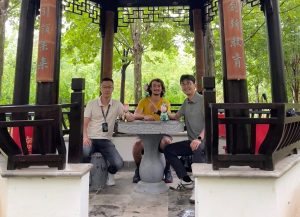
On 23 September, the students joined managers from Trelleborg’s Shanghai operations for a visit to XJTLU Entrepreneur College (Taicang). Dr. Fanglu Sun from the Department of International Studies at HSS, Dr. Muhammad Ateeq (School of Internet of Things), Prof. Mikhail Zenchenkov (X3 Co-Venture startup Hub) coordinated the visit.
The group visited the School of Intelligent Manufacturing Ecosystem, the Intelligent Manufacturing and Robotics Demonstration Lab, and other laboratories. They also explored how the university supports students in developing business ideas and turning them into practical projects.

Zhenzheng Zhang, an MA International Relations student, described the value of observing both industrial operations and university-supported innovation. “The two-day visit gave me an opportunity to understand both industrial development and university-based innovation from two different perspectives,” Zhenzheng said. “The first day showed how an established international company responds to industrial change, while the second showed how universities can support new ideas from an early stage. Together, they gave me a broader understanding of how companies and universities can contribute to innovation in different ways.”

Preparing students to understand business in context
The collaboration strengthens links between education, research and industry by involving students in a commissioned project during their studies. Working with company managers helps students develop problem-solving skills, assess evidence against operational experience and understand how relationships with suppliers and customers shape business decisions.
These activities form part of the Department of International Studies’ longer-term approach to connecting its BA International Relations, MA Global Public Policy and International Relations, and MA International Business and Global Affairs programmes with the world of production and enterprise.
Businesses operate within social, institutional and policy environments that shape their opportunities and constraints. By studying these connections and engaging directly with industry, students prepare for careers requiring an understanding of both international affairs and business practice—including how companies can respond to new challenges and sustain their competitiveness in international markets.
In addition to those mentioned above, the research group is composed of Munira Abudoureyimu (MA International Relations), Libing Chen(BA International Relations) and Yutong Xie (MA International Relations)
The project is jointly led by Professor Roberto Doná from IBSS and Dr. Francesco Macheda, Head of Department of International Studies at HSS.
Content from the Department of International Studies
12 Oct 2026