






Investment Management


September 2027

Full time

18 months

Suzhou


This programme leads to a University of Liverpool degree which is recognised by Ministry of Education, China.
Knowledge and skills
By the time you graduate from the MSc Investment Management programme, you will have:
- the programming skills to access Wharton research data and China’s stock market transaction databases, as well as technical expertise in finance and securities markets;
- a deeper understanding of contemporary economic and financial principles, and the ability to apply these principles to financial services, savings, and investment decisions;
- opportunities to take advantage of the School’s extensive industry links with companies in Suzhou and Shanghai as well as its research centres, which support your research and career development;
- the ability to access and conduct research on global financial markets at IBSS’s Trading Floor; and
- opportunities for international exchange and global learning with partner universities worldwide (subject to eligibility).
This master’s programme combines finance and investment theories with professional knowledge and skills. The aim is to enable students to use advanced technologies to analyse real investment problems and solve portfolio management issues in practice. It helps students become sophisticated in using the data, tools, and platforms common in the investment industry, thereby enhancing their employability as potential financial analysts and fund managers in the financial industry.


Dr Li Xie
Programme Director
Modules
*Programme modules listed are illustrative only and subject to change. XJTLU students are advised to log in to the e-Bridge Portal to view the effectuated module structure.
Semester 1
Semester 2
Semester 3
The university offers a broad range of activities aiming to enrich master students’ theoretical and experiential learning and professional development. Trainings, workshops and seminars, covering varieties of themes and topics, both generic and subject-specific, are often offered at both university and school/department levels. Additionally, IBSS programmes offer discipline- specific supplementary modules which will aid to broaden your knowledge in that specific field and enhance your skills. These would include opportunities to work as a teaching assistant, research assistant, or intern at XJTLU. Depending on the programme, field trips and company visits will be organized, and invited talks will be given by the industrial experts and professionals. All these activities will not only support you in your programme study, but also develop your personal and professional skills and enhance your overall career and employability.
Prior to starting the MSc Investment Management programme, my main interest lay in financial markets. Using the IBSS finance lab and working towards an applied certificate gave me the opportunity to combine knowledge with practice. This experience proved invaluable in helping me find a fulfilling job after graduation.

Meiting Shi
MSc Investment Management Alumna
Careers
Graduates of the MSc Investment Management programme are well prepared for careers in international banking, investment management, hedge funds, multinational organisations, and other financial institutions. The programme also provides the research skills and academic foundation required for doctoral study and future academic careers.

Overview
As the world’s second-largest economy, China is in a pivotal phase of financial reform and vigorous capital market development. The MSc Investment Management programme equips you with a strong foundation in finance, securities, and investment, preparing you for careers in a dynamic sector.
Connecting investment theory with industry-relevant knowledge and practical skills, the programme trains you to analyse real investment problems and apply portfolio management techniques with confidence. You will also become familiar with the data, tools, and platforms commonly used in the investment industry.
The MSc Investment Management programme is accredited by the CFA Institute’s University Affiliation Program and covers the core content of CFA Levels 1-3.
Why should I study the MSc Investment Management programme at XJTLU?
By studying this programme, you can expect to:
Distinctive features
IBSS Trading Floor
The state-of-the-art IBSS Trading Floor features 80 computers with Bloomberg Terminal, LSEG (London Stock Exchange Group) Workspace, and Wind Financial Terminal, complemented by real-time financial news displayed on an LED ticker. This setup creates an immersive learning environment that mirrors the fast-paced nature of global financial markets while supporting both innovation and practical training. These advanced resources support a transformative learning experience that integrates theoretical knowledge with real-world financial applications.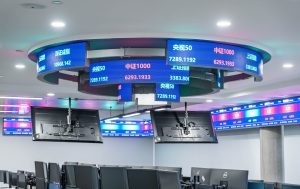
The IBSS Trading Floor enhances learning and teaching by integrating these platforms into both existing and newly developed modules. This enables a curriculum that is responsive to market demands while staying at the forefront of industry developments like fintech, AI in finance, and ESG innovation.
The facility also supports the development of essential transferable skills, with practical cases and simulations designed to strengthen analytical, critical thinking, and interdisciplinary capabilities. This prepares students to succeed in the complex and evolving landscape of business, finance, and economics.
Recognition by the CFA Institute
The MSc Investment Management programme has been designed in accordance with the CFA Institute’s Candidate Body of Knowledge (CBOK) and has been formally recognised under its University Affiliation Program.
AI and ESG integrated analytics
In response to the twin megatrends reshaping global finance – the rapid rise of artificial intelligence and the growing importance of sustainable investing – the MSc Investment Management programme has been enhanced to develop integrated AI and ESG analytical capabilities.
Through the AI stream, students develop proficiency in applying large language models (LLMs), machine learning, and Python-based predictive analytics to tasks such as automated financial statement analysis, sentiment extraction from earnings calls and financial news, quantitative signal generation, and portfolio optimisation.
Through the ESG stream, students learn to source, process, and interpret ESG data, integrating environmental, social, and governance factors into company valuation, security selection, and portfolio construction.
This integrative approach positions graduates at the forefront of the industry’s digital and sustainable transformation, enhancing their employability in investment banking, asset management, fintech, and ESG-focused advisory roles.