




25 Dec 2025


Recently, the Design School at Xi’an Jiaotong-Liverpool University has achieved outstanding results at the 16th YuanYe Awards International College Student Competition, winning multiple awards.
The YuanYe Awards is an international competition platform open to university students and young designers in architecture, urban planning, landscape architecture and public art. This year’s competition attracted more than 10,000 participants and received over 4,000 submissions. In addition to awards received by three student teams from XJTLU Design School, the School itself was also recognised with three institutional honours.
All three award-winning projects were developed as part of the undergraduate module UPD211 Urban Design and Theory II. The module was led by Dr Hyung Rae Cho, Assistant Professor in the Department of Urban Planning and Design, and co-supervised by Professor Bing Chen, Head of the Department, with support from part-time tutors Shijie Chen and Wenzhao Jia, and teaching assistant Shaowei Cui.
The module focused on urban regeneration in the Guoxiang neighbourhood of Suzhou. The project site is a 50-hectare district that embodies many of the challenges commonly found in rapidly developing Chinese cities. At the large scale, it is surrounded by new high-rise housing developments that expand from several directions. At the small scale, however, it is filled with a mixture of ageing residential areas, fragmented industrial lands, traditional markets, and a network of canals that shape local movement. Although the Suzhou True Colour Art Museum was introduced in 2008 to regenerate the area, much of the neighbourhood continues to show signs of decline.
Students were asked to investigate these contrasts and propose design strategies that could restore cultural identity, activate public spaces, introduce economic opportunities, and improve the quality of life for residents. The assignment required students to explore how heritage preservation, creativity, and sustainable design can work together.
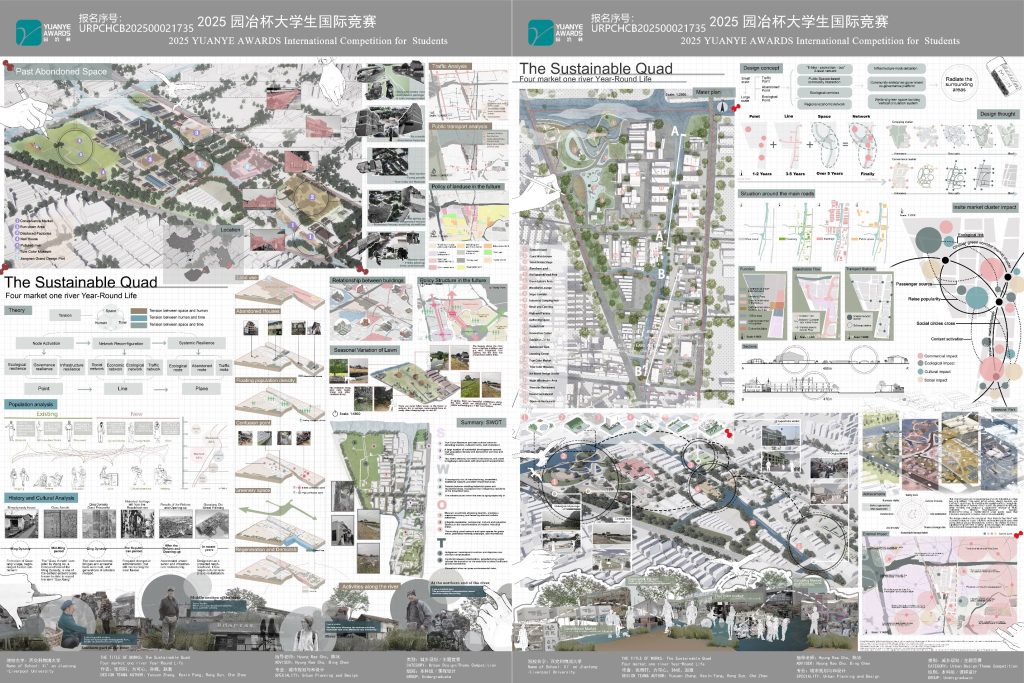
Among the three projects, The Sustainable Quad by Zhang Yuxuan, Fang Kexin, Sun Rong and Zhao Che received the Third Prize for its clear vision and innovative interpretation of Guoxiang’s markets and canal system. The student group proposed a year-round framework of public life shaped by four interconnected market clusters and a restored ecological water network. Their design utilises the concepts of point, line, space, and network to gradually improve circulation, enhance public spaces, and rebuild ecological corridors.
Instead of proposing a single large redevelopment plan, the students worked with the existing character of Guoxiang and introduced step-by-step interventions that can be realistically implemented. Their proposal shows how small improvements at key locations can build a neighbourhood that is more lively, connected, and sustainable. The project stood out for its balanced approach to cultural, social, and ecological considerations.
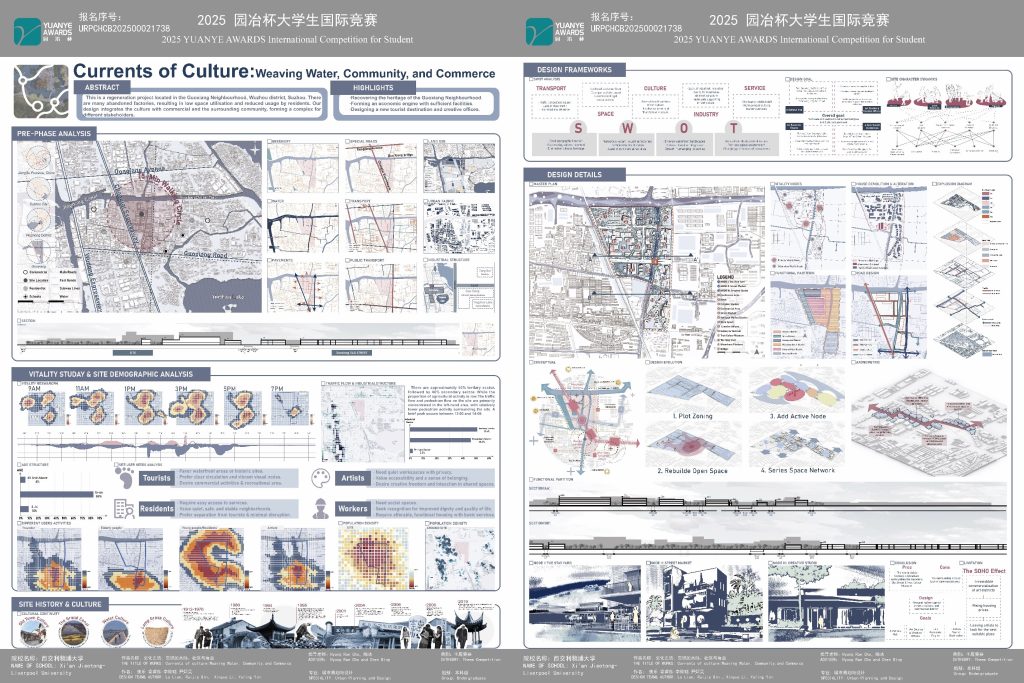
In addition, Currents of Culture: Weaving Water, Community and Commerce by Le Lian, Ruijia Qin, Xinyue Li and Yuling Yin, and Urban Loom: Regenerating the Industrial Waterfront by Hangyu Li, Daniel Sanchez Lopez, Mingxiang Wen and Jiayi Chen, both received Honourable Awards.
Currents of Culture was recognised for its strong analytical foundation and its sensitive approach to local identity. The team conducted a detailed study of vitality patterns, activity rhythms, demographic groups, and time-specific movements across Guoxiang. They explored how residents, tourists, artists, and workers use space differently and proposed a spatial structure that supports a peaceful coexistence of these groups.
Water becomes the central organising principle in their design. By reconnecting canals, public spaces, cultural facilities, and commercial streets, the proposal creates a cohesive system that integrates culture and everyday life. Judges praised the project for its depth, clarity of thought, and creative integration of community needs.
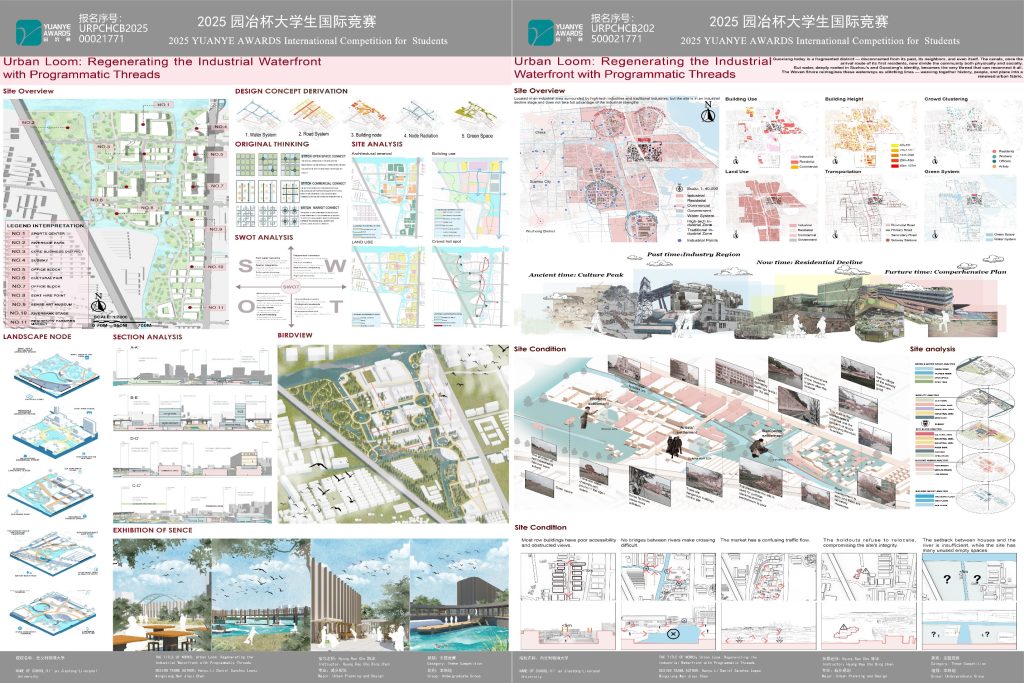
The Urban Loom project offers a powerful vision for transforming Guoxiang’s industrial waterfront. The team used the idea of weaving to describe how the neighbourhood’s fragmented spaces can be reconnected. Their strategy employs several programmatic threads, including water networks, green systems, cultural facilities, commercial functions, and movement corridors, to reconnect different parts of the neighbourhood.
The students also analysed building conditions, land uses, crowd patterns, and past industrial influences to support their proposal. Their design respects the industrial memory of the area while transforming it into a vibrant public realm. The project was recognised for its narrative clarity and its thoughtful balance between heritage, ecology, and community life.
Dr Hyung Rae Cho said that the awards reflect XJTLU’s teaching approach that integrates theory and practice, noting that the projects demonstrate not only students’ professional skills, but also their critical thinking, cultural sensitivity and creativity.
In addition to the student awards, XJTLU Design School also received the Outstanding Organisation Award, the Excellent Department Award, and the Outstanding Liaison Award, further highlighting the School’s overall strength in teaching quality and academic support.
Professor Bing Chen added that the achievements at this year’s YuanYe Cup demonstrate the continued development of XJTLU’s urban planning education in the field of urban regeneration, as well as reflect the University’s growing influence on national design education platforms.
Story and images provided by Department of Urban Planning and Design
Edited by Yi Qian
25 Dec 2025