





29 May 2026


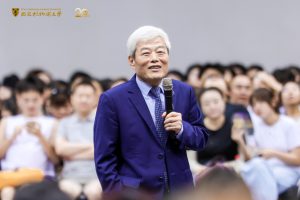
On 25 May, Professor Dan Huang, Professor and PhD supervisor at the Department of Literature, Beijing Film Academy, visited Xi’an Jiaotong-Liverpool University to deliver a lecture on screenwriting and cinematic storytelling to students and staff from the Academy of Film and Creative Technology.
The lecture was opened by Professor Qian Liu, Dean of the Academy of Film and Creative Technology, who introduced Professor Huang’s extensive experience in screenwriting, teaching, and research.
Professor Huang is the founder and Dean of the China Film Screenwriting Research Institute, which he established in 2015. He previously served as Dean of the Department of Literature at Beijing Film Academy. He is also Vice President of the China Film Literature Society, President of the Screenwriting Education Committee of the China Film Association, and President of the Young Screenwriters Creation Committee of the Beijing Film and Television Association.
His screenwriting credits include My 1919, Shadow Magic, The Taiwan Connection, and The Flower. He has received a number of major awards, including the Huabiao Award for Best Screenwriter, Best Screenwriter at the Changchun International Film Festival, and the Xia Yan Film Literature Award.
In his opening remarks, Professor Liu said that as artificial intelligence continues to reshape film production and the creative industries, it is increasingly important for students to learn directly from experienced practitioners and educators. He noted that Professor Huang has long used live teaching and blackboard demonstrations to guide students through the logic of screenwriting, allowing them to follow the development of their creative thinking step by step.

Starting with the question: What do you want to say?
During the lecture, Professor Huang began with one of the most fundamental questions in screenwriting: what does the creator want to say?
He said that a film must first have a clear creative proposition. For screenwriters, the story alone is not enough. What matters more is whether the creator truly understands the attitude, emotion, and meaning they want to communicate through the story.
Drawing on short films, animation, and well-known feature films, Professor Huang guided the audience through the relationship between character, story, detail, and emotional transformation. He said that filmmaking begins with expression, which is then developed through genre, character relationships, source material, plot structure, detail, and sound.
“Once I understand your story, I will ask: what exactly do you want to say?” he said, explaining that this is a question he often asks students in his teaching, and one that lies at the heart of many screenwriting problems.

Character, detail, and story
When discussing the process of developing a screenplay, Professor Huang said that writers should first identify the film's style and genre, as characters respond differently in different types of stories. The next step is to understand the characters and their relationships in depth, including their biographies, psychological profiles, and motivations.
He said that once the characters are found, half of the story has already been solved.
Professor Huang also distinguished between “material” and “story”. He explained that creators need to understand their characters, events, and background material from an almost omniscient perspective. However, what is eventually presented to the audience must be carefully selected and controlled.
Screenwriting, he said, is not about piling up information. It is about releasing information in a way that serves the film's central expression, allowing the audience to understand a character’s inner change through a limited sequence of events.
When discussing cinematic detail, Professor Huang used the example of sugared tomatoes in Aftershock to explain that meaningful details in film are not simply props or set decoration. Instead, they should carry emotional weight, drive character transformation, and help bring the story to its climax.
He said that a strong detail can allow the audience to understand a character’s pain, choices, and reconciliation in a single moment. This, he explained, is one of the ways cinema moves people.
Professor Huang also analysed My People, My Country and other familiar films to show how cinematic expression can be built through character, detail, plot, and structure. He encouraged students to keep asking whether each character choice, plot decision, detail, and line of dialogue serves the work's core expression. Only when every creative element points clearly towards that expression, he said, can the emotional force of a film truly reach its audience.

Authenticity, distinctiveness, and contemporaneity
Drawing on his years of experience in writing and teaching, Professor Huang summarised three key requirements for screenwriting: authenticity, distinctiveness, and contemporaneity.
He said authenticity is the foundation of writing. Characters’ actions should be emotionally and logically convincing, and should reflect both human feeling and lived experience.
Distinctiveness requires writers to search for fresh perspectives, new characters, and original forms of expression, rather than falling back on formulaic or conceptual writing.
During the Q&A session, students and staff exchanged ideas with Professor Huang on screenwriting, cinematic expression, character development, and film education. He encouraged students to stay sensitive to life, value the appeal of a good story, and keep questioning the emotions and attitudes behind their work.
The lecture gave staff and students from the Academy of Film and Creative Technology the opportunity to engage directly with an experienced screenwriter and educator. It also deepened their understanding of film writing, audiovisual expression, and creative practice. The Academy will continue to invite leading industry professionals and scholars to campus, thereby strengthening connections among creative education, professional practice, and talent development.

By Wenzhen Li
Photos courtesy of Yunyi Xue
29 May 2026