




Africa as China's New Gateway: Winning Amid Global Trade Shifts

10 Jun 2026


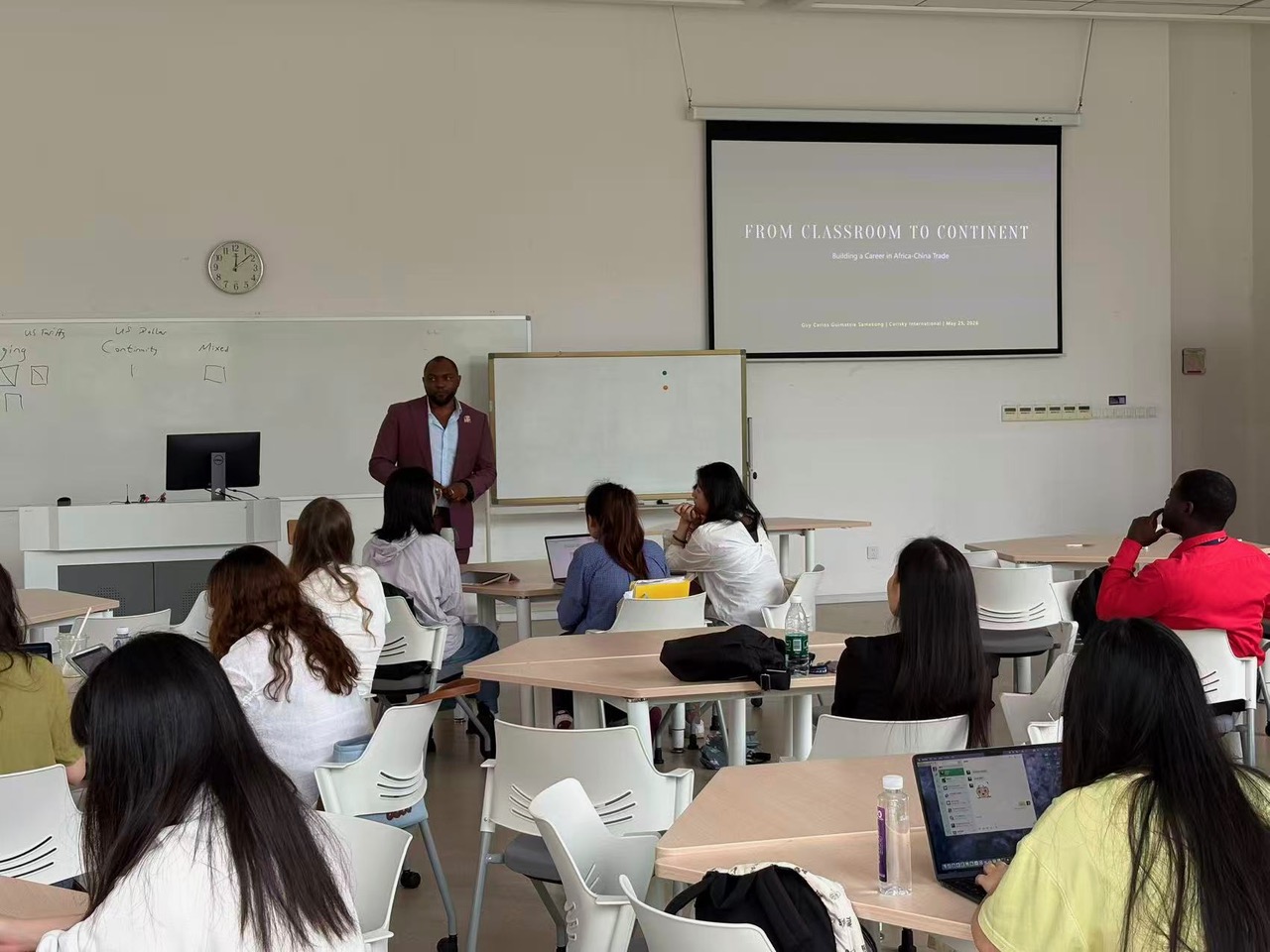
On 25 May 2026, the International Studies Department welcomed Guy Carlos Guimatsie Samekong, General Manager of Carlsky International Trading Technologies Co., Ltd., for a practitioner talk that took students from the theories of political economy right into the operational realities of China-Africa trade. With his academic foundation in Animal Biology, an MBA, and an ongoing Executive MBA, Mr. Guimatsie came to China starting to identify the many opportunities for suppling products in sectors that need them in his home country Cameroon. In his talk, Carlos Guimatsie shared his practical experience that many of our students can learn from. His message was direct: the global trade map is being redrawn, and Africa is not a destination for Chinese surplus, but becoming an important gateway.

Four Pathways In
In his talk, Mr. Guimatsie laid out four concrete entry points for students considering a career in this space, each with realistic earnings salary brackets and distinct skill demands:
Procurement
- Sourcing discipline, supplier verification, logistics coordination
- $15,000–100,000/year
Export Sales Builder
- Distribution network mapping, identifying unmet demand
- $20,000–150,000/year
Manufacturing Facilitator
- Factory internships to understand production
- Clients include governments and investment funds—"follow the money"
- $30,000–300,000/year
Consulting & Representation
- Market knowledge arbitrage
- Carlos currently represents two Spanish companies who "lack knowledge of market conditions in China" and, as he noted wryly, "listen to everybody"
- $10,000-250,000+/year
The takeaway was unambiguous: knowing a technical field matters, but so do human connections and first-hand understanding of another culture.
Sectors with a Future
Mr. Guimatsie identified concrete sectors where African demand and Chinese supply are already converging, and where students who are looking for internship and with a will to work with African companies can make a real difference.
For him, renewable energy and mobility stand out as the most dramatic growth corridor. Solar exports from China have surged 291%, while electric vehicle exports to Africa are expanding rapidly. The underlying need is immense: some 600 million Africans still lack reliable electricity, making this an exceptional trade opportunity while helping to resolve an infrastructure issue.
The speaker also pointed out the great potential right under their feet. Rather than chasing distant business opportunities, Carlos urged students to look closer to home. Established industrial clusters in the Yangtze River Delta like Suzhou, Nanjing, and Changzhou already host leaders in these emerging sectors, like Jinkou. "Make use of your current networks close to you," he advised.
Light electric vehicles, particularly tricycles and three-wheelers, represent another growth market. As they are already popular across African markets, they offer a practical entry point for electrification where full-scale EV infrastructure remains underdeveloped.
Medical equipment was where Carlos built his own early business, achieving 40–60% cost advantages and, crucially, evolving from broker to solution provider to capture a 22% net profit margin. Since the pandemic, African governments have been more actively sourcing medical equipment from China; 80% of his own products now come from China. Yet he stressed that regulation, certification, and compliance are the non-negotiable skills here, without them, the cost advantages collapse on delivery.
Finally, Mr. Guimatsie highlighted the construction and agriculture sectors. Africa still hold 60% of the world's uncultivated arable land, while the annual infrastructure gap runs between $130–170 billion. Carlos distilled the logic into three words: "Build, grow, feed."
一石两鸟: Evolving by Listening
With his experience in many of these sectors, Carlos emphasized that one Chinese idiom was central to his approach: 一石两鸟, killing two birds with one stone.
After establishing trade in dental and medical equipment, he asked a simple follow-up question: what else do hospitals need? The answer was solar panels and energy storage. Client recommendations led to factory partnerships, then residential applications. The business model shifted not through planning, but through listening to his customers’ needs. "Have the Chinese business catalogues, know the sales networks," he advised our students. But, more importantly, you also have to know what your client actually requires next. This same logic extended to niche opportunities: silent EV ambulances and airport transfers.
Carlos was candid about what textbooks understate: Human relations, understanding and trust are the the most important factors. His first business experiences with exporting bad goods got him into a lot of debt and the issues with supplier were not easy to resolve because he had not formalized the bargain, focusing too much on getting a better price.
"Do not only negotiate, but ask for getting to know the clients so you know their needs; give them more other options." There is no WeChat or Facebook advertising shortcut. In Africa, word of mouth still dominates. For young businesses, online marketing is largely ineffective; physical presence in warehouses is much more important for building the trust that converts into sales.
Mindset: Patience, Presence, Resilience
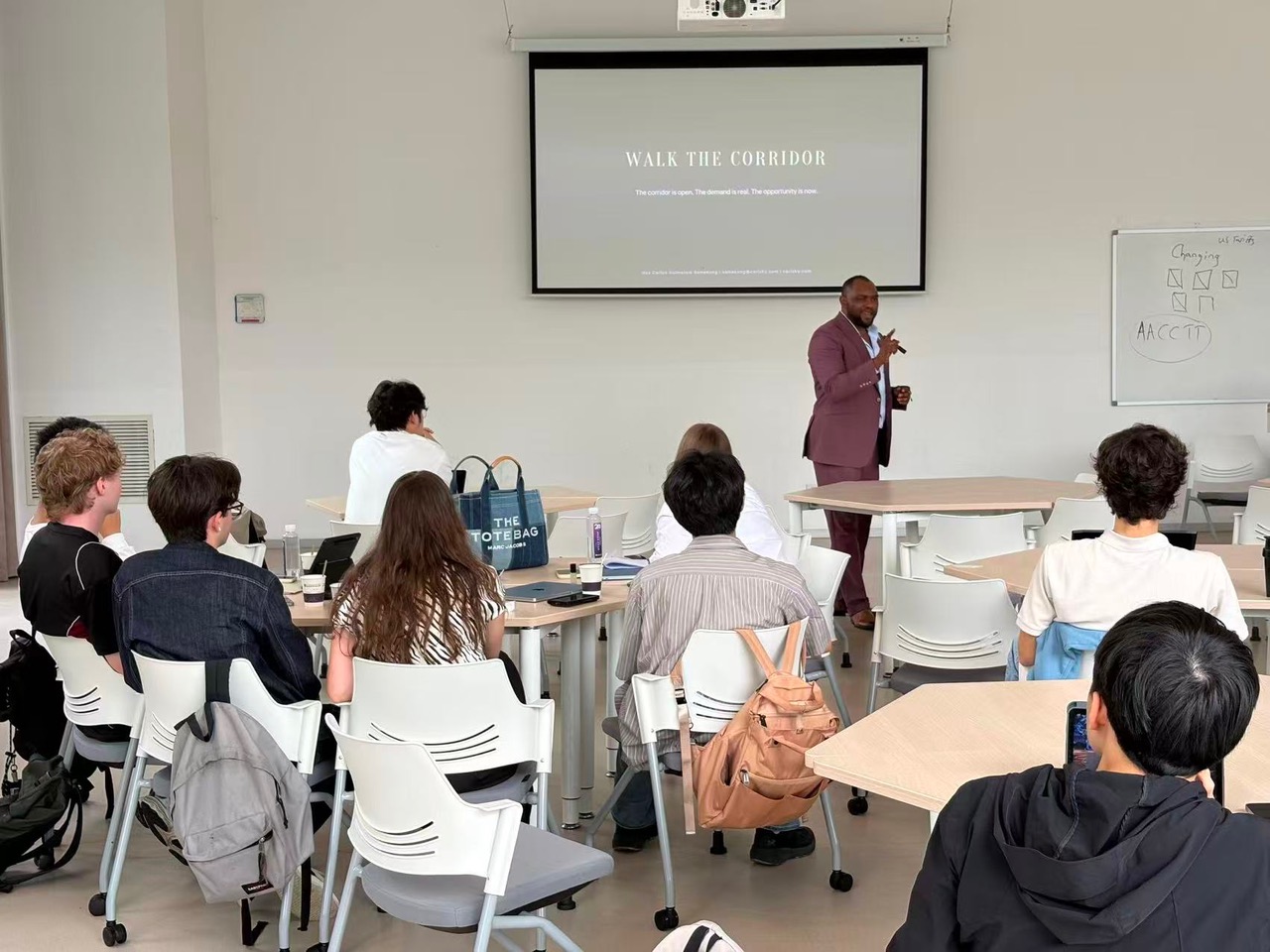
Carlos closed with three words: Patience, Presence, Resilience. The Africa-China corridor is not a market for quick extraction. It rewards those who go, who show up repeatedly, who absorb the 6–12 month cycle without abandoning the relationship architecture they have built.
For INS students thinking about which kinds of an IR degree might land them in a world of supply chain realignment, Carlos's talk offered a valuable perspective on a growing, and often underestimated African market in these highlighted sectors.
About the Speaker
Guy Carlos Guimatsie Samekong is General Manager of Carlsky International Trading Technologies Co., Ltd., active in China since 2013 and formally established in 2018. He has expanded operations across Benin, Cameroon, The Gambia, and developing networks in Europe and the United States. Since 2019, he has promoted Africa-China business engagement through high-level conferences in collaboration with academic and industry partners.
10 Jun 2026