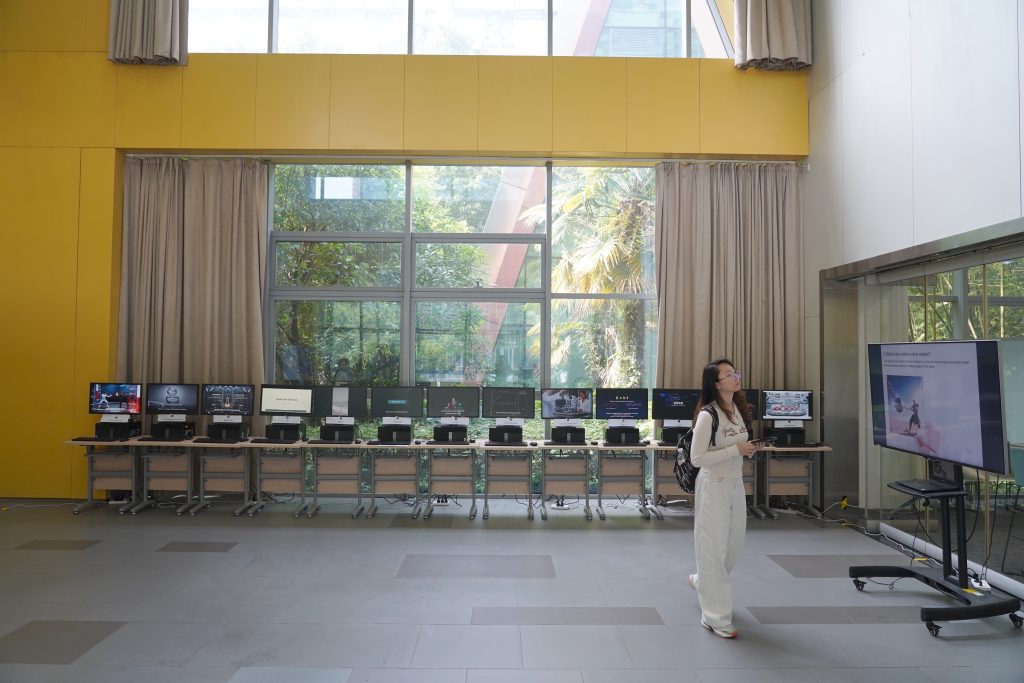
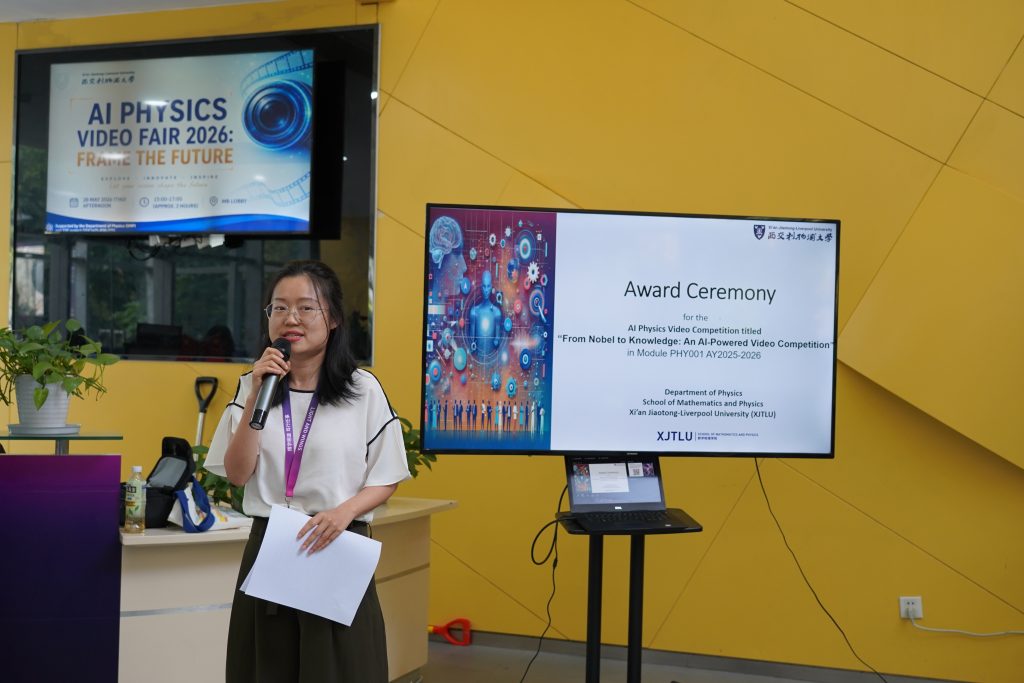
The Department of Physics in the School of Mathematics and Physics at Xi’an Jiaotong-Liverpool University recently hosted its first AI Physics Video Fair and held an award ceremony for the “From Nobel to Knowledge: An AI-Powered Video Competition”.
The event was designed to encourage students to use artificial intelligence tools to create physics-themed short videos, providing a platform for creative expression and academic exchange while exploring the intersection of AI, physics and innovative storytelling.
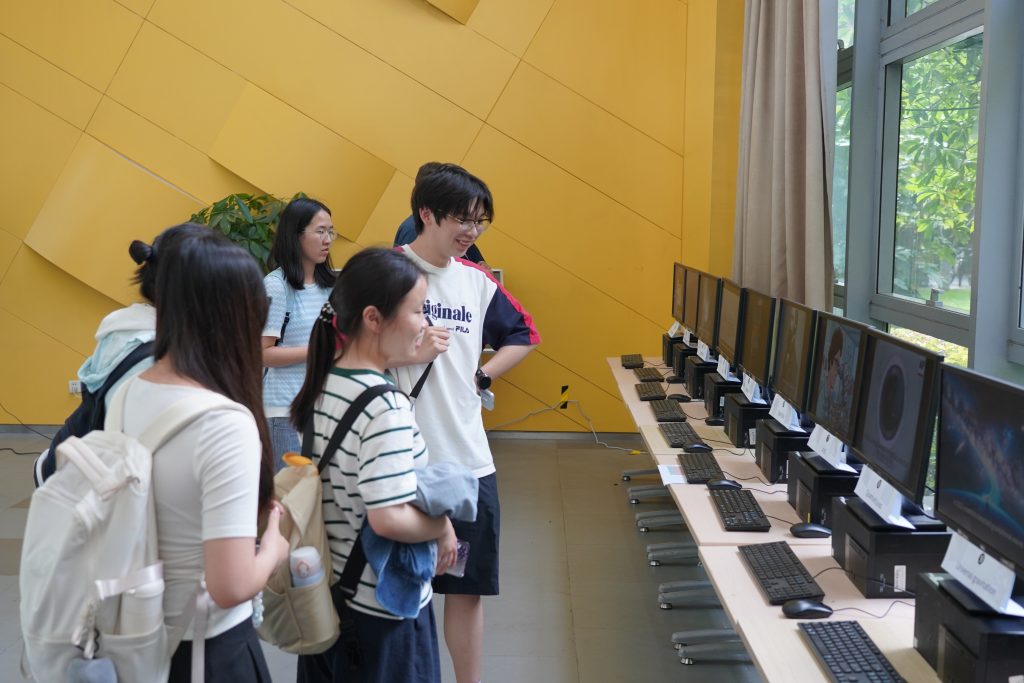
Participants were invited to produce videos connecting university-level physics concepts with their applications in Nobel Prize-winning discoveries. By using AI-generated content, students transformed abstract ideas from the classroom into engaging and accessible visual narratives.
Dr Xi Chen, organiser of the event, explained that both teacher-judged awards and audience-choice awards were introduced to recognise excellence from different perspectives, including physics understanding, AI application and communication effectiveness.
“We hope to encourage more students to explore the possibilities at the intersection of AI and physics, while developing their ability to communicate scientific ideas creatively alongside their academic knowledge,” she said.
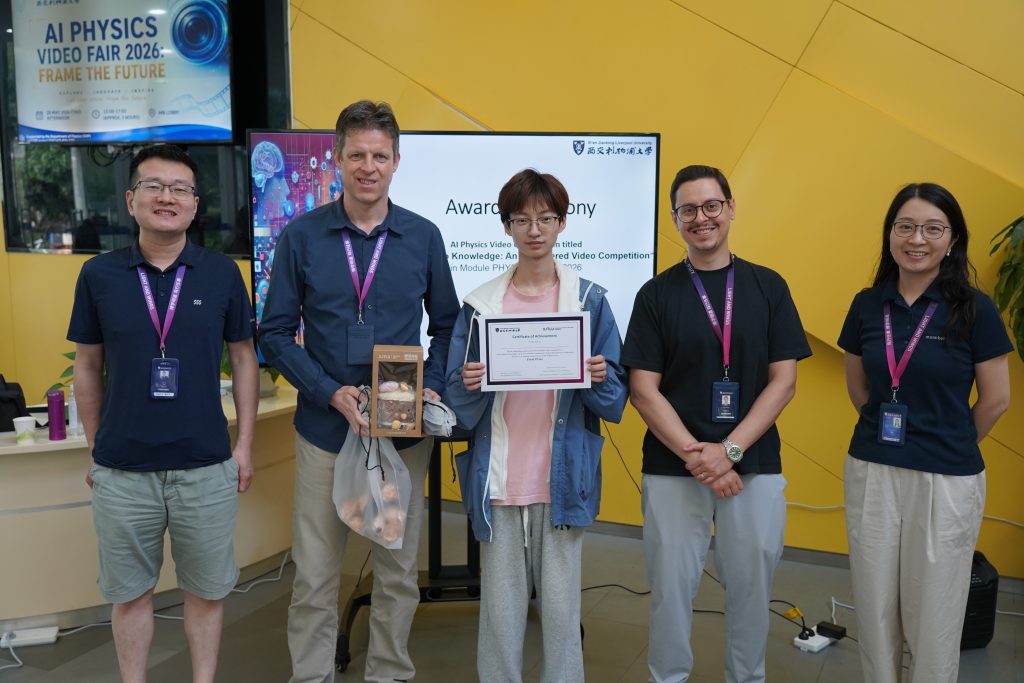
Chengguo Li (third from left) posing with the judging faculty from the Department of Physics
Among the winners, Chengguo Li received First Prize in the teacher-judged category for his video Unveiling the Mysteries of Maxwell’s Equations and Electromagnetic Waves. The video guides viewers through the derivation of the electromagnetic wave equation from Maxwell’s equations and connects the theory to Hertz’s experimental verification and modern wireless communication technologies, illustrating the journey from fundamental theory to real-world applications.
Reflecting on his approach, Li summarised it with a memorable phrase: “Physics provides the skeleton, while AI adds the flesh.” He explained that, after ensuring the scientific accuracy of the content, he used AI tools to generate animations and narration, helping to make complex concepts in electromagnetism more intuitive and accessible.
Jinbo Si, winner of both the Most Popular Video Award and the Best AI Application Award, took a different approach by presenting physical principles through a competitive arena-style format.
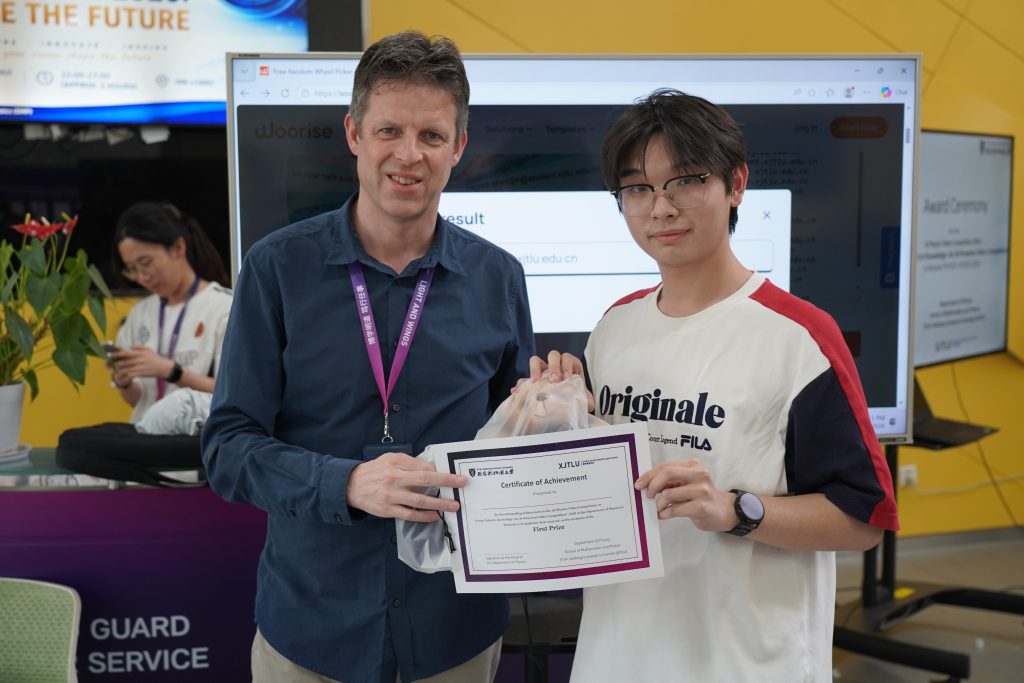
Jinbo Si (right) posing with the judging faculty from the Department of Physics
“I think audiences are most impressed by the realisation that physics can be this intuitive,” he said.
“The process of creating the video gave me a deeper understanding of both AI and physics,” he added. “In the future, I hope to continue turning more physics concepts into animated videos and help more people discover the enjoyment of learning physics.”
By Qinru Liu