








16 Jul 2026


With the rapid advancement of quantum computing, how to smoothly migrate information systems to post‑quantum cryptographic systems has become a major issue in the international cybersecurity field.
Recently, the 8th Asian Post‑Quantum Cryptographic Forum was held in Seoul, South Korea. Professor Jintai Ding, Dean of the School of Mathematics and Physics at Xi’an Jiaotong-Liverpool University and Director of the Post-Quantum Migration Interdisciplinary Laboratory, delivered a keynote presentation titled “Post‑quantum Migration in Banking in China”, sharing the team’s research findings with experts, scholars, and industry representatives from Asia and beyond.
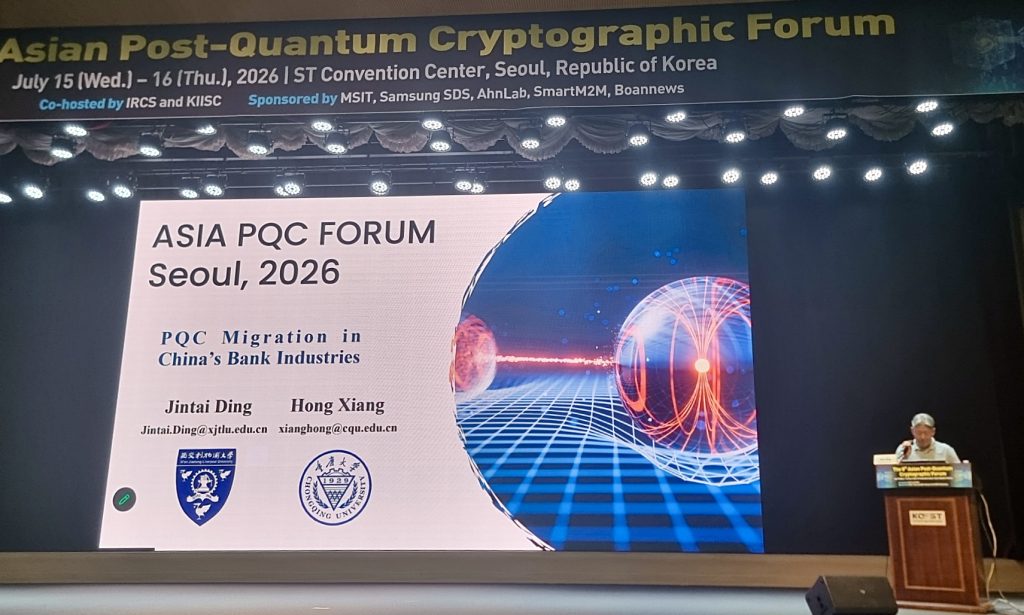
In his presentation, Professor Ding introduced the team’s research on post‑quantum migration in the banking sector, covering recent progress in migration framework design, development of an algorithm resource library, and system validation. The team has built an algorithm resource library that includes a variety of mainstream post‑quantum cryptographic algorithms and has proposed technical solutions for hybrid cryptographic deployment, providing a reference for smooth migration in the financial industry.
The team also validated the proposed solutions in a bank test environment, accumulating practical experience for the application of post‑quantum cryptography in large‑scale financial information systems.
Why is Post‑Quantum Migration a Global Concern?

As quantum computing continues to evolve, the existing public‑key cryptography infrastructure may face new security challenges in the future . Consequently, the world is accelerating its efforts to migrate to post‑quantum cryptography. So‑called post‑quantum cryptography (PQC) migration is not merely a matter of replacing one algorithm with another; it is a systematic upgrade of existing information systems while ensuring business continuity.
Core businesses in sectors such as finance and telecommunications rely heavily on public‑key cryptography, and upgrading cryptographic algorithms involves multiple factors including architectural adjustments, making it difficult to accomplish in a short time. Therefore, promoting post‑quantum migration has become a global consensus. The forum’s inclusion of Crypto Agility as one of its special topics reflects the recognition that migration is a long‑term, ongoing process. Systems with crypto agility can flexibly switch cryptographic algorithms without large‑scale restructuring of the underlying architecture— a capability that is particularly critical for the banking industry.
Post‑quantum migration is a long‑term undertaking involving technology iteration, standardization, and industry collaboration, and still faces many common challenges. Professor Ding’s team has provided valuable practical experience that can inform post‑quantum migration efforts in other industries and regions.
The forum focused on topics such as post quantum standardization, migration engineering, and industry collaboration, serving as a platform for exchange of related research and practice in Asia. Professor Ding’s participation further enhanced academic exchanges with international peers and opened new opportunities for future research and cooperation.
What is Post Quantum Cryptography (PQC) Migration?
PQC migration refers to the gradual upgrading of existing information systems to a new generation of cryptographic systems capable of resisting future quantum computing attacks, while preserving business continuity as much as possible.
What is Crypto Agility?
Crypto agility refers to the ability of an information system to flexibly switch and upgrade cryptographic algorithms. As future cryptographic standards continue to evolve, systems with crypto agility can be upgraded more efficiently. It is therefore regarded as a critical foundation for achieving post quantum migration.
By Qinru Liu
16 Jul 2026