





09 Jul 2026


As night fell, landmarks across Xi’an Jiaotong-Liverpool University’s Suzhou Industrial Park campus came alive through light, projection and interaction.
At Honour Square, a world map, student reliefs and flowing starlight appeared across the wall. The Liver Bird canal boat became the starting point for an interactive journey across cities and time. The Dialogue with the Wise sculpture, Foundation Building, Taihu stone and Gate of Wisdom were also reimagined through projection.
The showcase formed part of XJTLU’s 20th anniversary global light-up campaign, themed “Integrating the World, Lighting up the Future”, and offered a public art experience shaped by students.
Initiated by University Marketing and Communications, the project brought together nearly 50 Digital Media Arts students from the Academy of Film and Creative Technology. Under the guidance of Tian Leng, the students spent a semester creating immersive interactive projection works for six campus landmarks, which were unveiled on the University’s anniversary day.
For the students, the project was more than a light show to mark XJTLU’s 20th anniversary. It was a chance to take their learning from the classroom into a real-world creative project.
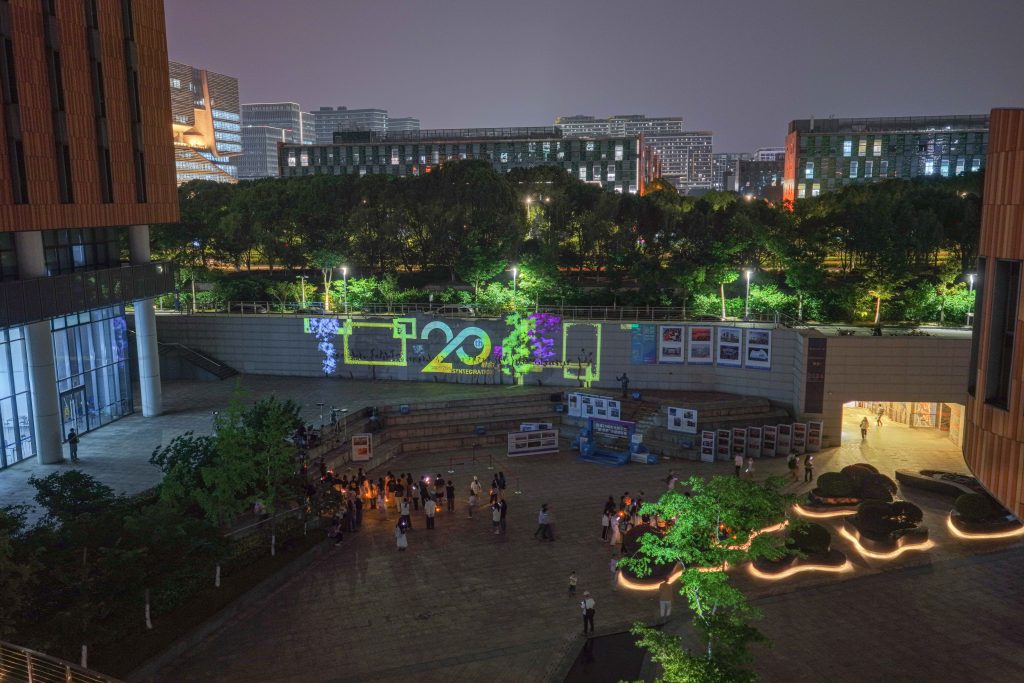
Light show at Honour Square
Rethinking familiar spaces
Before working with technology, the students first had to look again at the campus spaces they passed every day.
“If we simply projected animation onto a wall, people would watch it and then walk away,” says Leng. “I wanted the students to create something more than a visual display – something that audiences could take part in.”
From the start, every work was required to include interaction and to place the audience experience at its centre.
Within this framework, each group began with a campus landmark, exploring its cultural meaning and spatial potential.
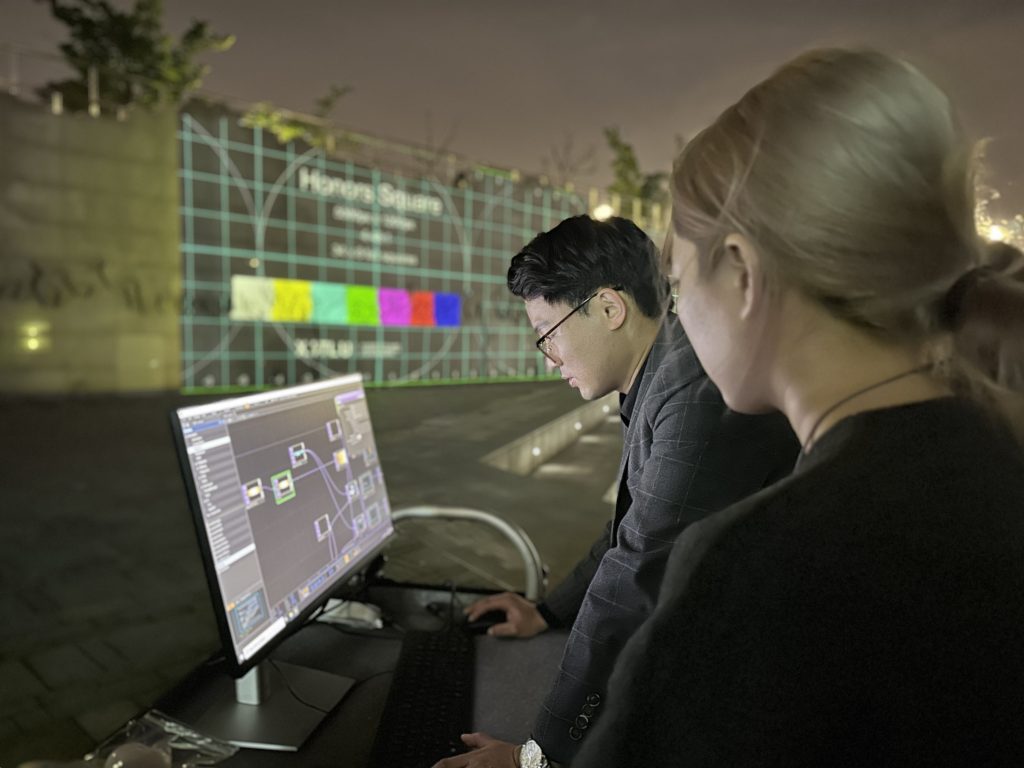
Tian Leng works with the student team to test equipment
Honour Square becomes an interactive canvas
Minyu Yao and her team were responsible for the work at Honour Square. They focused on the world map, student reliefs and commemorative plaques on the wall.
“We wanted the work to reflect XJTLU’s 20th anniversary, while also allowing staff and students to see their own connection with the University,” Yao says.
Centred on the ideas of “students”, “the world” and “belonging”, the team used light-based storytelling to express XJTLU’s open, diverse and international outlook. They also scanned and modelled the building structure and used multi-projector blending to ensure the visuals aligned precisely with the surface.
In the final work, Honour Square became a space audiences could enter and influence. When people stepped into the interaction area, the system identified their skeletal movements in real time and generated dynamic visuals made up of stars, flowers and hearts. When they opened their arms, these elements spread out across the wall, symbolising education, growth and infinite possibility.
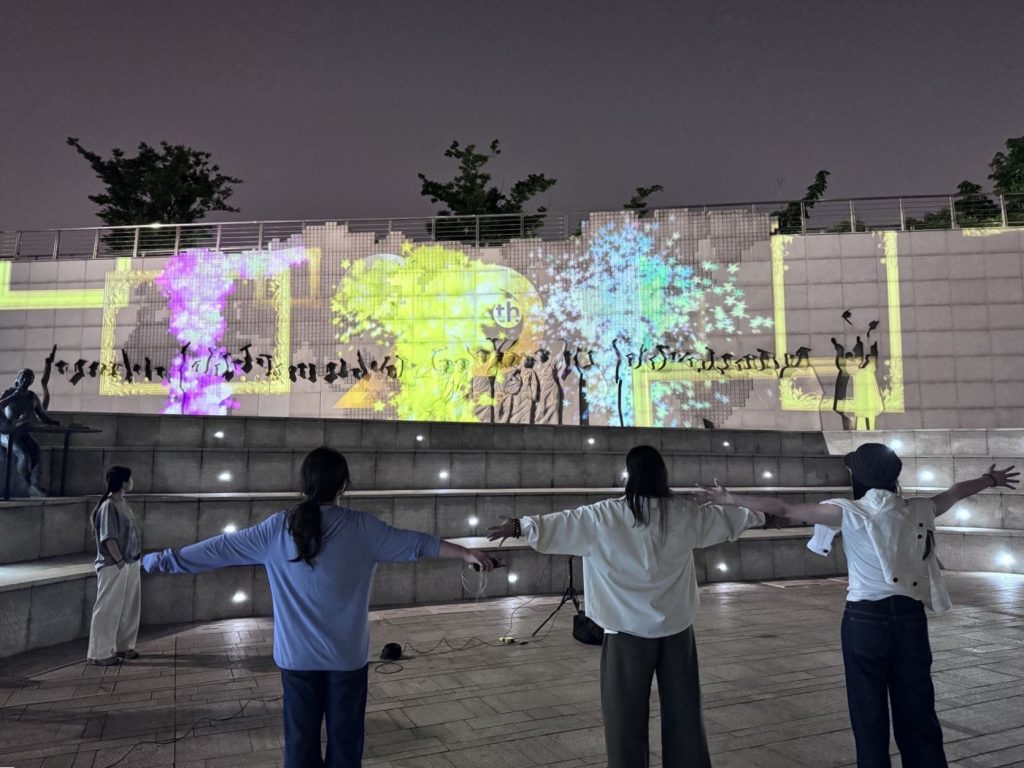
Audience members interact with the projection
During the event, audience members also held star-shaped lights prepared by the student team. As the small lights mingled with the projection, the square gradually became a moving “sea of stars”.
“That moment gave me a real sense of achievement,” Yao says. “The audience were not just watching; they had become part of the work.”
A voyage between Liverpool and Suzhou
The Liver Bird canal boat projection was led by Yingchu Ma and her team, who reimagined the historic campus installation through the lens of campus and city memory.
Through researching the University’s history, they learned that the canal boat had been given to XJTLU as an important gift for its 10th anniversary, travelling from Liverpool in the UK to Suzhou.
“We did not want to treat it simply as a campus landmark,” Ma says. “We wanted to see it as a character with its own story and memory.”
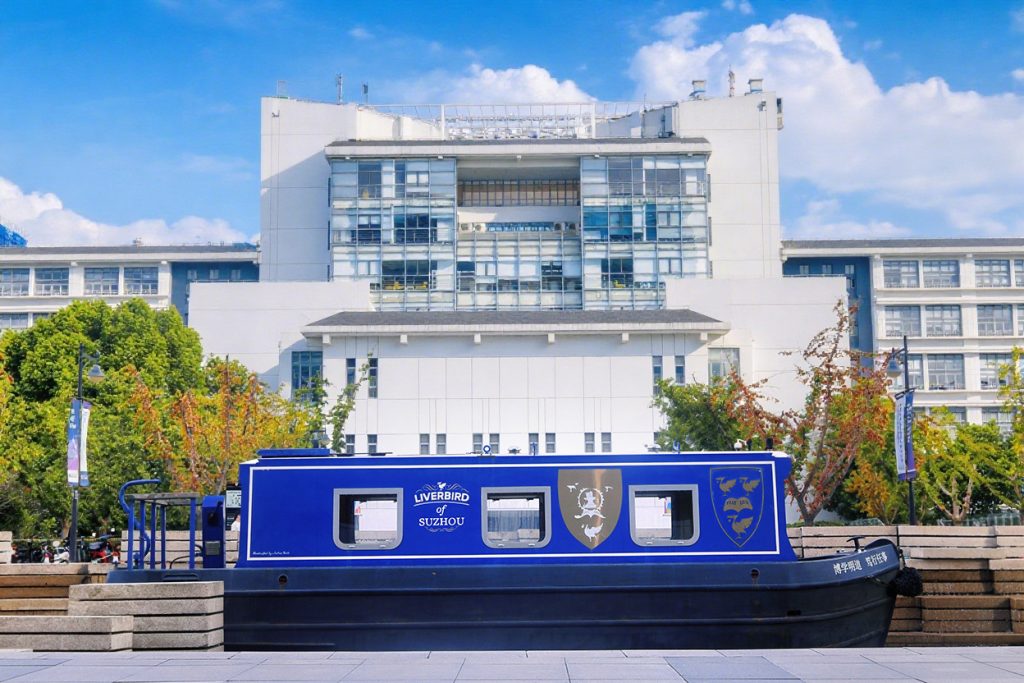
The Liver Bird canal boat
Using the idea of a “voyage” as the central narrative, the team connected the cultural imagery of Liverpool and Suzhou, allowing audiences to help drive the story through movement.
The work combined scrim and ground projection, using radar sensing to connect physical movement with the projected visuals. Walking across the ground projection triggered ripples, splashes and tidal changes. Stepping onto album-cover visuals played music by The Beatles. Other interactions referenced classic moments from Liverpool’s UEFA Champions League history and guided the Liver Bird towards its destination.
On the scrim, the boat shifted between Chinese classical and British visual styles. Sound design was also part of the interaction: the same melody was arranged in both Chinese and Western versions, changing dynamically with the audience’s position and creating a dialogue between sound and space.
“Tides are an important concept in the work,” Ma says. “Liverpool and Suzhou are far apart, but both are connected to water. Tides represent both connection and difference, and the audience become the people who link the two places.”
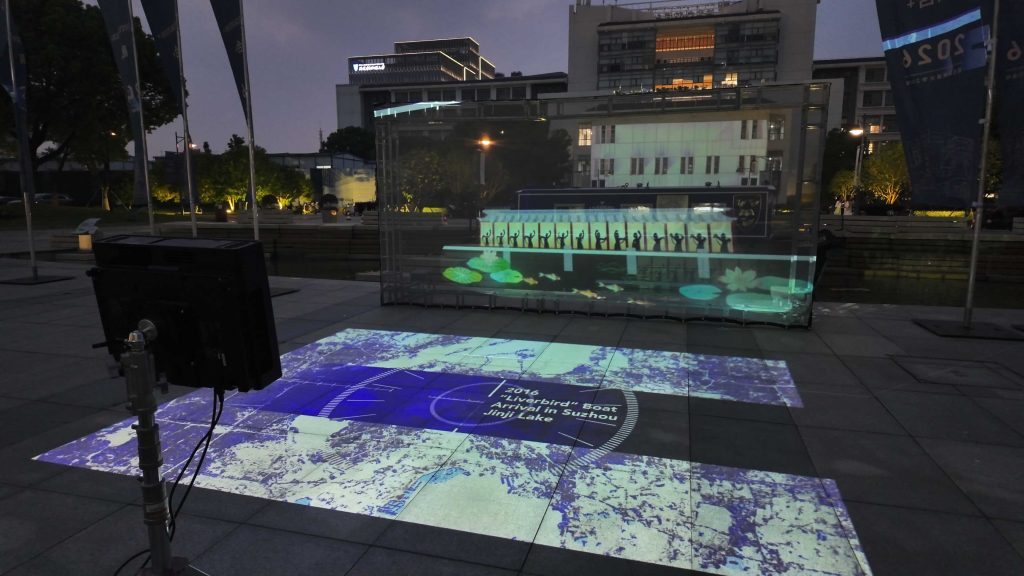
Light show on the Liver Bird canal boat
Learning through a real brief
While audiences experienced the light show over one evening, the student teams spent an entire semester developing the project.
From site research and creative proposals to technical testing, progress presentations, rehearsals and final delivery, the process resembled a professional creative project rather than a conventional course assignment.
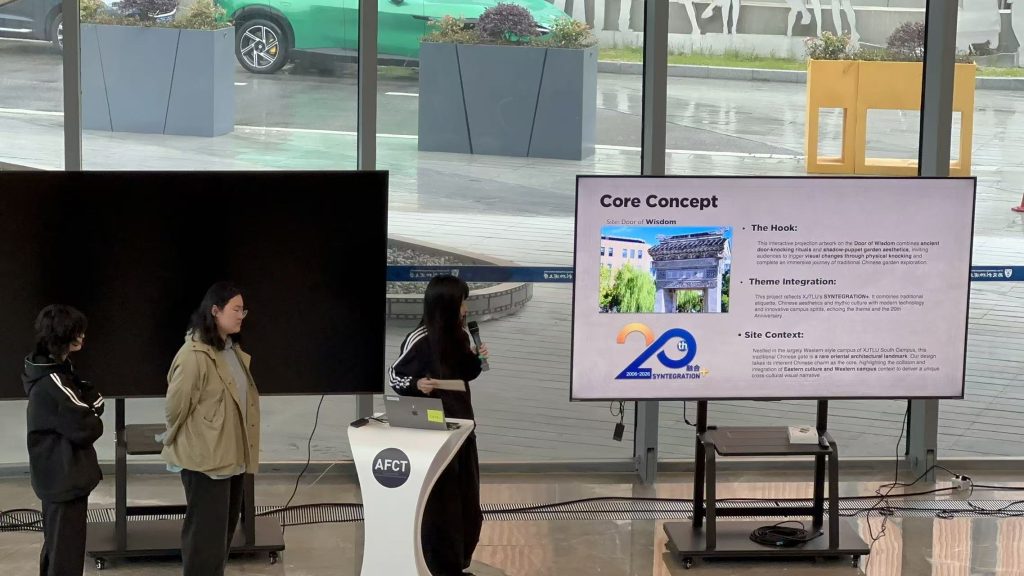
Students present their project proposal
Kangli Wang from University Marketing and Communications says: “We gave the students a theme and several landmarks, but we did not know how they would understand them, how they would express their ideas, or what the final outcome would be. It was like opening a mystery box.”
For Wang, the most surprising moment came when the project was officially lit up. What moved her most was not the technology itself, but the students’ distinctive understanding of campus space and culture.
The creative process was not always smooth. Students had to respond to real constraints, including on-site safety, equipment conditions, outdoor environments and time limitations, all of which required them to balance creativity with feasibility.
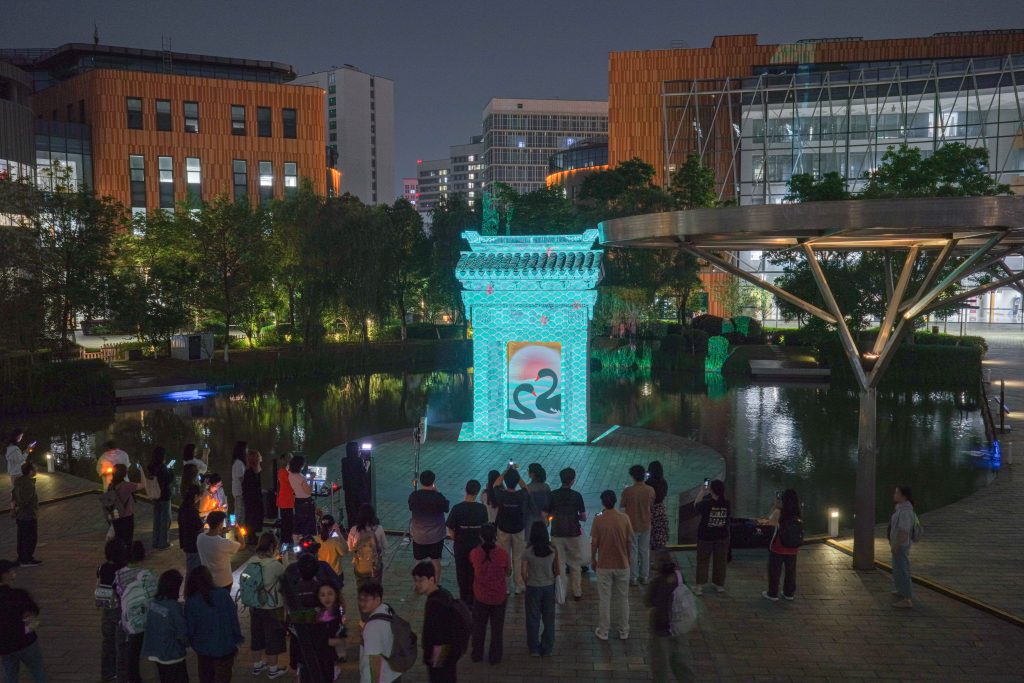
Light show at the Gate of Wisdom
For the Honour Square project, the team initially hoped to allow more people to interact at the same time. Testing showed, however, that too many participants would affect the experience, so the team reduced the number of simultaneous users to ensure stability.
“In previous assignments, we mainly thought about what we wanted to express,” Yao says. “This time, we had to think about whether the audience could understand it, whether they could participate, and whether it could actually be realised on site.”
Leng says this is the value of a real project.
“The students worked like a creative team, I was more like a project manager, and University Marketing and Communications was like a real client,” he says. “They not only had to complete the work, but also learn how to pitch ideas, communicate, respond to feedback, manage progress and take responsibility for the final outcome.”
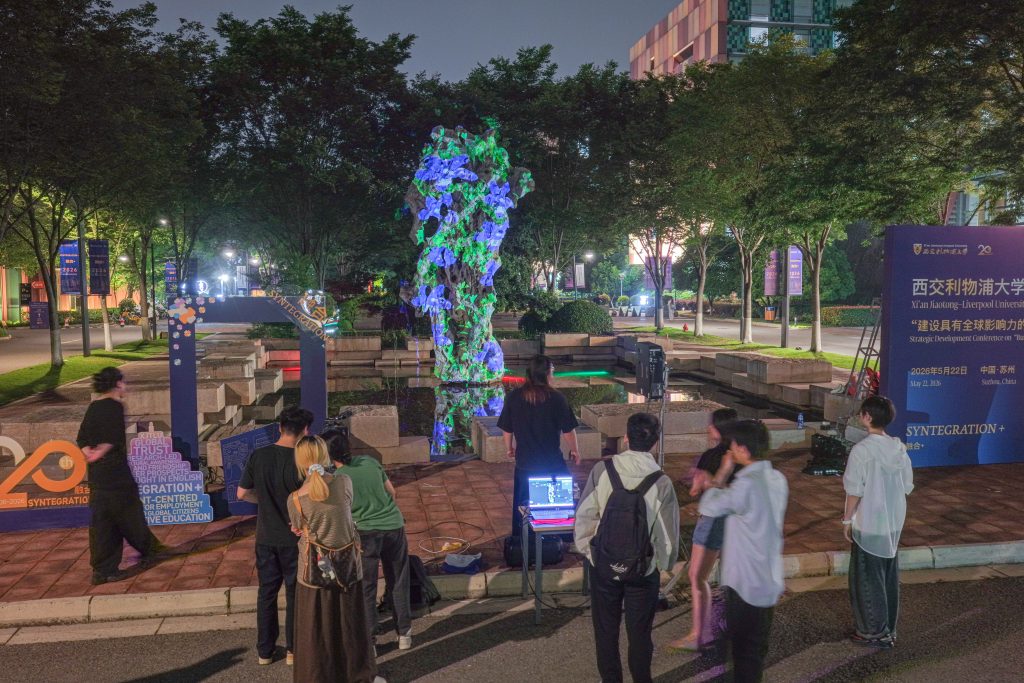
Light show on the Taihu stone
Making the anniversary a shared experience
On the evening the light show opened, many staff and students stopped to watch, interact and take photos.
“Usually, our works might only be seen by teachers and classmates,” Ma says. “This time, many audience members discussed the works, asked about the creative process and gave us immediate feedback. It felt completely different.”
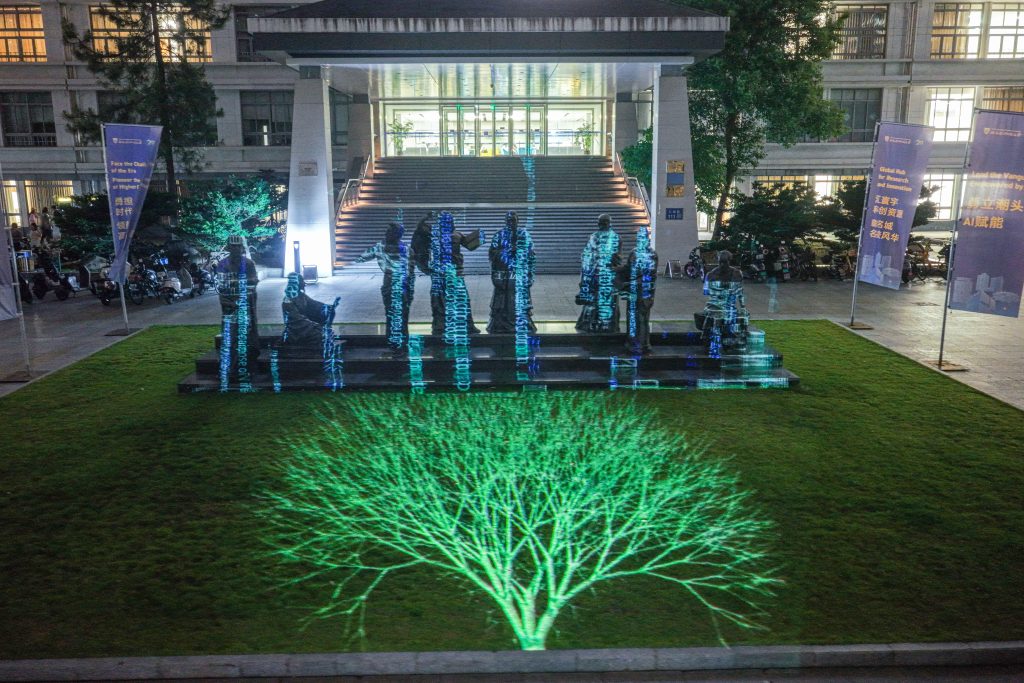
Light show at the Dialogue with the Wise sculpture
Ming Tang from University Marketing and Communications says that involving students deeply in anniversary activities can strengthen their sense of belonging and ownership, making the anniversary “our shared celebration”.
“Student works have their own vitality and power of communication,” she says. “The students were not only taking part in an event; they were helping to write XJTLU’s story.”
For the students involved, the 20th anniversary became more than a campus celebration. Over the semester, they rediscovered the campus, explored its history and experienced first-hand how their creativity could enter a real public space and be seen by others.
For XJTLU, what was lit up was not only the campus landmarks, but also students’ awareness of themselves as creators within the University’s story.
As light fell on the buildings, the students also left their own mark on XJTLU.
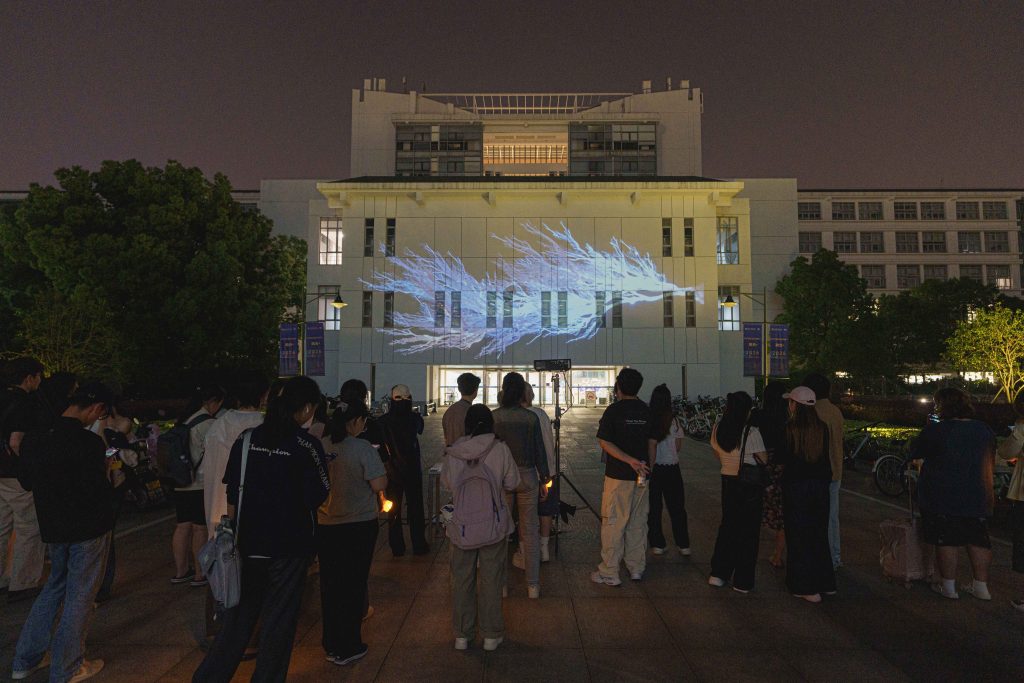
Light show at Foundation Building
By Wenzhen Li
Photos courtesy of Xinyu Hu, Yuqing Xiao and Zijie Zhang
09 Jul 2026