





10 Aug 2026


On 27 June 2026, two undergraduate teams from the Department of Civil Engineering at Xi’an Jiaotong-Liverpool University won four honours at the eighth International Concrete Dragon Boat Competition (2026-ICDBC), held at Guangxi University. Mowan (魔丸号) received Second Prize, the Best Creativity Award and the Best Paper Award, while Mingri Fangzhou (明日方舟) received Third Prize.
Co-hosted by Guangxi University and XJTLU, this year’s competition adopted the theme “砼舟共济·壮韵争先” (“Concrete Boats Together, Zhuang Spirit Ahead”). Founded by Zhejiang University in 2019, the competition is organised by the International Concrete Dragon Boat Technical Committee, with support from professional bodies including the American Concrete Institute (ACI). With an international outlook and a field drawn from universities across China, this year’s event brought together 18 teams and nearly 100 students from 14 universities. At the opening ceremony, Dr Ominda Nanayakkara, Head of XJTLU’s Department of Civil Engineering, delivered opening remarks.
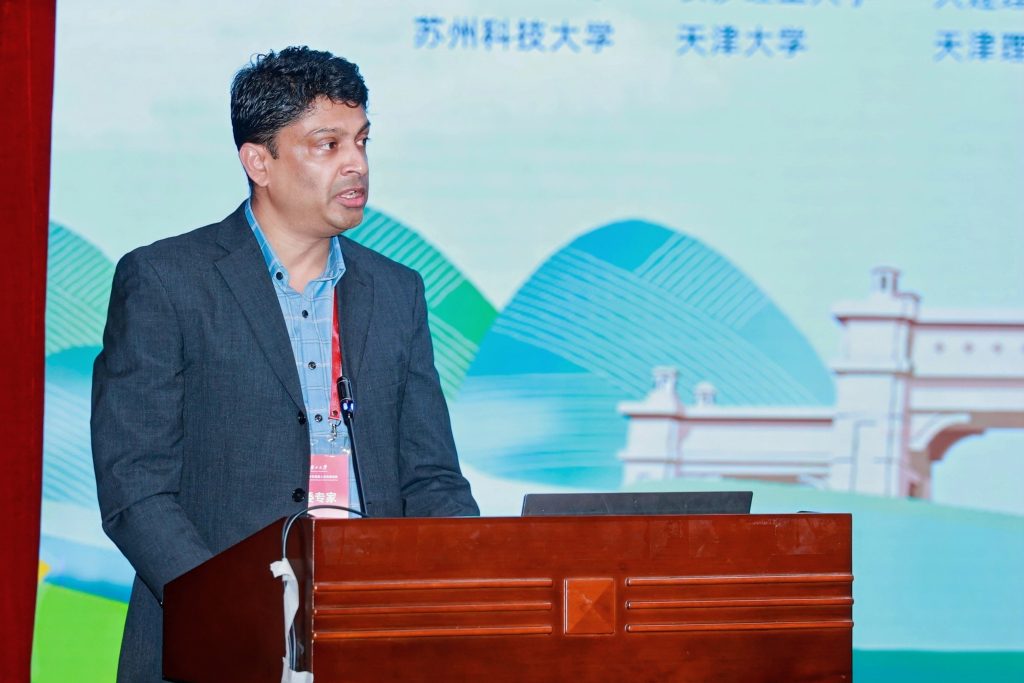
Dr Ominda Nanayakkara, Head of XJTLU’s Department of Civil Engineering, delivers remarks at the opening ceremony
Teams were assessed across seven components: a technical paper, aesthetic design, poster presentation, a load-carrying return race, material specimen testing, a straight-line speed race and curved-course navigation. Together, these challenges covered the full engineering process: from materials development and structural and hydrodynamic design to hull fabrication and on-water control, providing a demanding test of research innovation, engineering practice and interdisciplinary collaboration.
XJTLU’s two-team entry was led by Dr Engui Liu, who was responsible for the overall organization, technical coordination and academic supervision. Dr Jun Xia and Dr Ominda Nanayakkara also provided academic guidance to Mowan and Mingri Fangzhou, respectively.
Making concrete float - and engineering work as a system
A concrete dragon boat is not a single fabrication task; it is a systems-engineering challenge that integrates materials science, structural design, fluid mechanics, digital simulation, manufacturing and electromechanical control. The two teams began by developing lightweight cementitious composite mixes and testing specimens in XJTLU’s Civil Engineering Laboratory. They then used Computational Fluid Dynamics (CFD) analysis to refine the hull geometry and critical load-bearing regions before progressing through mould fabrication, thin-shell construction, propulsion and remote-control integration, and finally load, straight-line speed and manoeuvrability tests. Together, these stages formed a complete development pathway from concept design to on-water validation.
Throughout the process, students had to balance low mass, structural strength, buoyancy, hydrodynamic resistance, controllability and build quality. Experimental evidence, numerical simulations and on-water trials informed each iteration of the material mix and hull design, turning the competition into an interdisciplinary platform for translating classroom knowledge into testable and optimizable engineering solutions.
“The value of this project goes beyond the awards. It enabled students to experience the full engineering process--from materials design and numerical simulation to fabrication, system integration and on-water validation--and to turn interdisciplinary knowledge into workable engineering solutions within a demanding timeframe,” said Dr Liu, the project lead.
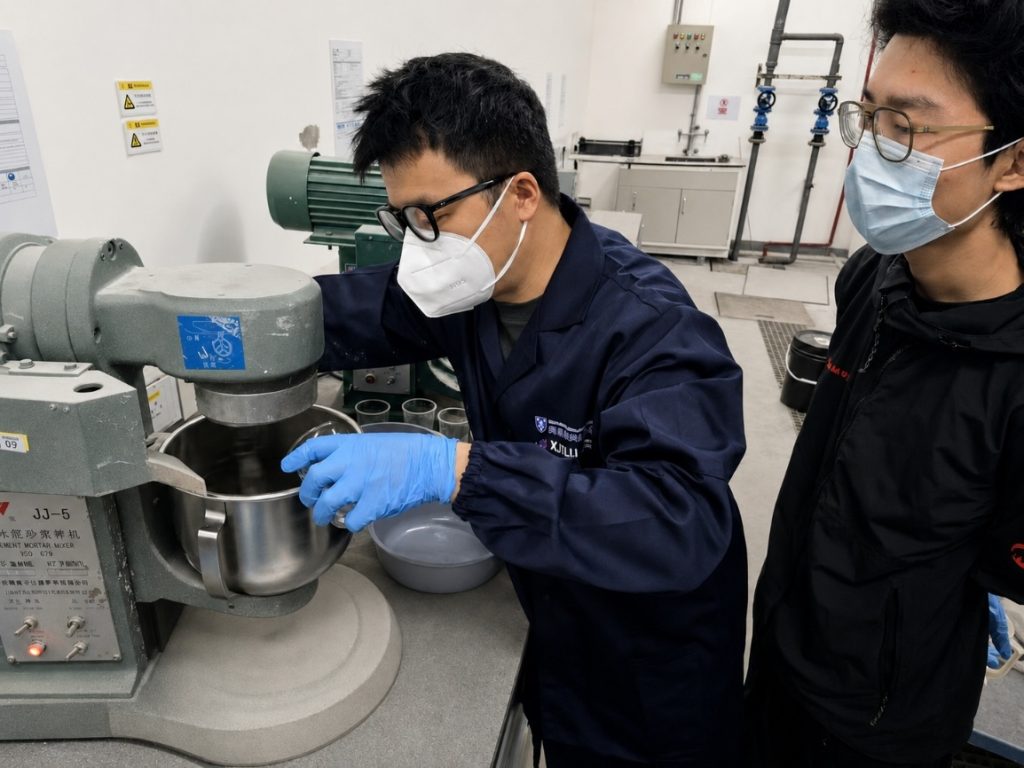
Dr Engui Liu instructs students in preparing lightweight cementitious composites in the Civil Engineering Laboratory
Mowan: connecting performance with cultural expression
Mowan uses red and gold, with dragon and Nezha-inspired wave-breaking motifs across its hull. Its load-bearing, hollow, double-layer thin shell was made from a fibre- and glass-mesh-reinforced cementitious composite, with removable foam serving as the fabrication mould. In a numerical comparison using the same external hull geometry, the hollow model was 25.2% lighter than the filled control. A further simulation indicated a 30.6% reduction in resultant hydrodynamic load when heave and pitch were permitted. The connection between the technical paper, structural solution and visual concept helped the team secure Second Prize, the Best Creativity Award and the Best Paper Award.
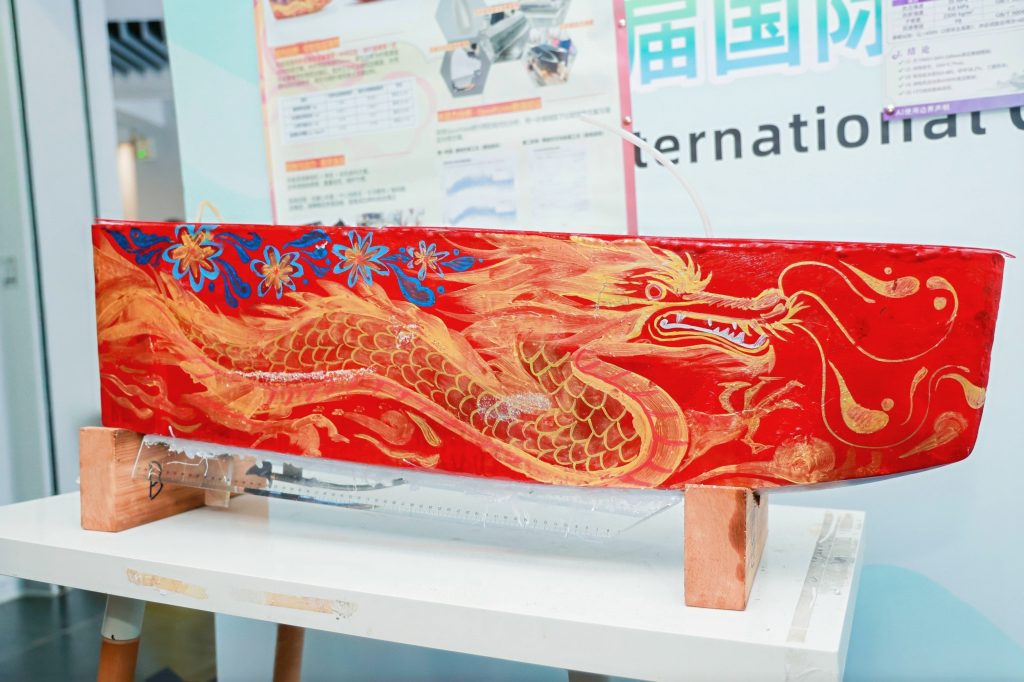
Mowan uses red-and-gold dragon motifs to express its wave-breaking theme
Mingri Fangzhou: lightweight design and stable control
Mingri Fangzhou features a blue-and-white visual identity, a slender hull and a shallow V-shaped bottom. Its polymer-modified cementitious composite thin shell uses PVA fibres and alkali-resistant glass-fibre mesh, together with local reinforcement and a low-centre-of-gravity propulsion layout, to balance weight, stability and manoeuvrability. CFD simulations helped the team identify pressure concentrations near the bow and forward bottom and refine the hull and reinforcement. Blue dragon, wave and Zhuang-inspired motifs connect the design to the competition theme. The team received Third Prize in the overall competition.
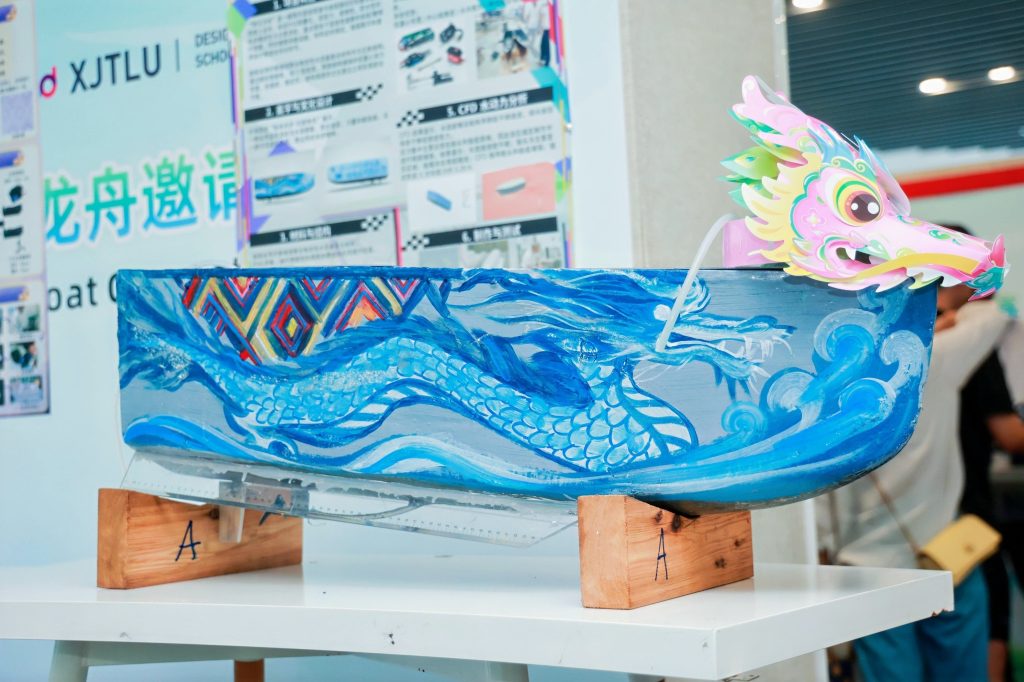
Mingri Fangzhou combines a blue-and-white visual identity with a lightweight hull
Taking classroom knowledge onto the water
The Mowan team comprised Junyao Wang, Shutian Huang and Shenglin Xu; the Mingri Fangzhou team comprised Yujie Xu, Zerui Li and Shuaijun Li. During the preparation process, XJTLU’s Civil Engineering laboratory technical team and doctoral researchers Ziqiang Sun and Rengeng Zheng provided specialist support in materials preparation, mould and hull construction, equipment operation and testing. Dr Wei Zhang supported both teams with Computational Fluid Dynamics (CFD) simulations and hull-form optimisation. Their contributions helped the students translate design concepts into manufacturable and testable boats.
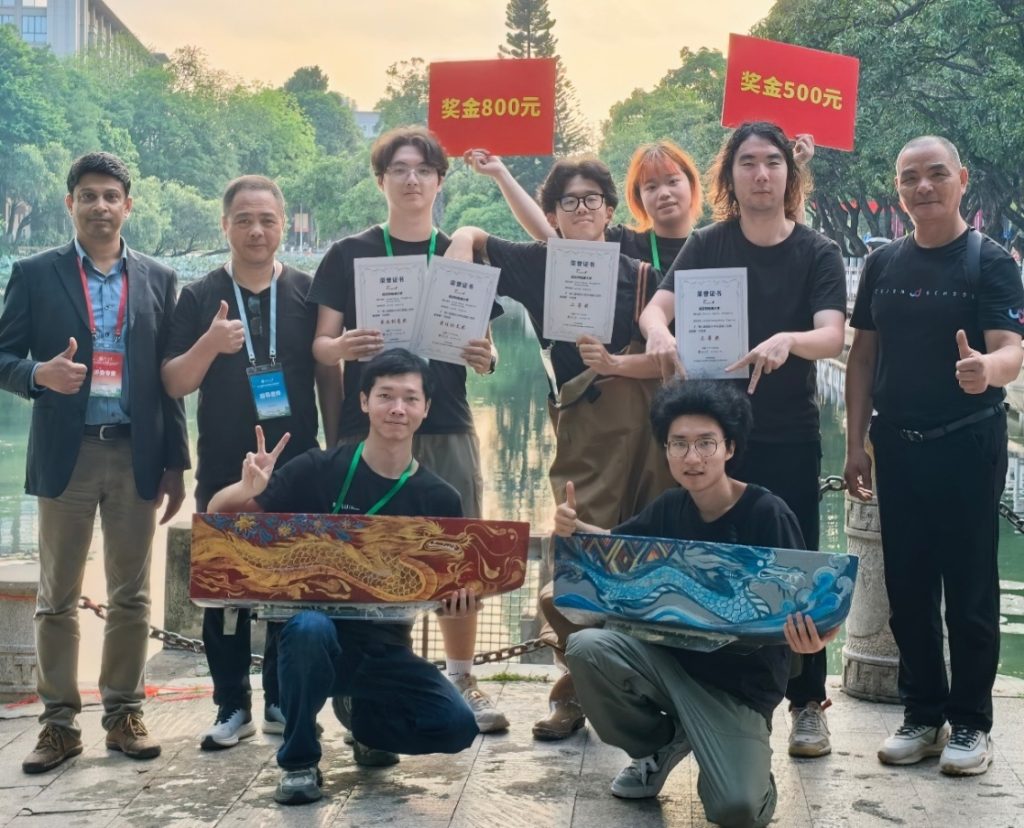
XJTLU competition teams at the award ceremony
As one of the co-hosts, XJTLU also contributed to the organisation of this year’s event. The competition evaluated more than the performance of a finished boat: students had to explain and defend each engineering decision through technical papers, posters, material specimens and on-water events. This approach combines research-led learning, project-based work and interdisciplinary collaboration.
XJTLU’s Department of Civil Engineering has organised student participation in the International Concrete Dragon Boat Competition for several consecutive years, progressively developing the project into an integrated experiential learning platform spanning advanced cementitious composite design, structural and hydrodynamic analysis, digital simulation, engineering fabrication and teamwork. In 2026, the two student teams secured four honours, further highlighting the Department’s research strengths and capacity for innovation in engineering materials - particularly cementitious composites - while advancing a research-led, project-based approach to engineering education.
Story and images provided by Department of Civil Engineering
10 Aug 2026