







Spot the Problem, Sell the Solution: XJTLU International Students' Entrepreneurship Showcase

12 Jun 2026


The CLT305 Business Chinese course at Xi’an Jiaotong-Liverpool University recently completed a special assignment: international students took part in a creative “product poster exhibition” and a simulated investment pitch. Their roles transformed—they became “product designers,” “entrepreneurs,” “live-streaming hosts,” and “product analysts”, solving real-world problems in Chinese.
Problem Identification: From Everyday Annoyances to Business Opportunities
“I want to order takeout, but I can’t understand the Chinese apps.” “I need to stay energized during reading week, but coffee and energy drinks just make me more tired.” “I’ve been studying for so long that my back and shoulders ache.” “I’m about to be late, but I can’t find a parking spot for my e-scooter."
For international students who have lived at XJTLU for four years, these frustrations are almost part of daily life. But in the CLT305 classroom, they were no longer just complaints—they were transformed into “business opportunities.”
The task design logic is clear: Step one, identify pain points. Students were asked to draw on their own experiences at XJTLU, interactions with local classmates, and observations of Suzhou to uncover real, unmet “problems.” This was not just a casual brainstorming session, but the starting point of research.
Once pain points were identified, the course moved into a more rigorous phase: conceptualizing products, designing surveys, and analyzing data. Students had to turn their intuitions into testable hypotheses. Through research, they needed to answer: Is this pain point widespread? What kind of solution are target users willing to pay for? Data became the key bridge between “I think” and “I discover.”
Presenting the Solution: The Poster as a Business Plan
Once the demand was validated, the real challenge began—transforming an abstract product concept into a tangible, visual design.
The next step required students to design a visual poster. This poster served as a condensed business plan. It had to include six core elements: product name and slogan, target customer profile, core pain point, solution and selling points, visual centerpiece, and a call to action.
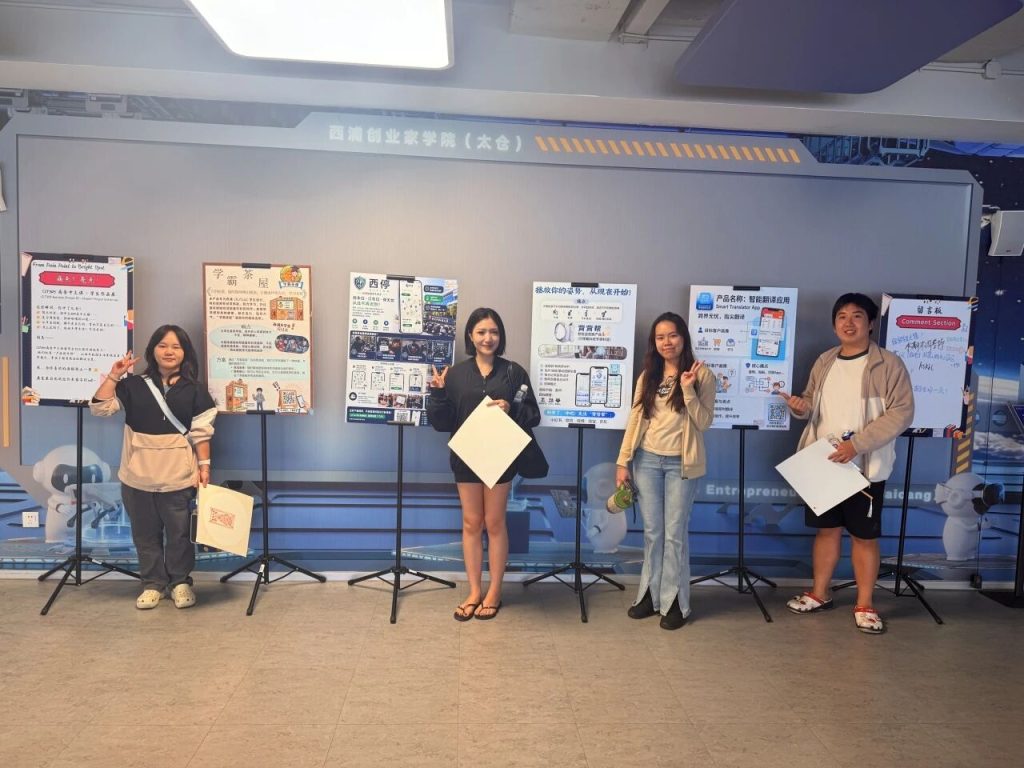
At the exhibition, each poster told its own story. The visual centerpiece might be a product prototype or an illustration of the product in use, allowing viewers to grasp the core logic at a glance. The “call to action” section cleverly guided viewers from passive observers to active participants—“Scan the QR code to learn more,” “Come support us at the pitch event,” “Put a star on the poster you like.” These phrases gave the static exhibition a dynamic energy.
Skills in Action: Pitching, Live-Streaming, and Peer Review
If the poster is a static business manifesto, the next phase was a dynamic test of skills.
During the investment pitch, students had to stand before “potential investors” (played by instructors) and clearly articulate their product logic, market potential, and revenue model within a limited time. This tested not only the precision of their Chinese expression but also their logical persuasiveness.
The live-streaming sales simulation required students to act as hosts in a simulated real-time shopping scenario, using engaging Chinese to present their products and encourage “purchases.” This segment was full of spontaneous interaction and humor, helping students improve their spoken fluency while experiencing the commercial value of language in marketing contexts.
Finally, the students switched roles again, from “entrepreneurs” to “product analysts.” They were asked to give peer feedback on each other’s products and offer mock investment recommendations. This step pushed students to step outside their own perspectives and examine business logic more objectively and critically—a deep exercise in both language and analytical thinking.
12 Jun 2026