





09 Sep 2026


On 5 September 2026, the International Business School Suzhou (IBSS) at Xi’an Jiaotong-Liverpool University held its 2026 Alumni Conference on the South Campus. As one of three parallel panels, ‘Smart Investment in New Landscape: Opportunities in Tech Investment and Capital Market’ was moderated by Dr Bo Jiang, Associate Professor in the Department of Economics at IBSS.
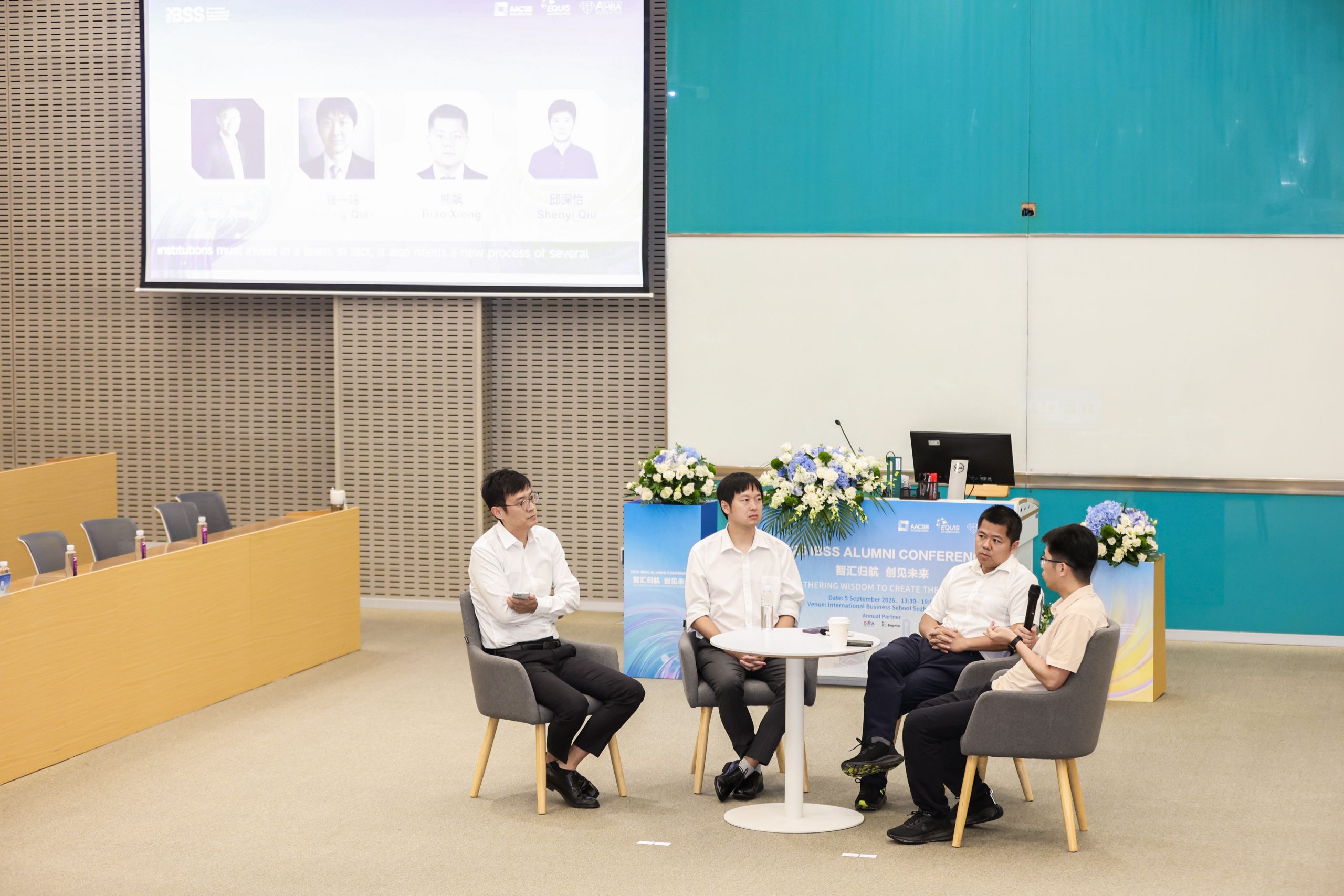
The panel brought together three distinguished speakers: Biao Xiong, Vice President of Shanghai Haixin Group; Dr Yiming Qian, Senior Research Scientist at Singapore’s Agency for Science, Technology and Research (A*STAR) and AI Advisor to Standard Chartered Bank; and Shenyi Qiu, Director of Capital Operations at Suzhou Zhitu Technology. The discussion covered government-backed industrial funds, AI-driven entrepreneurship and AI transformation within large financial institutions.
Biao Xiong, Vice President of Shanghai Haixin Group, used the Shenzhen HKC panel project he led in 2020 as an example to illustrate how government-backed industrial funds balance the dual objectives of attracting investment and delivering financial returns. The project involved a total investment of 22 billion yuan and was not without controversy at the time. However, his team based its decision on four layers of analysis: industry trends, competitive positioning, market strategy and technological differentiation.
They believed that Chinese companies were well placed to replace their Japanese, South Korean and Taiwanese counterparts in the panel industry, and that HKC, as a new entrant, enjoyed greater management efficiency while targeting underdeveloped emerging markets across Asia, Africa and Latin America. The project ultimately listed in 2026 with a market capitalisation of between 200 to 300 billion yuan, generating over 10 billion yuan in returns for state-owned capital while also contributing to employment and tax revenues. The case challenged the common perception that government funds focus solely on attracting investment rather than the quality of individual projects.
Mr Xiong then reflected on the investment case of XPeng Motors. The investment was made in the second half of 2018, and the company successfully listed on the US stock market in 2020, after which his team exited with solid returns. Mr Xiong outlined his investment framework in three parts.
First, it is essential to thoroughly understand policy trends; China's push for new energy vehicles is driven both by energy security concerns and by the strategic opportunity to compete with established carmakers in a new technological race. Second, investors should consider the advantages of backing new entrants rather than incumbents. NIO, XPeng and Li Auto were all founded by entrepreneurs from outside the traditional automotive industry, whereas founders with a legacy automotive background could be more constrained by existing ways of working, as exemplified by the bankruptcy of WM Motor.
Third, the founder's ability to sustain financing and manage large teams is critical. He Xiaopeng, who had already achieved financial freedom through the sale of UC Browser to Alibaba, invested heavily in the company himself and secured ongoing backing from Alibaba, Foxconn and Tencent. Mr Xiong stressed that a similar framework can be applied to today’s AI sector.
Shenyi Qiu, Director of Capital Operations at Suzhou Zhitu Technology, shared insights on financing strategies and capital management for tech start-ups, drawing on her own company's experience. Suzhou Zhitu Technology, a self-driving technology company spun off from FAW Jiefang, operates across commercial vehicle scenarios including long-haul logistics, sanitation and factory logistics.
The company has been recognised as a national-level "Little Giant" enterprise specialising in niche sectors and completed a Series B financing round of over 100 million yuan in 2025. Ms Qiu noted that for start-ups, the most critical factor is securing customers and investors who recognise the value of the product. She argued that effective capital management depends on creating a positive cycle between the company and industry trends. Only when the trend is established and the product is validated by the market can subsequent financing proceed step by step.
Suzhou Zhitu Technology, through its proprietary Yingteng autonomous driving system, has achieved commercial success in the commercial vehicle advanced driver-assistance systems (ADAS) market, with product shipments exceeding 100,000 units and a market share of over 10 per cent in the heavy truck segment. This, she said, demonstrates a viable path from technological development to commercialisation.
Dr Yiming Qian, Senior Research Scientist at A*STAR and AI Adviser to Standard Chartered Bank, explored the direction of software entrepreneurship in the AI era. He observed that AI has dramatically lowered the barriers to software entrepreneurship, reducing the time from idea to a testable prototype from months to hours.
However, general-purpose software addressing impulsive needs is vulnerable to being replaced by AI, whereas the real value lies in domain-specific software that embeds industry knowledge. He identified AI agents as an emerging trend: while foundational AI companies focus on underlying capabilities, entrepreneurs can train AI agents to master specific industry knowledge and business processes, with a single agent potentially taking on work previously carried out by large teams. Business models are also shifting from licence fees or subscriptions to outcome-based pricing, where charges are triggered by token usage and actual results delivered.
On the topic of AI adoption in large financial institutions, Dr Qian discussed some of the practical challenges. AI serves two main purposes: helping generate revenue and reducing costs. The real challenge, however, arises on the cost side. If AI is positioned as a means to reduce labour costs, it tends to meet resistance from business units concerned about redundancies, often manifesting in delayed data provision and stalled projects.
Moreover, budget cycles in large institutions are lengthy, with projects not budgeted for the current year having to wait until the next. Dr Qian's proposed solution is to focus on additional value rather than replacing existing operations, approaching AI from the revenue side rather than the cost side, and to avoid touching established interests.
Rather than building a single enterprise-wide system, the practical approach is to work with individual business units to develop large numbers of lightweight tools that improve efficiency within existing frameworks. This model, he confirmed, has been used in practice at Standard Chartered and fully complying with the bank’s strict regulatory requirements.
During the audience Q&A, Mr Xiong explained that his provincial-level platform manages approximately 100 billion yuan across more than 30 funds using a fund-of-funds plus direct investment model. Unlike market-oriented PE and VC firms, the primary pressure comes from attracting investment rather than generating short-term cash returns, and local government LPs are chiefly concerned with when major projects will be established locally and begin contributing tax revenue and employment.
Government capital, he noted, can be managed on a perpetual bond basis, rolling over as long as dividend cash flows cover interest costs, and overall exit pressure is relatively modest. Responding to a question about whether a fragmented approach to AI implementation would create management conflicts within the tightly regulated banking environment, Dr Qian confirmed that this model does not require restructuring core systems and has proven compatible with existing compliance frameworks.
On financing difficulties in the biopharmaceutical sector, Mr Xiong observed that primary market financing for biopharma has fallen sharply, with capital now concentrated in AI, robotics, integrated circuits and quantum computing. To attract investment, biotech firms need a compelling international proposition centred on out-licensing, ideally as the first-in-class or fastest progressing against a particular target, globally or domestically. They should also build teams with experience at major European or US pharmaceutical companies, and maintain stable organisational resources. A narrative focused solely on the domestic health insurance market, he cautioned, would struggle to gain traction with investors.
The one-hour panel brought together first-hand experience and forward-looking perspectives on investment strategy, industry trends, entrepreneurship and AI transformation. Questions and discussion with alumni added a practical dimension to the session, offering different perspectives on how investors, entrepreneurs and established organisation can respond to rapidly changing technological landscape.
09 Sep 2026