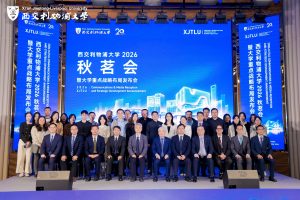
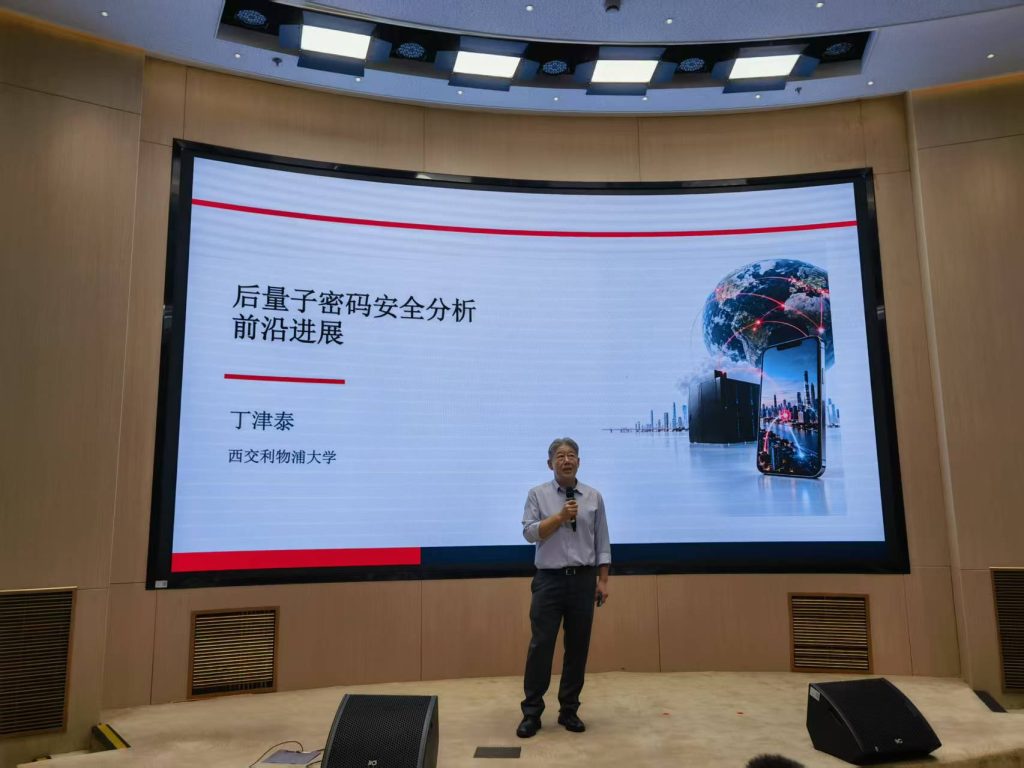
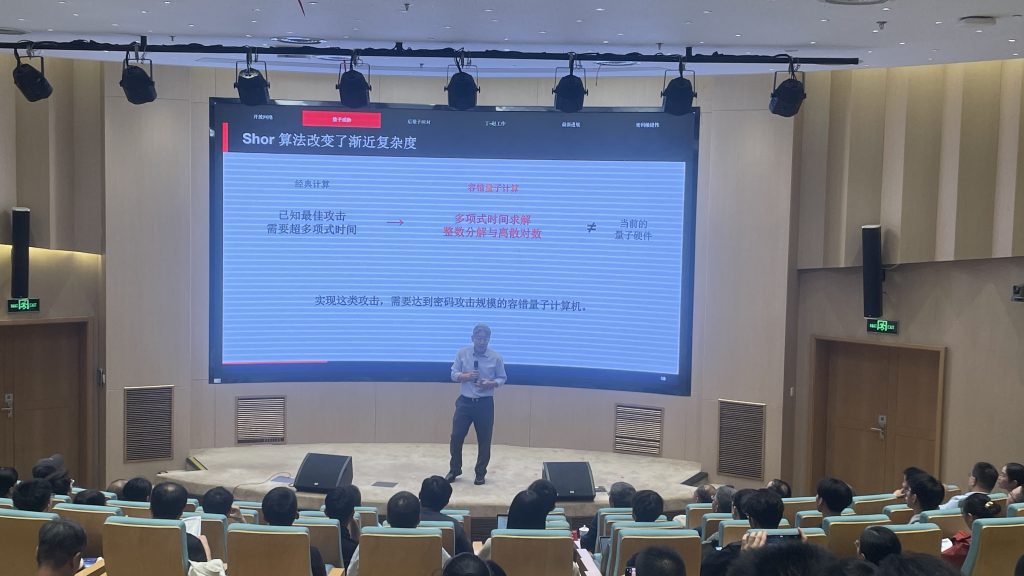
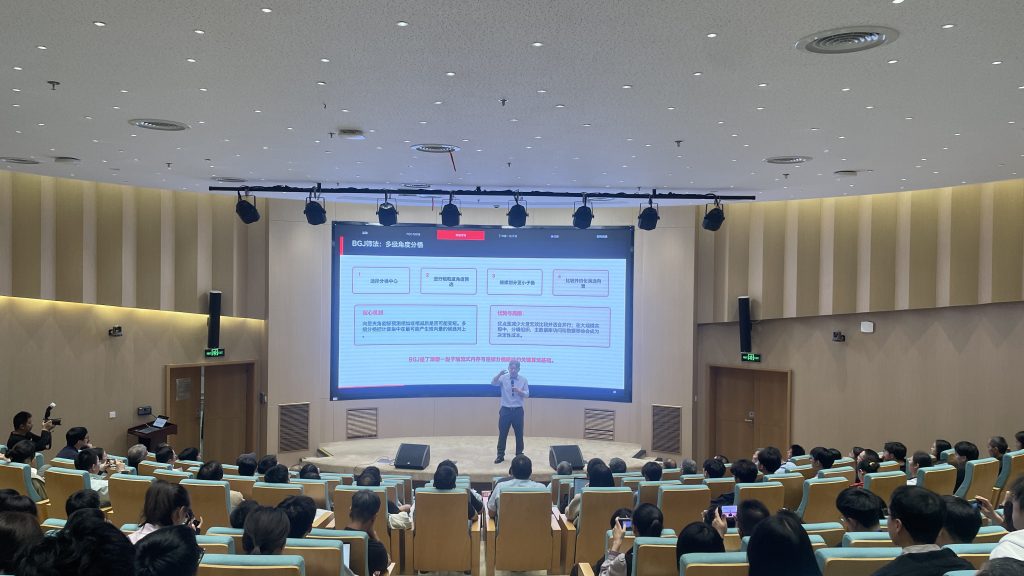
On 31 October, The 2026 CACR Conference on Cryptographic Mathematics Theory opened at Fudan University. Professor Jintai Ding, Dean of the School of Mathematics and Physics at XJTLU and Director of the Post-Quantum Migration Interdisciplinary Laboratory (PQC-X), delivered the opening keynote on "Frontiers and Prospects in Post-Quantum Cryptanalysis."
Rather than focusing on macro-level standards and migration, Prof. Ding brought the audience back to the core of lattice-based cryptography: theoretical proofs lay the foundation, but practical attack costs determine the true security level.
Public-key cryptography allows one authenticated public key to be distributed to many users, but it also concentrates risk: if a quantum computer breaks the private key using Shor’s algorithm, all communications are compromised.
If the sum of data confidentiality lifespan and migration time exceeds the quantum attack window, waiting until the threat is confirmed will be too late.
With NIST publishing standards like FIPS 203 (ML-KEM), PQC has entered the deployment phase. As one of the designers of ML-KEM, Prof. Ding analysed why lattice cryptography is central to this transition, while pointing out theoretical boundaries. While reductions link average-case to worst-case problems, standard parameters do not directly satisfy all conditions of conservative reductions. Parameter choices rely heavily on the current best attacks and security margins. Thus, storage and data movement costs must be factored into security assessments.
Turning Attack Costs into Measurable Evidence
In lattice attacks, solving the Shortest Vector Problem (SVP) is critical. Mainstream "sieve" algorithms often face memory and bandwidth bottlenecks at high dimensions. Prof. Ding, collaborating with his PhD student Ziyu Zhao, restructured the data flow of the BGJ sieve algorithm without changing its mathematical principles. By employing sequential streaming reads, multi-level bucketing, and deferring expensive comparisons to cache, they introduced a "storage-aware" architecture.
This approach led to consecutive breakthroughs in real SVP challenges:
- 2024: SVP-183 (approx. 0.9 TB memory, ~30 days without GPU)
- 2025: SVP-200 (approx. 961 GiB peak memory, ~31 days total)
- 2026: SVP-210 (max sieve dimension 171, 56.05 days preprocessing)
Prof. Ding emphasised that challenge dimensions are not equivalent to actual security bits. These records do not break the official ML-KEM parameter sets, nor do they change the asymptotic complexity of the sieve. Their core value lies in proving that real memory and data movement costs may be lower than older models, and future security estimators must incorporate an "empirical backend."
Turning New Evidence into Action
Recent cases in the field—such as cache-timing attacks on HQC and the withdrawal of HAWK following AI-assisted structural attacks—demonstrate that implementation-level flaws are as critical as mathematical foundations. While AI is accelerating the combination of attack modules, all results still require rigorous mathematical validation.
The report concluded with Crypto-Agility. The security level of lattice cryptography is a scientific judgment requiring continuous maintenance, rather than a permanently fixed number. Building systems with asset inventories, continuous monitoring, and independent verification ensures standards can rapidly respond to new empirical evidence.