




Why Are We Willing to Pay for “Wanghong” Shops? HSS Scholar Receives NSFC Funding

08 Oct 2026


Why are people willing to queue for an “Wanghong” shop? Why does a meal need not only to taste good, but also to look good and photograph well? When we pay for the atmosphere and “emotional value” of a place, how exactly does space shape the way we consume?
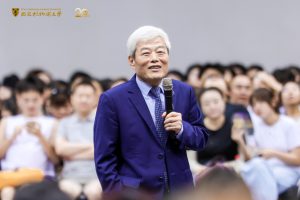
These everyday phenomena lie at the heart of a question that Dr Liu Cao (pictured below), Assistant Professor in the Department of China Studies at the School of Humanities and Social Sciences, Xi’an Jiaotong-Liverpool University, has long explored: How do people perceive and use space, and how does the material environment within a space shape their behaviour and experience?

Focusing on this question, Cao’s project, “Embodied Practices and Place-Making in New Urban Consumption Spaces: A Human–Material Interaction Perspective”, has received funding from the National Natural Science Foundation of China (NSFC) Young Scientists Fund (Category C) in 2026. It is also the first NSFC-funded project awarded to XJTLU’s School of Humanities and Social Sciences.
When Consumption Becomes an “Experience”
“In the past, when we thought about consumption spaces, shopping malls might have been the first thing that came to mind, with people going there specifically to buy something. But many new consumption spaces today are no longer simply about ‘buying things’; they are increasingly connected with people’s emotions, feelings and perceptions,” Cao said.
From visually appealing meals and internet-famous neighbourhoods to independent concept stores, consumption settings that emphasise experience and atmosphere are becoming an increasingly visible part of urban life.
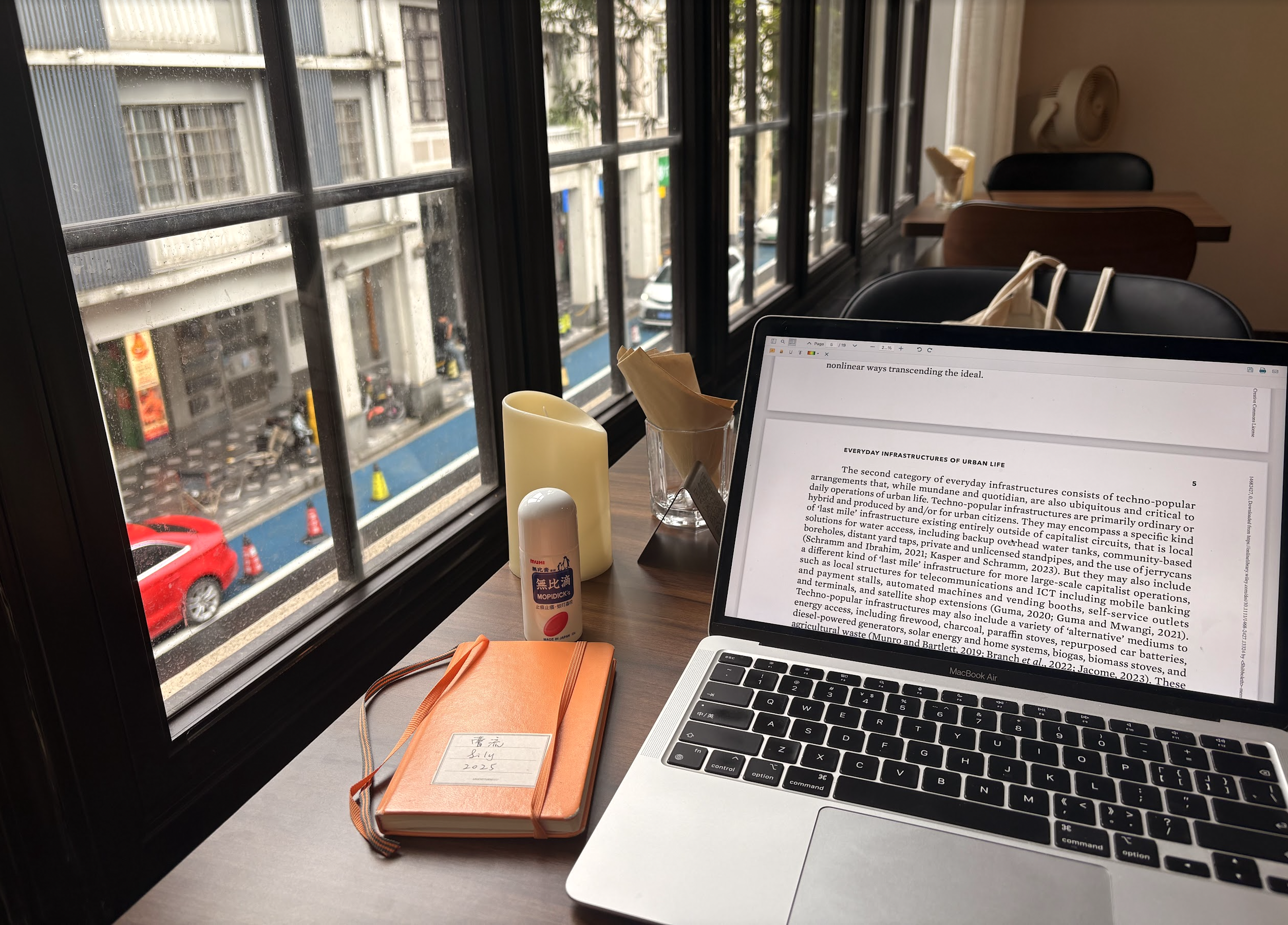
Cao organises research materials during fieldwork
Cao cites Dongshankou in Guangzhou, where she previously conducted fieldwork, as an example. The area is home to many distinctive shops. People visit not only to shop and dine, but also to take photos, stroll around and experience the neighbourhood environment.
“The idea of a ‘visually appealing meal’ is a very intuitive example. Sometimes what we consume is not just a meal, but also a mood and an environment.”
In her view, space is not simply a static backdrop against which consumption takes place. Shop design, the street environment and objects within a space can all shape how people perceive and use a place. At the same time, people also participate in shaping that place through practices such as walking, lingering and consuming.
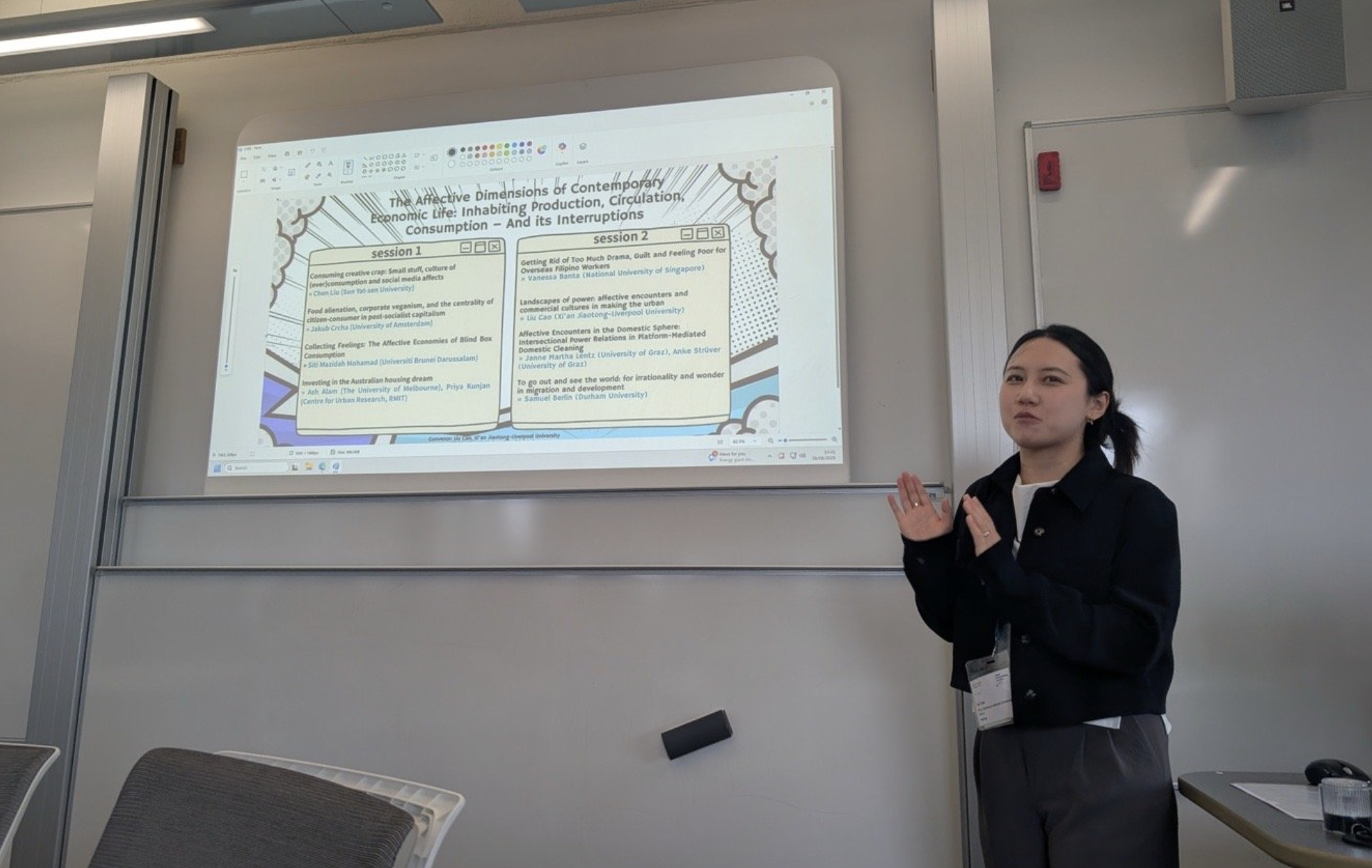
Cao presents her research at an academic conference in Birmingham, UK
The project further focuses on the body and lived experience, examining at the micro level how space acts upon people and how people, through their interactions with the material environment, form consumption experiences and participate in place-making.
Finding Research Questions through City Walks
Cao’s research questions also emerge from her long-term observation of everyday urban life.
She enjoys city walks. As she moves through the city and encounters new shops, neighbourhoods and forms of consumption, she experiences them while observing how the city is changing.
“I’m very experience-oriented, and I’m also driven by inspiration. Many of my research ideas come from things I suddenly notice or experience in everyday life, rather than being imagined from behind a desk.”
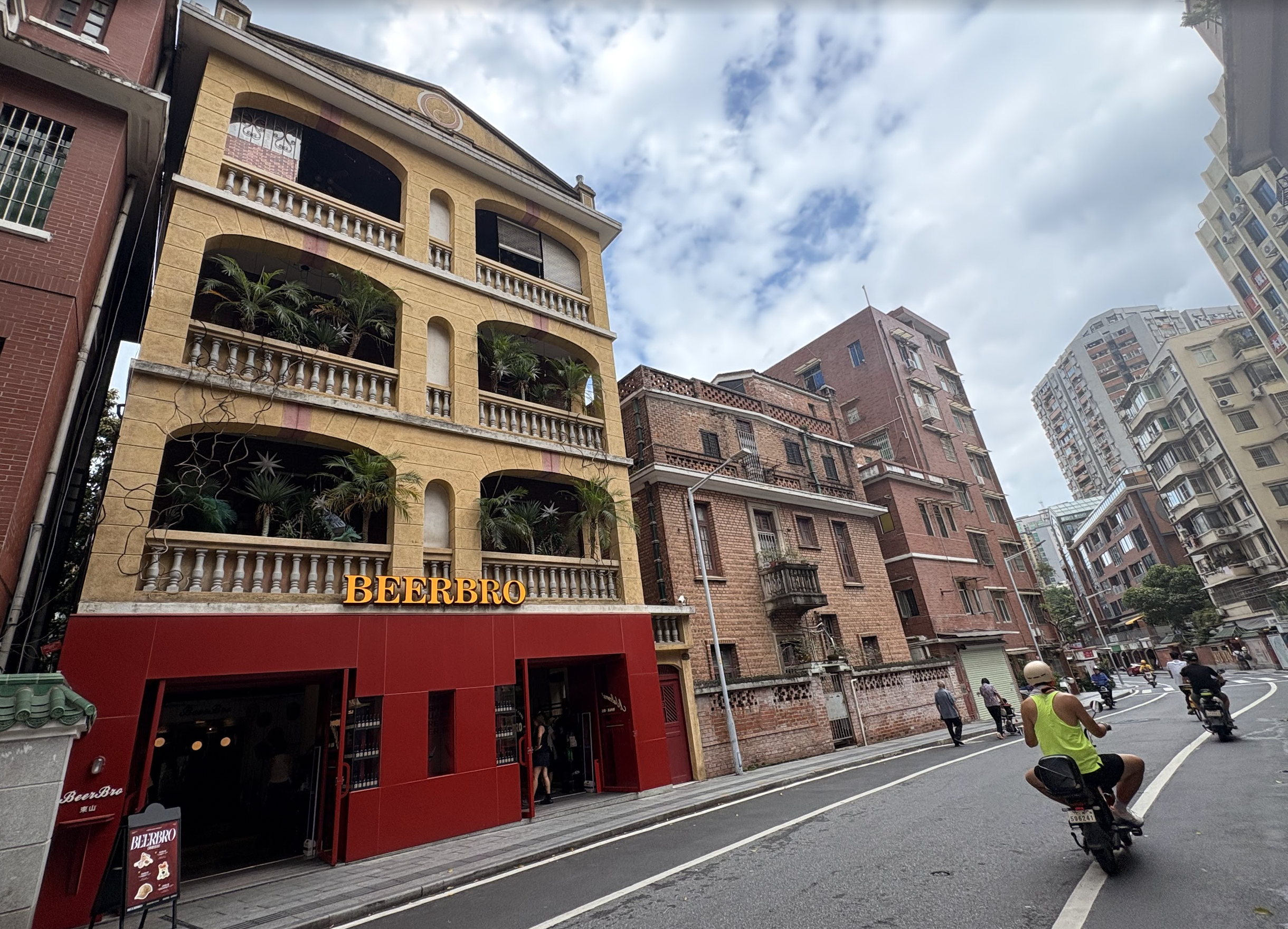
An urban neighbourhood where Cao conducts research on consumption spaces
Around 2019, as phenomena such as visiting “internet-famous” places for photos began to attract attention, Cao started observing changes in China’s urban consumption spaces and gradually turned these observations into research questions. The newly funded project is a continuation and extension of her work in consumption geography since her doctoral studies.
Living in Suzhou, she finds such changes all around her. From large commercial developments around Jinji Lake to the distinctive shops clustered along Shiquan Street, spaces at different scales reveal different forms of consumption.
“Shiquan Street, for example, shows how the vitality generated by consumption itself can drive bottom-up urban regeneration in a place,” Cao said.
From Dongshankou in Guangzhou to Shiquan Street in Suzhou, and from the interior details of a single shop to the transformation of an entire neighbourhood, urban spaces at different scales continually offer her new observations: as new forms of consumption enter the city, how do people, material objects and space interact, and how do these interactions further shape the formation and transformation of a place?
Seeing the People Behind the Data
Some shop owners whose businesses have been labelled “internet-famous” have told Cao that they do not actually like the term. To them, being “internet-famous” often implies fleeting popularity, while what they truly care about is how to sustain a business over the long term.
Such perspectives have led Cao to pay closer attention to the individuals behind broader consumption trends and urban change, as well as to their lived experiences and real needs.
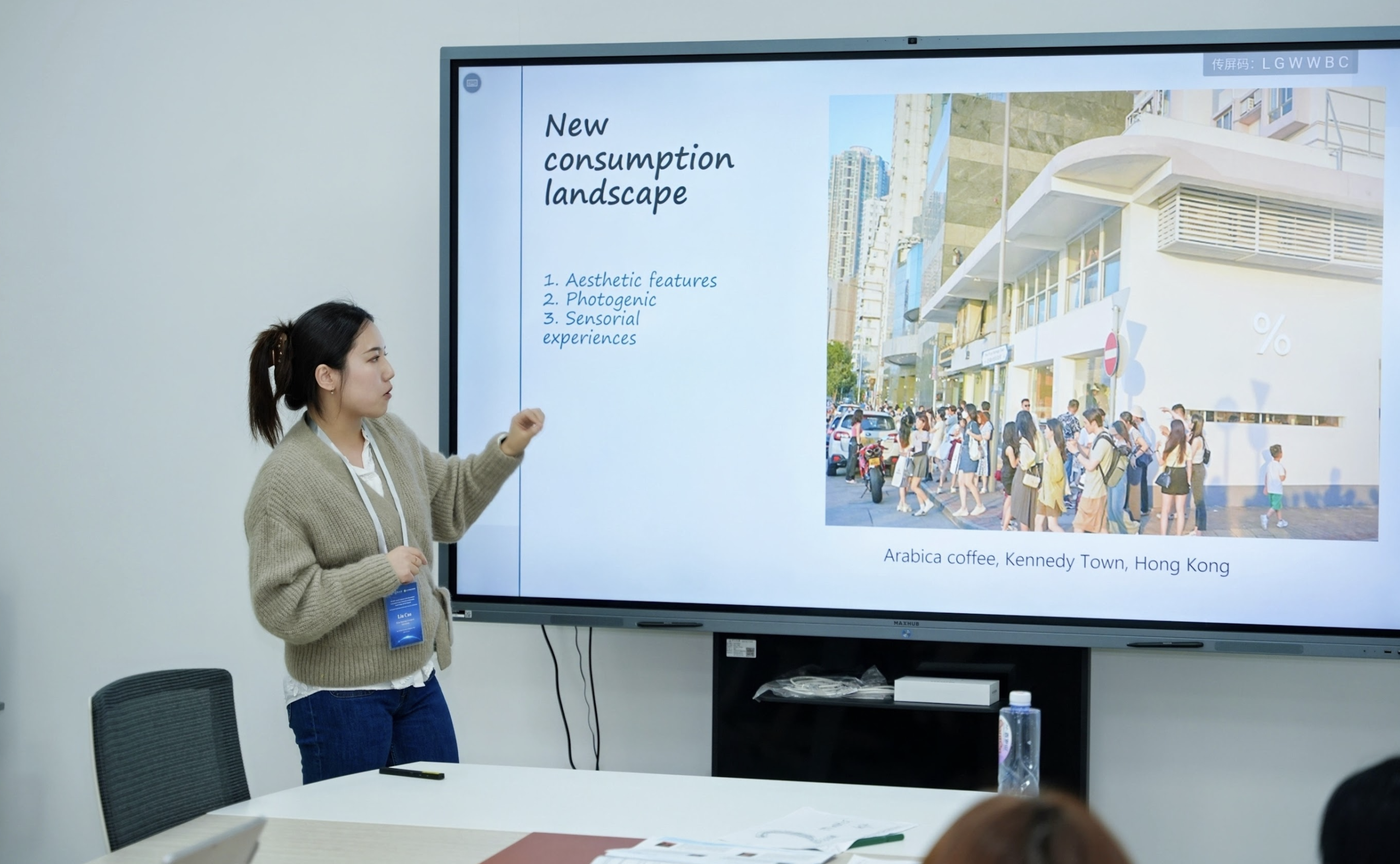
Cao shares her research on new urban consumption spaces
In this project, Cao plans to use interviews and observation to understand consumers’ experiences in specific spaces, while also drawing on geographical tools such as geographic information systems (GIS) to analyse consumption spaces and their characteristics at different scales.
GIS can help researchers analyse geographic coordinates, spatial distributions and relationships between different areas, while interviews and observation enable the research to engage more closely with individuals and understand their lived experiences.
“Everyone has their own thoughts; they are not just a cold number,” Cao said.
“Geographic information systems can help us analyse coordinates and spatial distributions, but as a human geographer, I also pay attention to how people are affected by space. I don’t want people’s voices and ideas to be diminished.”
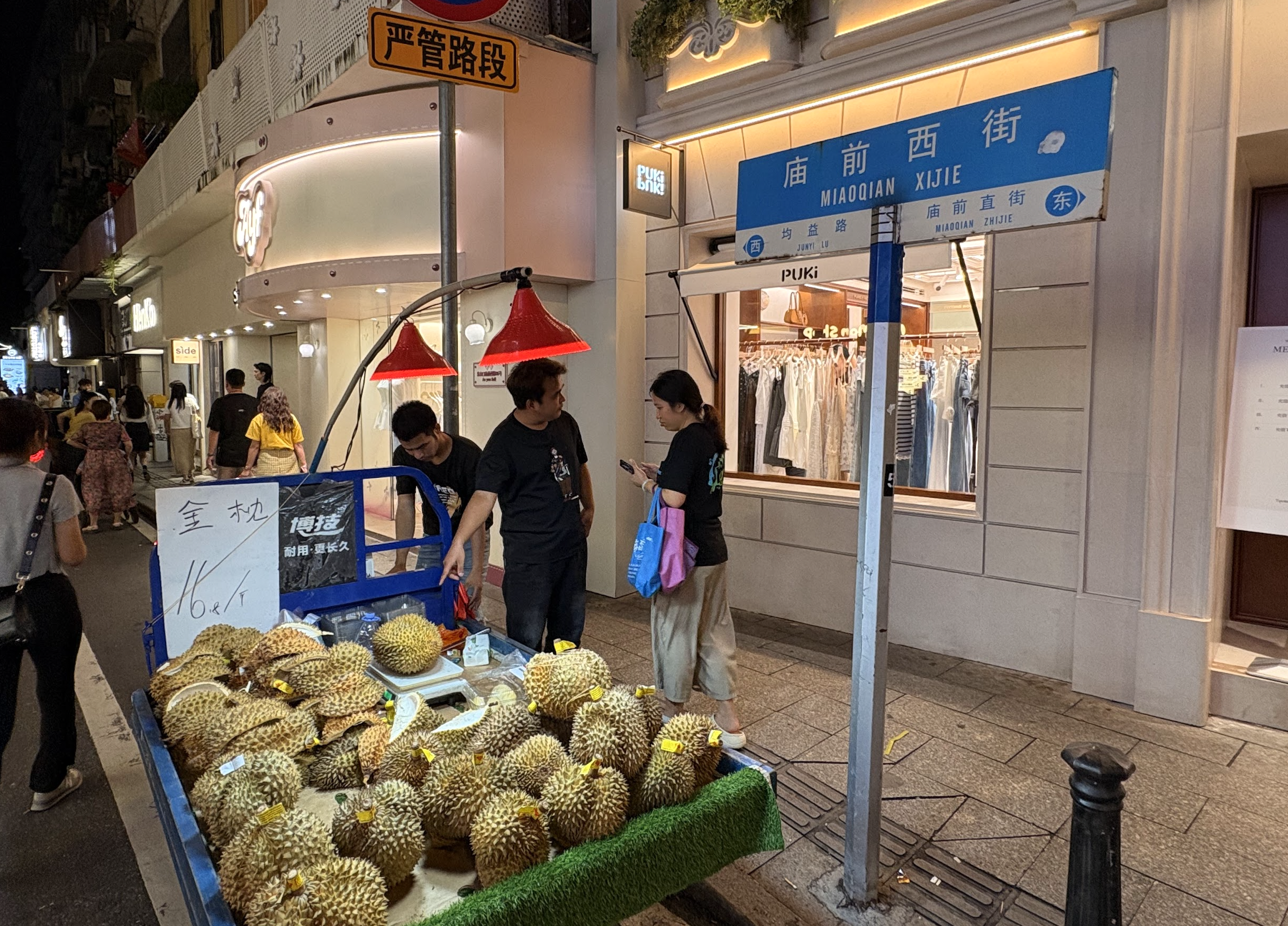
A consumption scene recorded by Cao during her observations of everyday urban life
This approach also reflects the project’s emphasis on “human–material interaction”. Rather than focusing only on how people use space, Cao also seeks to understand how the material environment itself acts upon people: spatial layouts, surroundings, objects and even bodily perceptions within a space can all contribute to the formation of consumption experiences.
For Cao, this is also an important feature of human geography: it analyses space while always paying attention to the people within it.
“I want to do work that can build connections with society, rather than allowing research to remain detached from reality.”
In the future, she plans to share her research findings with small and medium-sized businesses and relevant practitioners through public-interest seminars and other forms of engagement, providing practical reference for business operations and spatial practices. She also hopes that the findings can be further translated into policy recommendations, strengthening the connection between research and real urban life.
By Yiyi Gu
Photos courtesy of Liu Cao
08 Oct 2026