







Gennaro Senatore


Recent Advances in the Design of Adaptive Structures: from Structural Control toward Intelligent Structural Synthesis
Abstract
Adaptive structures are an emerging class of load-bearing systems characterized by the integrated co-design of structural layout and control mechanisms, enabling purposeful modification of mechanical response through sensing, computation, and actuation. As such, they fall within the broader category of cyber-physical systems, in which physical and digital components interact through feedback. Within this paradigm, structures sense external actions and actively modulate stiffness and geometry to control deformations and redistribute internal forces. Structural behavior is therefore governed not only by material properties and geometry, but also by embedded computational decision-making.
Recent advances have extended adaptivity beyond real-time response toward structural synthesis and lifecycle resilience. When structural topology and control system layout are co-designed through All-In-One optimization formulations, adaptivity enables new limits of material efficiency that conventional structural systems cannot achieve [1]. At the building scale, adaptive floor systems demonstrate material savings exceeding 60% compared to conventional flat slabs [2]. At the infrastructure scale, design and retrofit strategies for bridges using active components show potential to significantly reduce damage accumulation and extend service life [3], [4]. These principles have been validated through large-scale demonstrators, including a 10 × 6 m rib adaptive floor slab developed at the University of Stuttgart.
This keynote reflects on the trajectory from conceptual frameworks to full-scale validation and discusses how the next phase will merge the mechanics of adaptive structures with artificial intelligence for design and operation. Machine-learning models, including Graph Neural Networks, Variational Autoencoders, and Reinforcement-Learning Agents, open new directions for structural topology optimization and control synthesis, enable cross-scale generalization, and embed physical constraints directly into learning architectures. This convergence is expected to uncover previously unexplored, highly efficient structural configurations and to advance adaptive systems capable of self-diagnosis, damage mitigation, and performance optimization. A forward objective is the transition toward “metastructures”, in which adaptivity is embedded across structural, component, and material scales through architected material systems. We are entering a stage where structures will not only respond to loads but will infer their effects and adapt accordingly. The fusion of mechanics and data-driven will play a defining role in the next era of structural design.
References
[1] G. Senatore and Y. Wang, “Topology Optimization of Adaptive Structures: New Limits of Material Economy,” Computer Methods in Applied Mechanics and Engineering, vol. 422, p. 116710, Mar. 2024, doi: 10.1016/j.cma.2023.116710.
[2] A. P. Reksowardojo, G. Senatore, M. Bischoff, and L. Blandini, “Design and Control Benchmark of Rib-Stiffened Concrete Slabs Equipped with an Adaptive Tensioning System,” Journal of Structural Engineering, vol. 150, no. 1, p. 04023200, Jan. 2024, doi: 10.1061/JSENDH.STENG-12320.
[3] K. A. Canny, G. Senatore, and L. Blandini, “Investigation of Retrofit Strategies to Extend the Service Life of Bridge Structures through Active Control,” Journal of Bridge Engineering, vol. 30, no. 2, p. 04024109, 2025, doi: 10.1061/JBENF2.BEENG-6925.
[4] A. P. Reksowardojo, G. Senatore, A. Srivastava, C. Carroll, and I. F. C. Smith, “Design and testing of a low-energy and -carbon prototype structure that adapts to loading through shape morphing,” International Journal of Solids and Structures, vol. 252, p. 111629, Oct. 2022, doi: 10.1016/j.ijsolstr.2022.111629.

Figure 1 AIO Structure-Control Topology Optimization: a) ground structure, b) adaptive, and c) passive [1]; video demonstration
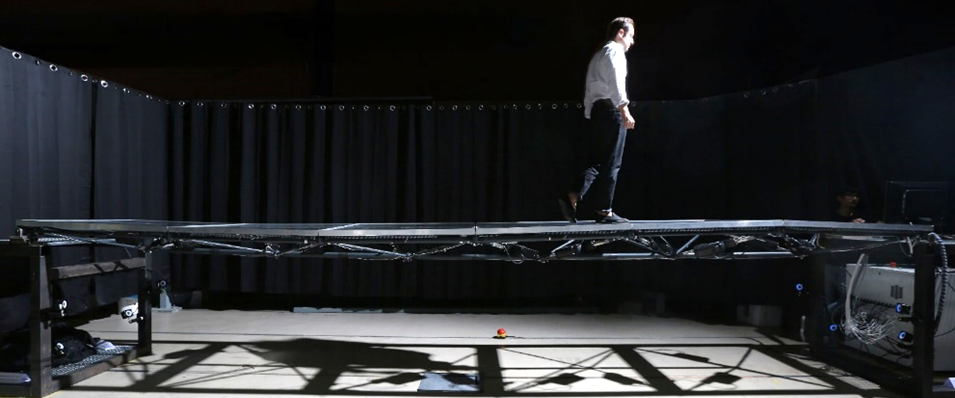
Figure 2 Shape-morphing bridge prototype, EPFL IMAC laboratory, [4]; video demonstration
Biography
Gennaro Senatore is Head of Research in Adaptive Structural Systems at the Institute for Lightweight Structures and Conceptual Design (ILEK), University of Stuttgart. He previously held research leadership roles at the Swiss Federal Institute of Technology Lausanne (EPFL), University College London, and Expedition Engineering in London.
His research integrates computational design synthesis, structural optimization, and control systems engineering to enable ultra-lightweight, low-carbon, resilient, and adaptive structural systems — pioneering novel methods and solutions for the built environment. He has published over 35 articles in top-tier peer-reviewed scientific journals in the fields of computational structural mechanics, structural optimization, and adaptive systems. These methods have been validated through the design, fabrication, and testing of near-full-scale physical prototypes.
In professional practice, he has contributed to high-profile international projects through advanced computational workflows for the conceptual design of complex structural systems. To broaden accessibility to structural design and optimization, he developed PushMePullMe, an interactive educational tool that combines game mechanics with numerical methods to support intuitive understanding of structural behavior.
As part of his commitment to knowledge transfer and methodological innovation, he served as a Lead Expert appointed by the European Commission’s Joint Research Centre to develop the New European Bauhaus Self-Assessment Method, a policy-aligned framework integrating performance across environmental, functional, aesthetic, technological, social, governance, and economic dimensions.
WEBSITE: www.gennarosenatore.com
PhD Habil. Gennaro Senatore
Head of Research in Adaptive Structural Systems
at the ILEK University of Stuttgart, Germany