






Bringing Architectural Theory to Life with an AI Learning Companion

Bringing Architectural Theory to Life with an AI Learning Companion
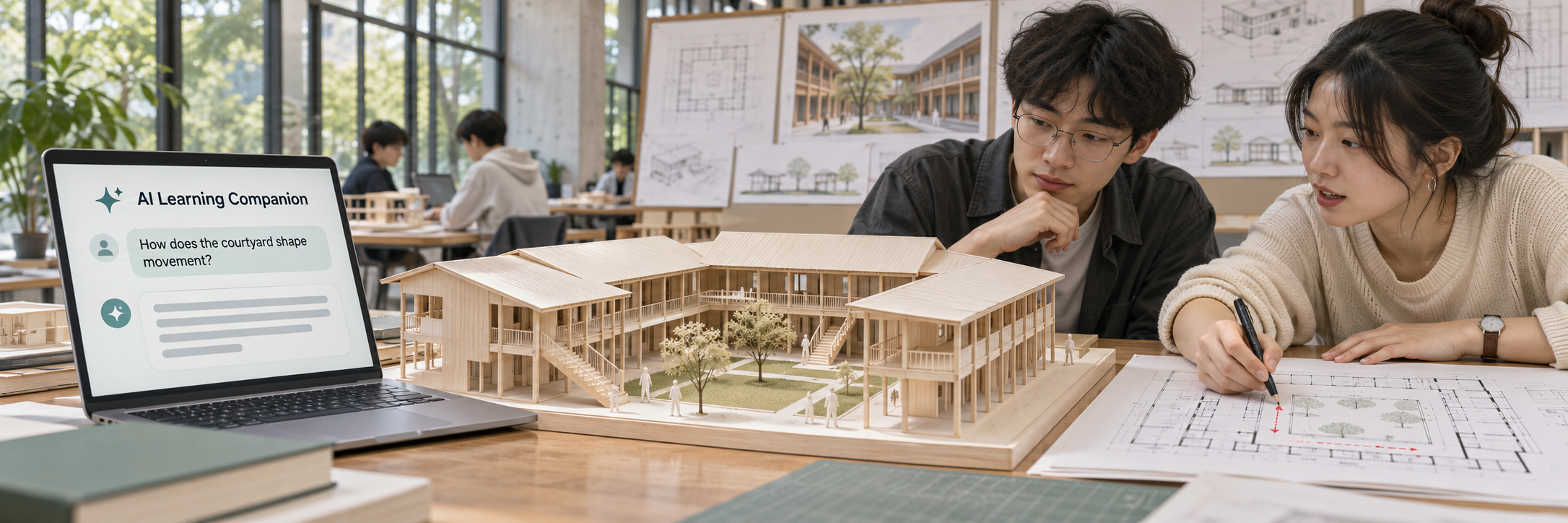
Roberto Podda introduces Ernesto, a custom AI agent integrated into the Architecture Design Theory module to help students explore theoretical concepts, ask questions and participate more confidently in discussions. Through AI-supported seminars and hands-on design activities, students are encouraged to think critically, challenge ideas and connect architectural theory with practice.
Key Lessons Learned and Recommendations for Colleagues
- Embed AI into a structured learning process. AI is most effective when connected to clearly defined activities, learning outcomes and assessment, rather than used as a standalone tool.
- Keep educators in control. AI should support teaching and facilitate discussion, not replace the tutor’s role in guiding learning.
- Use reliable, discipline-specific resources. Building an AI agent around a carefully selected knowledge base can help reduce inaccurate responses and provide students with relevant academic references.
- Encourage critical engagement with AI outputs. Requiring students to question, verify and correct AI-generated content helps develop critical thinking and responsible AI use.
Learn more about this case
Roberto worked with EDU to develop Ernesto, a customised AI agent designed specifically for ARC303.
Unlike a general-purpose chatbot, Ernesto uses a closed knowledge base of 80 books carefully selected by the teaching team, helping students access relevant theoretical perspectives and bibliographic references while reducing the risk of inaccurate information.
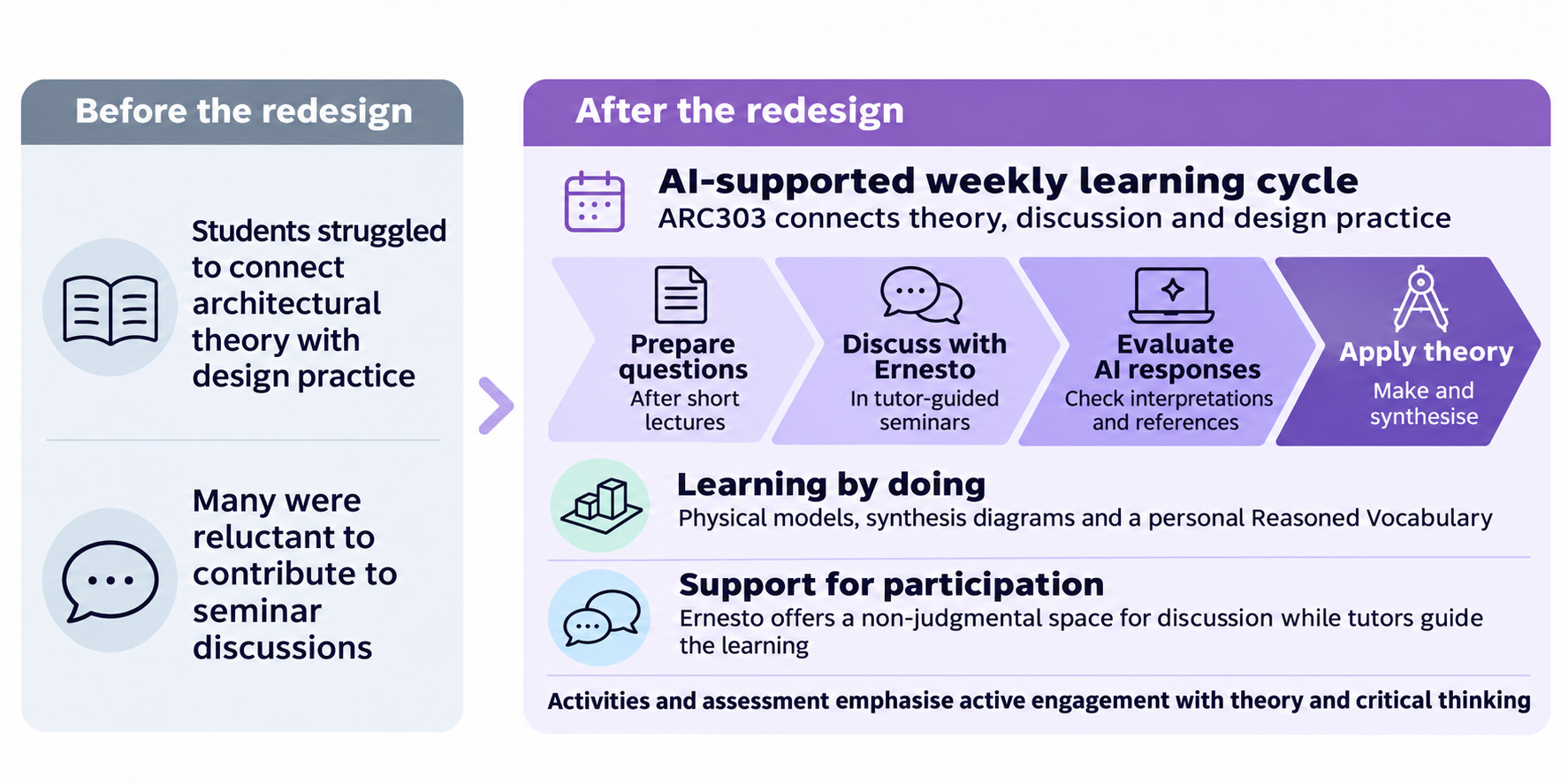
Ernesto was embedded throughout the weekly learning cycle:
- Before seminars: Students attended short lectures and prepared five questions based on the concepts introduced.
- During seminars: Students and tutors used Ernesto to explore questions, generate interpretations, identify theoretical connections and stimulate discussion. The agent acted as a non-judgmental intermediary, helping students feel more comfortable participating.
- After seminars: Students used Ernesto to deepen their understanding, explore references and create synthesis diagrams, which they were expected to critically review and correct.
AI-supported learning was also connected to practical activities and assessment, including physical models and a personal Reasoned Vocabulary, encouraging students to turn theoretical understanding into tangible outcomes.
Evidence was collected through student work (physical models, vocabulary entries and synthesis diagrams), tutor observations and anonymised transcripts of seminar discussions.
These sources suggested that Ernesto helped encourage participation from quieter students, creating a more inclusive environment for discussion. The requirement to review and manually correct AI-generated diagrams also supported students in developing critical thinking skills.
The structured weekly learning cycle helped distribute the workload and made students’ developing understanding more visible to tutors.

Roberto Podda
Roberto Podda is an Associate Professor in the Department of Architecture and the Module Leader of ARC303. His research spans architectural composition, urban design, architectural theory and history, and urban regeneration, with a specific focus on integrating AI into theory and
design teaching. This focus is embodied in Ernesto, the cross-phase AI agent he developed for ARC303 to connect theoretical debate, disciplinary literature and design practice within a controlled and tutor-supervised learning environment.
If you wish to learn more about Roberto’s case and the resources he’s used to implement AI in his module, send him an email at roberto.podda@xjtlu.edu.cn.
What was Roberto trying to improve?
Roberto wanted to address two key challenges in teaching Design Theory: helping students connect abstract theoretical concepts with practical design work, and encouraging more active participation in seminar discussions.
Students often felt reluctant to speak up, question ideas or contribute to debates. The redesign aimed to create a more inclusive and interactive learning environment where students could confidently explore theoretical concepts, develop their own perspectives and translate their understanding into practical design outcomes.