





Rethinking Assessment with AI: From Essays to Creative Projects

Rethinking Assessment with AI: From Essays to Creative Projects
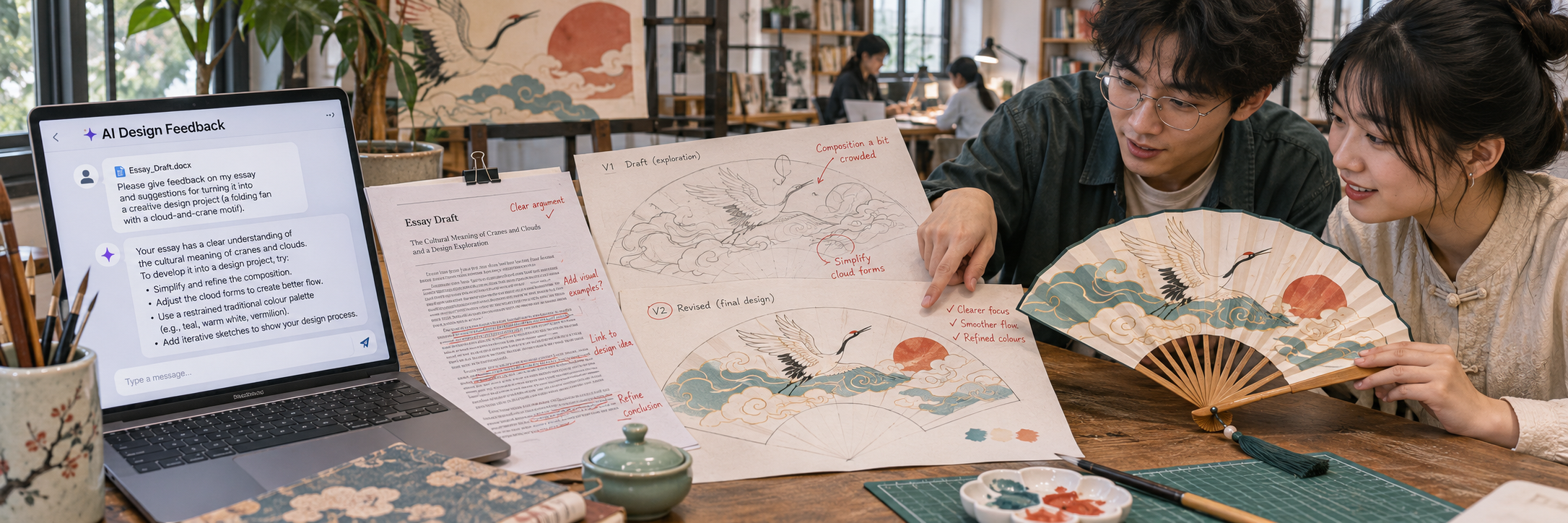
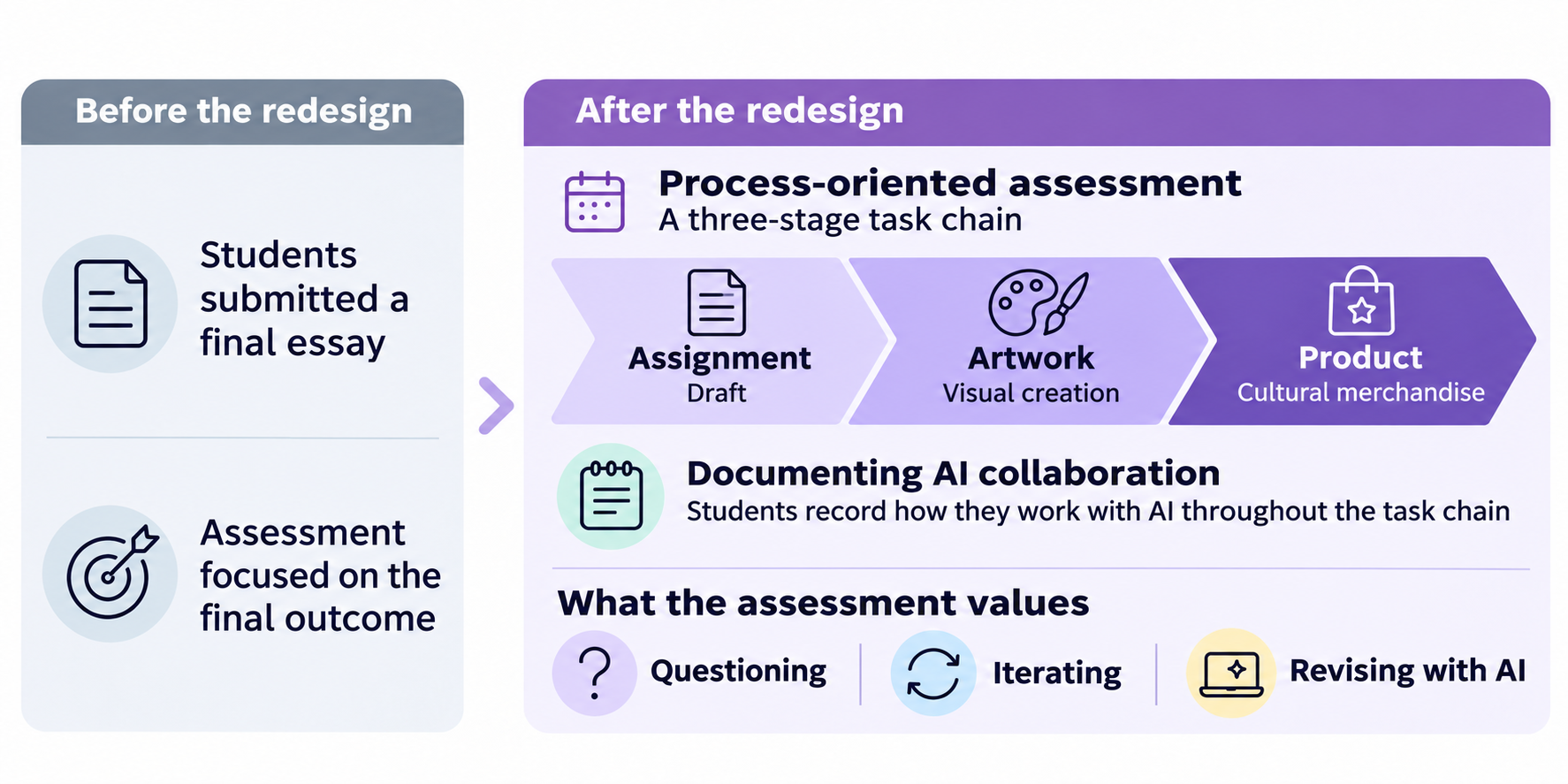
Xiaodan Guo redesigned the assessment in the CCT009 module, replacing traditional essays with creative projects involving writing, visual design and cultural products. Students use AI as a learning partner, developing their creativity and critical thinking while learning to question AI-generated content and use it responsibly.
Learn more about this case
AI acts as a collaborative partner. Students lead the intellectual process – designing prompts, questioning AI outputs, and verifying facts.
In the first stage, students must engage in at least 3 rounds of meaningful interaction with AI.
Staff act as facilitators, using a five-dimension rubric (Collaboration, Critical Thinking, Creativity, Aesthetic Sense, Judgement) to evaluate students’ work.
To ensure academic integrity, we do not mandate specific AI platforms; instead, we require shareable dialogue links and recommend an “AI Academic Integrity Statement” to make the process transparent.
Data collected included pre-post surveys, AI dialogue links, and multi-instructor scoring data.
Results showed that 93.3% of students proactively verified AI-generated details.
Post-tests revealed significant improvements in AI confidence and critical thinking.
Instructor scoring tests showed an Intraclass Correlation Coefficient (ICC) of 0.83 for total scores, proving the rubric’s reliability, with an average grading time of 6.5 minutes per work.

Xiaodan Guo
Dr. Xiaodan Guo is a lecturer at the Chinese Cultural Teaching Centre, XJTLU. She holds a PhD in Media and Cultural Industries and serves as the PI of a Youth Project of Humanities and Social Sciences, Ministry of Education of China. Her research focuses on local communication, new media, film aesthetics, and Intangible Cultural Heritage (ICH) communication. She has published multiple papers in CSSCI journals and is the lead director of the ICH Studio co-built with the Suzhou Gusu District Government. Her teaching integrates AI with humanities education to enhance cultural confidence and critical thinking.
What was Xiaodan trying to improve?
The CCT009 module was redesigned to address the invalidation of traditional essay assessments due to AI ghostwriting, as well as the challenge of engaging students in massive classes.
It aimed to shift the pedagogical approach from ‘preventing AI’ to ‘using AI as a cognitive scaffold’, constructing a transferable assessment model that objectively evaluates students’ critical thinking and AI literacy.