







Stress-testing a new cryptographic algorithm: XJTLU study accepted at Crypto 2026

20 Aug 2026


Professor Jintai Ding of Xi’an Jiaotong-Liverpool University (XJTLU) has co-authored a paper with researchers from Tsinghua University, the Ethereum Foundation, and the University of Luxembourg that has been accepted by the 2026 International Cryptology Conference (Crypto 2026). Titled “Graeffe-Based Attacks on Poseidon and NTT Lower Bounds”, the paper was presented by Professor Ding at the conference on 19 August.
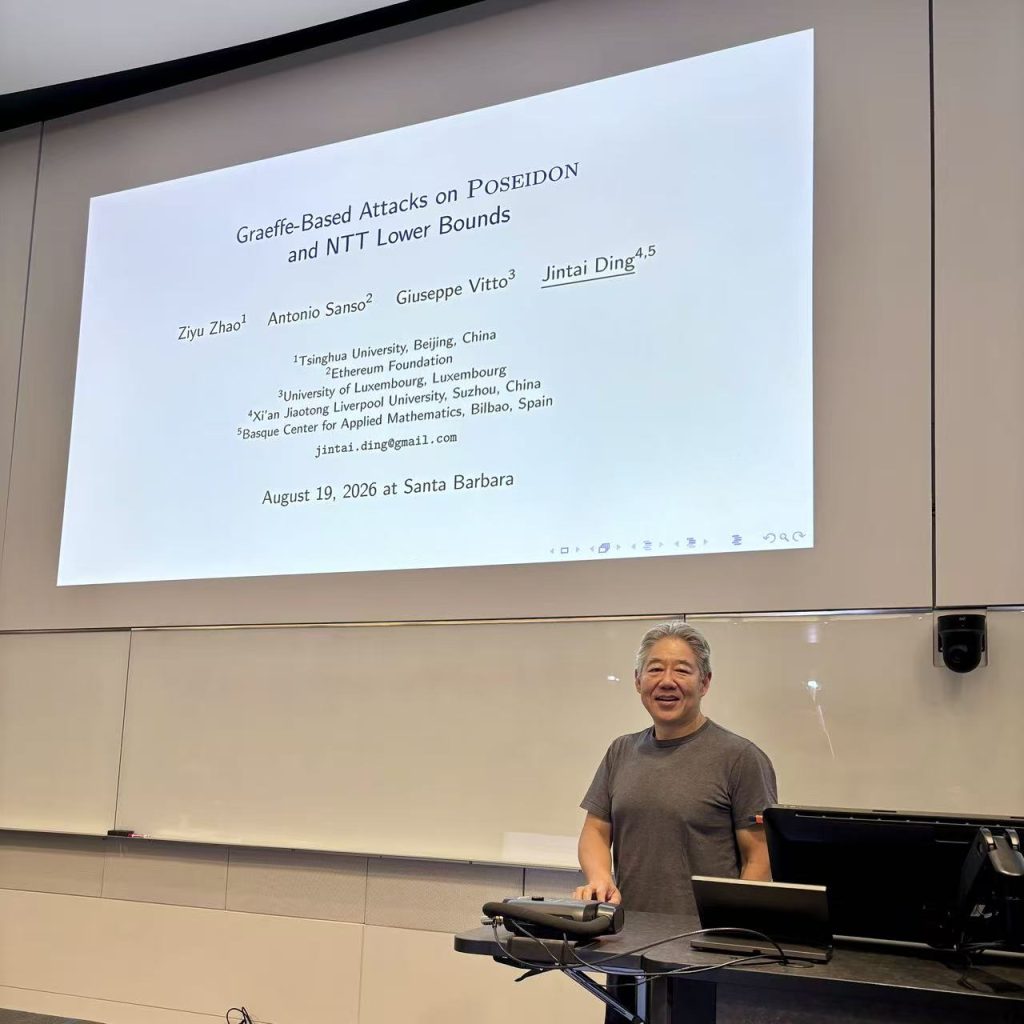
Crypto is organised by the International Association for Cryptologic Research (IACR). Along with Eurocrypt and Asiacrypt, it ranks among the three leading conferences in cryptography, and is a major venue where researchers worldwide present frontier work.


What is Poseidon?
Poseidon is a new hash function built for applications such as zero-knowledge proofs. In plain terms, a hash function generates a “digital fingerprint” of data: change even a small part of the input, and the output changes completely. Mobile payments, online banking, and many verification systems rely on this at their core. A zero-knowledge proof lets one party show another that a statement is true without revealing the underlying information.
Unlike mature hash functions such as SHA-2 and SHA-3, which have been studied and deployed for years, Poseidon is relatively new, so its security boundaries still need ongoing analysis and verification. In cryptography, researchers routinely try to “attack” algorithms. This does not mean a real-world cyber breach – it is a form of security analysis in which researchers design mathematical methods to probe for weaknesses and test the conditions under which an algorithm might be broken.
The process is best understood as an escalating series of stress tests. The stronger the method, the more precisely researchers can judge what an algorithm can withstand – and the clearer its security boundaries become.
Around 8,000 times faster
This is where the new study comes in. The researchers introduced the Graeffe transform – a classic method for finding polynomial roots – into the cryptanalysis of Poseidon, substantially improving the efficiency of the security analysis.
Experiments show that the new approach runs up to about 8,000 times faster per computation than previous methods, and uses about 22 times less memory. On that basis, the researchers solved several previously unsolved security challenge instances and released the solver code as open source on GitHub.
A speed-up of roughly 8,000 times means researchers can run a deeper security analysis of Poseidon using far less time and computing power. Cryptanalysis often involves calculations on a very large scale; with higher analytical efficiency, researchers can examine problems that were once too expensive to attempt, and can determine an algorithm’s security boundaries more accurately.
Importantly, even under this more thorough analysis, the paper still finds Poseidon secure under standard parameters. In cryptography, putting an algorithm through stronger stress tests – even when it is not ultimately broken – helps define its safe operating range more clearly and lays groundwork for later research.
“The key to testing a new cryptographic algorithm is to map out its security boundaries,” says Professor Ding. “We hope that, through the most thorough analysis we can manage, we can give this class of new algorithms a solid test result.”
“This research clarifies its security boundaries more clearly and gives follow-up studies a reusable analytical tool,” he adds.
The cost of data movement
The researchers also examined parts of the process involving the Number Theoretic Transform (NTT). They found that as the scale of computation grows, the “movement cost” of reading and transferring data between storage locations can weigh on overall efficiency.
In other words, judging a cryptographic tool means looking beyond theoretical speed to memory use and the real cost of moving data on actual hardware. As computation gets faster, what caps overall efficiency may shift from “how fast it computes” to “whether data can be moved to where it is needed”.
From giving a new hash function a more efficient security checkup to pinpointing performance bottlenecks in real computing environments, the study deepens understanding of both the security boundaries and the computational costs of new cryptographic components, and supplies fresh analytical tools for related work.
Professor Ding has long studied cryptography and post-quantum cryptography. He directs the Post-Quantum Migration Interdisciplinary Laboratory (PQC-X) at XJTLU and serves as Dean of the School of Mathematics and Physics.
By Qinru Liu
Edited by Xinmin Han
20 Aug 2026