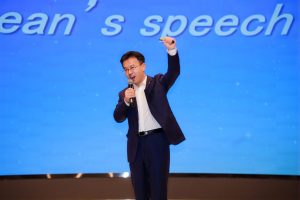


Professor Dijiang Huang is Dean of the School of Internet of Things and an internationally recognised researcher in cybersecurity, distributed systems, and trustworthy intelligent computing. He received his BSc in Telecommunications from Beijing University of Posts and Telecommunications and his MSc and PhD in Computer Science from the University of Missouri–Kansas City.
Prior to joining the School of Internet of Things at XJTLU Entrepreneur College (Taicang), Professor Huang served as Chief Researcher at the Beijing Academy of Blockchain and Edge Computing. He was previously a tenured professor at Arizona State University (ASU), where he founded and led the Secure Networking and Computing Lab, which advances research on secure mobile, edge, cloud, and networked systems. His current research focuses on autonomous cyber defence, AI and system security, blockchain technologies, and distributed and trustworthy computing.
Professor Huang has authored over 200 peer-reviewed publications, written three professional and academic books, and holds 10 US patents. Over his career, he has secured approximately 25 million USD in competitive research funding from agencies and organisations, including many federal funding agencies in the US and China, as well as industry partners. Notably, he also served as lead principal investigator for a major national research project under the Ministry of Science and Technology of China.
As an educator and mentor, he has supervised 17 PhD graduates – five of whom are now academic staff members – and 26 master’s thesis students, many of whom now work in academia and leading technology companies worldwide.
Professor Huang is the recipient of numerous honours, including the US Young Investigator Award, IEEE Communications Society Distinguished Lecturer recognition, the JSPS Research Fellowship, and the Hewlett-Packard Innovation Research Award. He is also an entrepreneur who co-founded two start-ups and was recognised as an ASU Fulton Entrepreneurial Professor for his contributions to innovation and technology transfer.
He has contributed extensively to the professional community through more than a decade of service in the IEEE Internet Technical Committee, including a term as Chair, leadership roles in over 40 IEEE and ACM conferences and workshops, editorial service for multiple international journals, and participation in IEEE technical working groups. He is a member of the National Academy of Inventors (NAI) in the US.