




22 Dec 2025


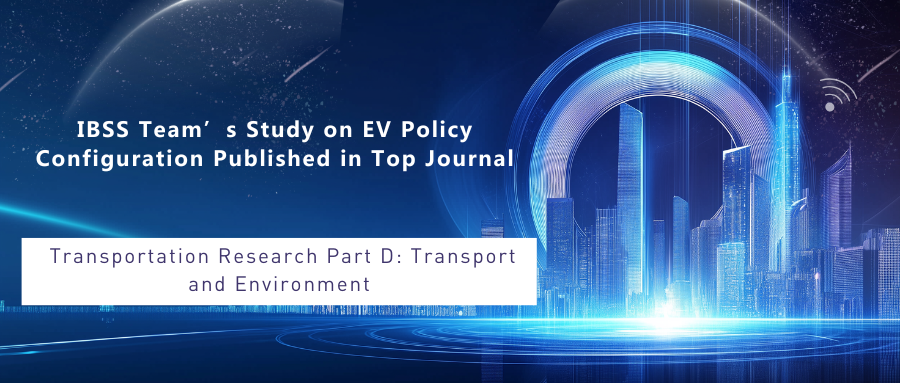
Recently, the paper "Configurational Impacts of Government Policies on Electric Vehicle Diffusion: A Global Analysis" by Professor Lixian Qian, Dr Miaomiao Liu & PhD student Chi Yang (IBSS, XJTLU) was published in top journal Transportation Research Part D (ABS-3, ABDC-A, CAS-Q1). With Chi Yang as first author, it analyzes 516 policies across 25 nations, exploring policy-macroenvironment alignment to offer policymakers scientific, practical insights amid global EV transition.
The global shift to electric vehicles (EVs) is accelerating, but government policies to promote EV adoption vary sharply in effectiveness across countries. Through empirical analysis, the research team confirms there is no universal "optimal" EV policy. Instead, successful EV diffusion hinges on aligning policy feature combinations with a nation’s specific macroenvironment for precise policy-national context matching.
To uncover this core logic, the study uses Fuzzy-sets Qualitative Comparative Analysis (fsQCA) to identify multiple successful EV promotion pathways. A key finding stands out: strong government intervention is not essential for EV adoption. In favorable macroenvironments—robust economy, high population density, advanced education, high urbanization, and relatively low GHG emissions—market forces alone can drive widespread EV use. Denmark’s 2022 practice exemplifies this: by reducing excessive policy intervention under such conditions, it achieved remarkable EV diffusion results.
However, the study emphasizes well-designed policies remain indispensable in most countries. The core of policy formulation lies in strategically matching two key features—"policy density" (number of policies) and "policy intensity" (support strength)—with the national macroenvironment: In developed, complex settings with high economic, educational, and urbanization levels, a high-density policy system is crucial to address diverse market challenges and signal strong government commitment to EVs, as seen in Australia’s 2022 policies. In developed countries with mature systems but low environmental urgency, combining high-density and high-intensity policies is often needed to break the traditional fuel vehicle-dominated market and stimulate substantial EV demand, as demonstrated by Germany’s 2020 policy mix.
Additionally, the research analyzes the differentiated mechanisms of various policy types. It finds fiscal policies (e.g., purchase subsidies, tax credits) and regulatory policies (e.g., emission standards, mandates) operate through distinct pathways. Thus, policymakers must select appropriate combinations based on specific contexts. For example, high-density fiscal policies effectively stimulate consumer demand in highly urbanized, low-pollution areas. In sparsely populated regions with educated residents, regulatory policies require both high density and intensity to ensure effective implementation.
Based on these findings, the team offers four core recommendations for global policymakers: 1) Abandon one-size-fits-all models and tailor policy packages to unique economic, social, and environmental conditions. 2) Adjust policies dynamically as macroenvironments evolve. 3) Prioritize strategic alignment—clarify whether more policies, stronger support, or both are needed. 4) Wisely use diverse tools, recognizing differences between fiscal and regulatory instruments to select and combine them based on contextual fit.
The study’s innovation lies in breaking the single-policy evaluation framework and revealing policy-macroenvironment alignment rules from a configurational perspective. This approach enables governments to design more effective, efficient, context-specific policy combinations, accelerating the global EV transition and supporting climate change mitigation and green sustainable development.
Professor Lixian Qian is a Professor in Marketing and Innovation at International Business School Suzhou (IBSS) of Xian Jiaotong-Liverpool University (XJTLU). He is currently serving as the Associate Dean for Research at IBSS and the Deputy Chair of University Research Committee. He was the founding director of Smart Mobility Analytics Center of IBSS. He joined XJTLU in 2012 after obtaining his PhD degree at Lancaster University, UK. He obtained his Bachelor and Master degrees from Fudan University, China. He also had rich industry working experience in Fortune Global 500 companies (Intel and Emerson Electric) prior to his PhD study.
Professor Qian’s research focuses on innovation/technology adoption and diffusion, data-driven marketing strategy, smart mobility, and sustainability. His research has been published widely on leading international journals, such as Production and Operations Management, Risk Analysis, Journal of Travel Research, Tourism Management, Journal of Business Ethics, Transportation Research Part A, Psychology & Marketing, Journal of Business Research, Technological Forecasting Social Change, among others. His research has been funded three times by the General Programme of National Natural Science Foundation of China (NSFC). Professor Qian teaches a range of modules on marketing and research methods at undergraduate, postgraduate and executive education levels. He is the Fellow of the Higher Education Academy (FHEA) in the UK and the council member of China Marketing Association of Universities (CMAU).
He serves as the Section Editor of Sustainable Futures (JCR Q1, CAS Q3, ABS-1), Editorial Board Member of Technological Forecasting & Social Change (JCR Q1, CAS Q1, ABS-3), and ad-hoc reviewer for over 20 SCI/SSCI academic journals and international conferences. He received the 2016/2017 Outstanding Teacher Award of XJTLU, the 2018/2019 IBSS Research Excellence Award, the Outstanding Advisor of the Sixth China National College Students Competition on Energy Economics in 2020, the 2022 Honored Staff of XJTLU, and the Best Paper of 2024 Academy of Management Annual Meeting (Technology & Innovation Divison), the Excellent Paper Award of 2024 Chinese Academy of Management Annual Conference, Finalist of Excellent Paper Award of 2025 Marketing Science & Innovation (MSI 2025) International Conference. He was selected into the Jiangsu 333 High-level Talent Programme in 2022.
Dr Miaomiao Liu is currently an Assistant Professor in the Department of Intelligent Operations and Marketing at the International Business School Suzhou (IBSS), Xi'an Jiaotong-Liverpool University (XJTLU). She also serves as the Programme Director for the Undergraduate Digital and Intelligent Marketing Programme and Coordinator of the Smart Mobility Analytics Centre.
Prior to joining IBSS, Dr Liu earned her PhD from Fudan University and conducted postdoctoral research at the Postdoctoral Research Station of Management Science and Information Systems (MS&IS) at Fudan University. Her research interests primarily focus on the sharing economy, service refusal, smart mobility, advertising, the silver economy, and user-generated content (UGC). Her scholarly work has been published in several internationally renowned journals, including Decision Support Systems, Journal of Business Research, Transportation Research Part D, and IEEE Transactions on Professional Communication.
Transportation Research Part D: Transport and Environment (ABS3, ABDC-A, CAS-Q1) publishes original research on the environmental impacts of transportation, policy responses to those impacts, and their implications for the design, planning, and management of transportation systems. It covers broad aspects of the interaction between transportation and the environment, ranging from the environmental effects of a local transportation system to global implications of natural resource depletion and atmospheric pollution.
22 Dec 2025