




Global Media Highlights in January

28 Jan 2026


CHINA BRIEFING
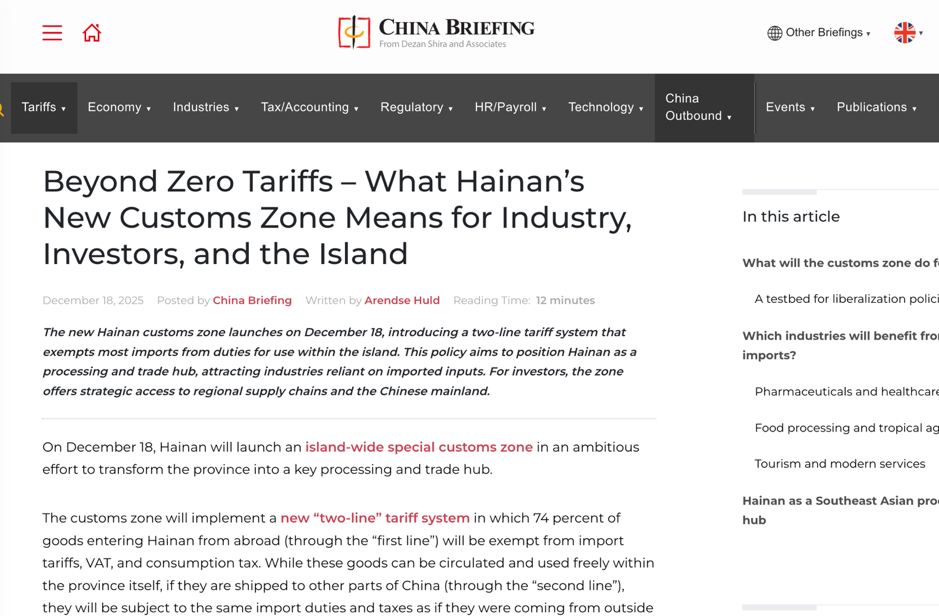
Headline: Beyond Zero Tariffs – What Hainan’s New Customs Zone Means for Industry, Investors, and the Island
Published on: 18 December 2025
CHINA BRIEFING
Headline: How Companies Can Leverage the 30% Added Value Rule in Hainan
Published on: 18 December 2025
Summary: China has established the island of Hainan as a new customs zone, introducing a “two-line” tariff system that excuses most imports from duties to transform the province into a key processing and trade hub.
Dr Linjia Zhang and Dr Haili Wu, both at XJTLU’s International Business School Suzhou (IBSS), provided comments. Dr Zhang said that the policy is about more than just lowering costs. He explained it is designed to reshape firms’ location choices and value-chain positioning within China’s dual circulation framework. Dr Wu noted that Hainan’s island geography and proximity to Hong Kong make it a powerful testbed, stating that policies proven successful there will likely be promoted to other free-trade zones across China.
CHANNEL NEWS ASIA (CNA)
Headline: Hainan now has a new customs regime. What does it signal for China’s trade openness?
Published on: 18 December 2025
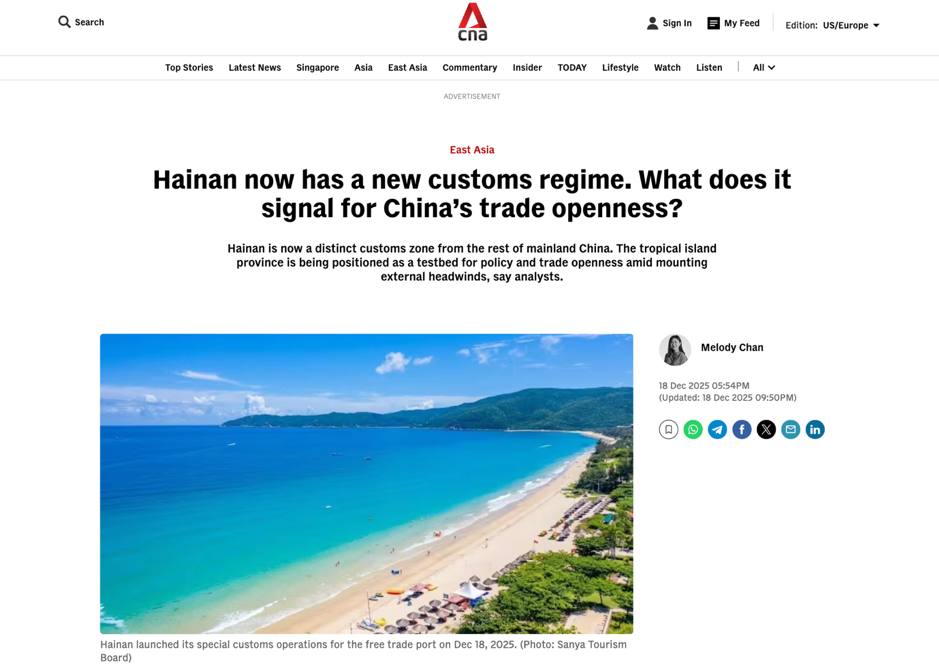
Summary: In with interview with CNA, Dr Haili Wu at XJTLU’s International Business School Suzhou (IBSS) said that the Hainan Free Trade Port is meant to serve as a low-risk testing ground for China’s transition to higher-level openness. She also pointed out that the new customs regime could provide businesses a strategic path to navigate international trade tensions.
REUTERS
Headline: China bets on AI to power its green transition
Published on: 22 December 2025
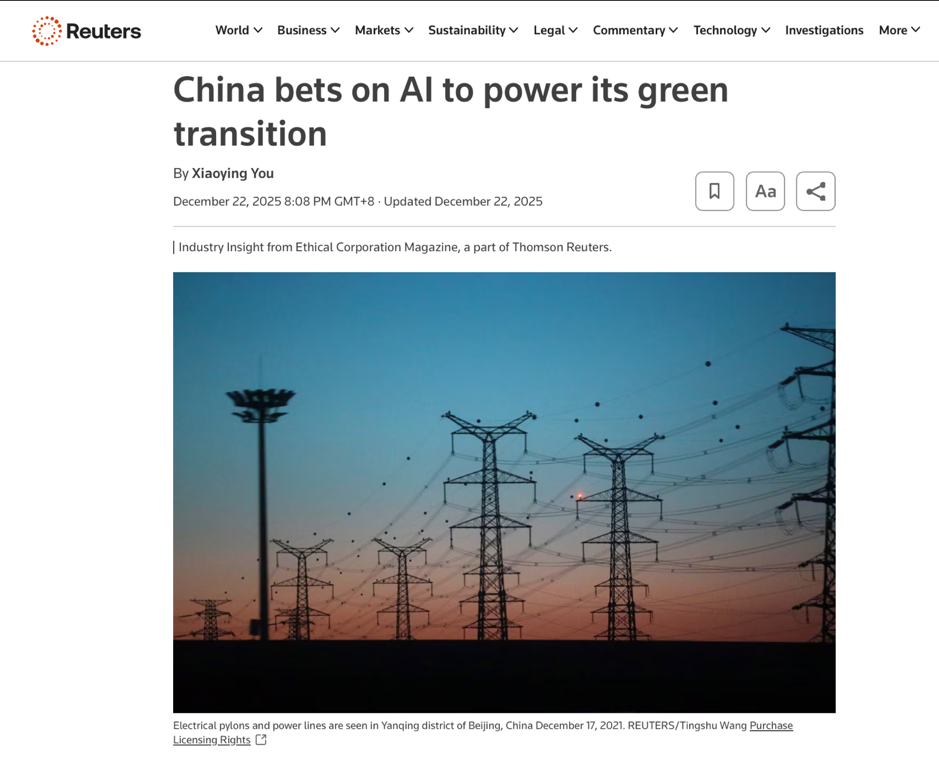
Summary: China is using artificial intelligence (AI) as a core strategy to modernise its energy grid and accelerate its green transition, even as the AI industry’s own massive power consumption presents a major new challenge.
Dr Lurui Fang, Assistant Professor at XJTLU’s School of Advanced Technology, explained the vital role AI plays in grid management. He said that by accurately forecasting renewable energy supply and electricity demand, AI allows grid operators to balance the system efficiently in advance.
CNBC
Headline: Mobilità del futuro: tra elettrico e guida autonoma (Mobility of the future: between electric and autonomous driving)
Published on: 23 December 2025
Summary: In a recent interview with CNBC, Dr Jiawei (Steven) Hai, Assistant Professor at XJTLU’s Entrepreneurship and Enterprise Hub, analysed the current market and geopolitical dynamics in the technology innovation sector, focusing on China’s role in shaping the direction of electric and autonomous vehicles.
CHANNEL NEWS ASIA
Headline: China wants more homegrown chips in its cars. The hard part isn’t geopolitics
Published on: 1 January 2026
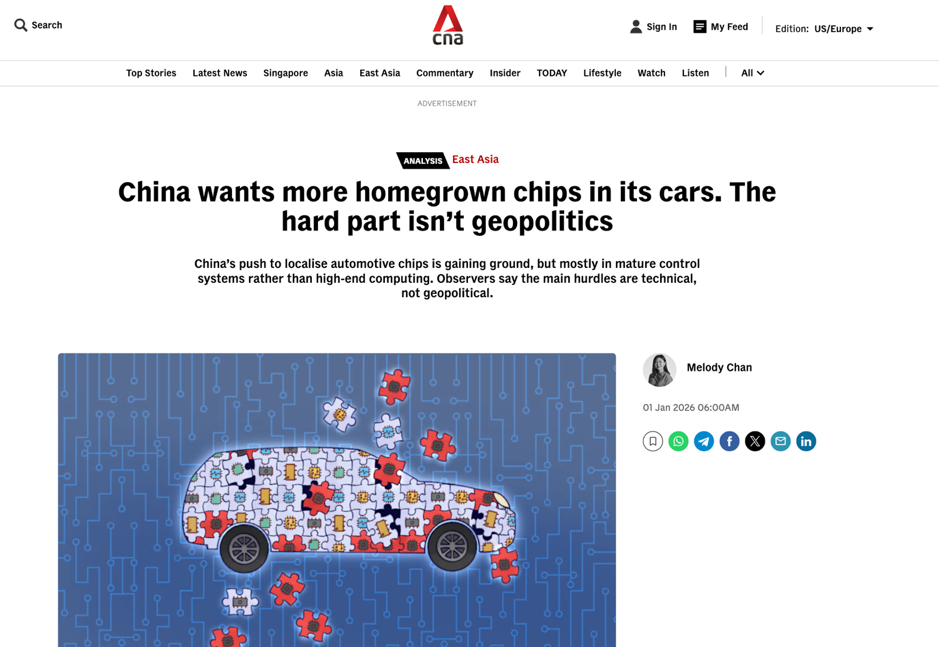
Summary: Chinese automakers are rapidly increasing their use of domestic semiconductor chips, driven by a desire for supply chain security and the advanced needs of the smart vehicles.
Dr Dongyao Jia at XJTLU’s School of Advanced Technology provided insight into this progress. He noted that localisation is advancing in certain chip types, with industry coordination progressing faster than many external observers expect, but he also said that achieving full localisation is a complex goal.
THE STRAITS TIMES
Headline: ‘Vape valley’: Double standards in China’s powering of world’s e-cigarette boom
Published on: 5 January 2026
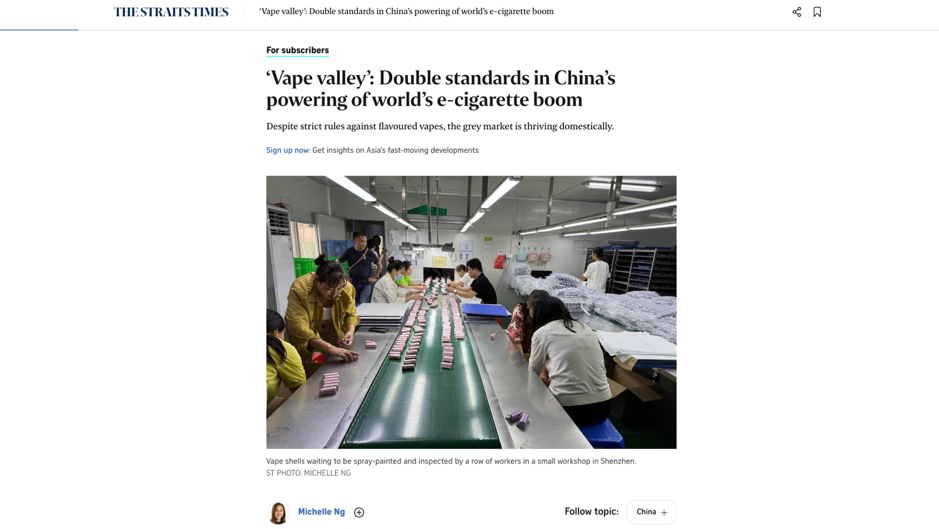
Summary: China produces an estimated 90% of global e-cigarettes, even as it enforces strict domestic bans on flavoured vapes to protect public health and its state tobacco monopoly.
Dr Rhonwyn Vaudrey at XJTLU’s International Business School Suzhou (IBSS) analysed the apparent double standard. She explained that from an economic perspective, manufacturing vapes for export is “profitable, practical, and fits a familiar pattern”. However, she pointed out that simply regulating sales is insufficient, adding that “more public health education and manufacturer monitoring will be needed as well” to address the complex issues surrounding tobacco and vaping in society.
THE WIRE CHINA
Headline: China’s Labor Market Braces for an AI Shock
Published on: 4 January 2026
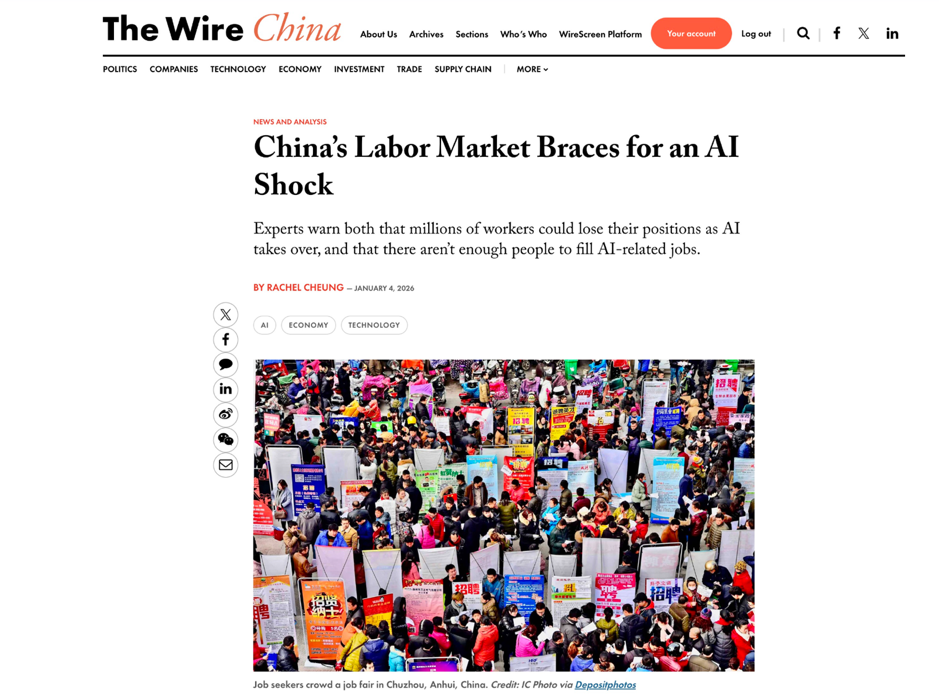
Summary: China’s labour market faces disruption as AI replaces jobs in customer service, driving, delivery, and manufacturing. A Tencent survey found 40% of Chinese workers fear being replaced by AI.
In an interview with The Wire China, Dr Weize Huang, Associate Professor at XJTLU’s Entrepreneurship and Enterprise Hub, said: “Historical experience from previous waves of technological innovation shows that when productivity rises, new tasks, jobs, occupations, and industries tend to emerge at the same time. [For example,] demand continues to grow for AI-related positions such as data analysts, algorithm maintenance engineers, and digital supply chain managers.”
CNET JAPAN
Headline: XJTLU、創立20周年を記念し、世界規模の「Light Up the World」祝賀イベントを開催 (XJTLU marks 20 years with global ‘Light Up the World’ celebration)
Published on: 5 January 2026
Summary: On 1 January 2026, XJTLU launched its 20th anniversary celebrations with a global campaign, “Light Up the World”. The initiative combines digital and real-world experiences, including an interactive online map where participants can light up their location and unlock landmark illuminations worldwide.
EARTH COM
Headline: What really happens to rice when soils get scorching hot
Published on: 8 January 2026
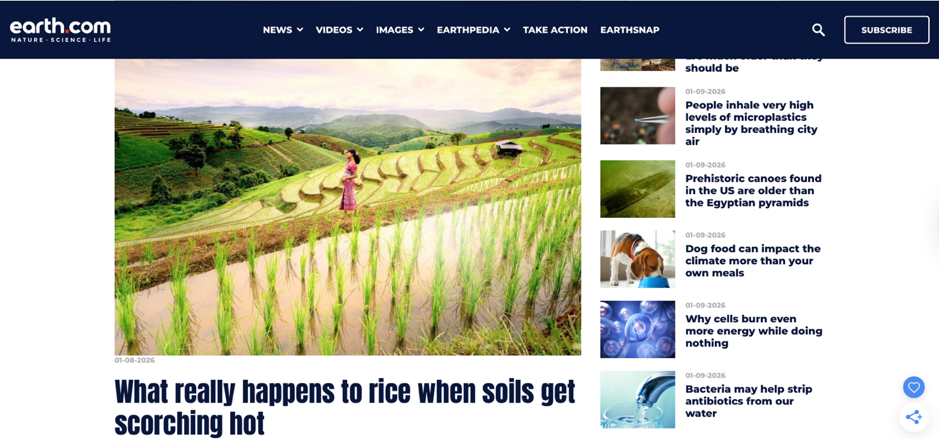
Summary: A new field study offers a reassuring finding: heating the soil alone, even during extreme heatwaves, does not automatically drive more arsenic or heavy metals into rice grains.
Professor Zheng Chen at XJTLU’s School of Science is the co-corresponding author. He said that while arsenic became more available in the soil water later in the season, the rice grains did not mirror that dramatic jump.
“This decouples soil mobilisation from grain contamination,” he said, highlighting that “flooded conditions buffered short term heat impacts, and rice physiology acted as a natural safeguard”. The findings suggest that plant biology and seasonal factors play a bigger protective role than previously assumed.
By Kayla Foniel Johan and Xinmin Han
Edited by Patricia Pieterse
28 Jan 2026