





04 Feb 2026


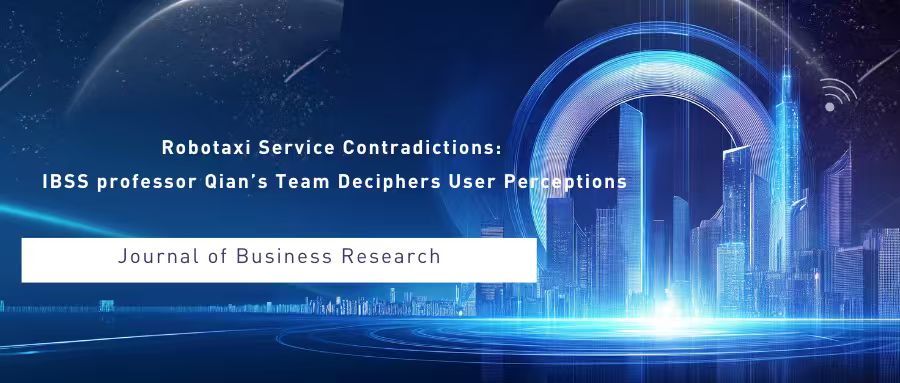
Recently, a research paper titled “When Service Process Contradicts Service Outcome: Spillover Effect of Users’ Perceptions in the Case of Robotaxi Service Encounters” by Professor Lixian Qian from the International Business School Suzhou (IBSS) at Xi’an Jiaotong-Liverpool University (XJTLU) and his co-authors, has been accepted for publication in Journal of Business Research (JBR). Focusing on the understudied contradictory scenarios in robotaxi services, the research delves into the complex dynamics and spillover mechanisms of user perceptions, providing both academically rigorous and practically actionable strategic guidance for the industry.
As automated driving (AD) technology reshapes the global mobility landscape and robotaxi services expand their commercial reach, new types of service challenges have emerged, breaking the traditional binary evaluation framework of "success or failure" in service management. Unlike conventional service experiences, robotaxis often involve "mixed scenarios": for instance, on-time pick-up (successful process) paired with delayed arrival (failed outcome), or an in-ride breakdown (failed process) resolved to ensure on-time destination arrival (successful outcome). These contradictory scenarios trigger cognitive dissonance among users, leading to unconventional patterns of blame attribution and positive perception transfer— a dynamic critical to safeguarding customer trust and the public reputation of AD technology.
Through systematic research, the study has identified three core findings with profound implications for the industry:
- Significant "success-failure" spillover risk: When a smooth service process culminates in a poor outcome, users’ blame extends beyond the service provider to AD technology itself, undermining public confidence in the entire technological field rather than just a single brand;
- Valuable "failure-success" opportunity: Effective service recovery—turning a problematic process (e.g., an in-ride breakdown) into a successful outcome—drives users to transfer positive perceptions of the specific robotaxi to the operational competence of the service firm, making adversity recovery a pivotal pathway for brand building;
- Proactive firm engagement as a double-edged sword: Initiatives such as remote technical assistance are not universally beneficial. Strategic intervention in a smooth process that still ends in failure can absorb user dissatisfaction and prevent blame spillover to AD technology. However, ill-timed intervention in an already failing process that concludes poorly amplifies users’ negative perceptions of AD technology.
Based on these insights, the research proposes three actionable recommendations:
- Implement transparent expectation management and real-time communication: Service providers should set realistic service commitments (e.g., accurate arrival time estimates) and deliver timely updates during disruptions to avoid the "success-failure" perceptual contradiction at its source;
- Prioritize service process smoothness on par with final outcomes: Invest in enhancing the reliability and punctuality of robotaxi fleets to fundamentally curb the spillover of negative perceptions to AD technology;
- Deploy proactive engagement strategies selectively: Abandon routine, automated interventions and allocate human support exclusively to critical, recoverable scenarios with a high likelihood of positive resolution. Importantly, frame such interventions as "exceptional value-added services" rather than routine fixes for technical faults.
This study breaks the binary analytical framework of traditional service management and for the first time systematically uncovers the spillover mechanism of user perceptions in the emerging autonomous mobility sector. It not only provides a scientific basis for robotaxi providers to design communication strategies and service recovery systems but also offers academic support for the sustainable development of the intelligent connected vehicle industry.
Professor Lixian Qian is a Professor in Marketing and Innovation at International Business School Suzhou (IBSS) of Xi'an Jiaotong-Liverpool University (XJTLU). He is currently serving as the Associate Dean for Research at IBSS and the Deputy Chair of University Research Committee. He was the founding director of Smart Mobility Analytics Center of IBSS. He joined XJTLU in 2012 after obtaining his PhD degree at Lancaster University, UK. He obtained his Bachelor and Master degrees from Fudan University, China. He also had rich industry working experience in Fortune Global 500 companies (Intel and Emerson Electric) prior to his PhD study.
Professor Qian’s research focuses on innovation/technology adoption and diffusion, data-driven marketing strategy, smart mobility, and sustainability. His research has been published widely on leading international journals, such as Production and Operations Management, Risk Analysis, Journal of Travel Research, Tourism Management, Journal of Business Ethics, Transportation Research Part A, Psychology & Marketing, Journal of Business Research, Technological Forecasting Social Change, among others. His research has been funded three times by the General Programme of National Natural Science Foundation of China (NSFC). Professor Qian teaches arange of modules on marketing and research methods at undergraduate, postgraduate and executive education levels. He is the Fellow of the Higher Education Academy (FHEA) in the UK and the council member of China Marketing Association of Universities (CMAU).
He serves as the Section Editor of Sustainable Futures (JCR Q1, CAS Q3, ABS-1), Editorial Board Member of Technological Forecasting & Social Change (JCR Q1, CAS Q1, ABS-3), and ad-hoc reviewer for over 20 SCI/SSCI academic journals and international conferences. He received the 2016/2017 Outstanding Teacher Award of XJTLU, the 2018/2019 IBSS Research Excellence Award, the Outstanding Advisor of the Sixth China National College Students Competition on Energy Economics in 2020, the 2022 Honored Staff of XJTLU, and the Best Paper of 2024 Academy of Management Annual Meeting(Technology & Innovation Divison), the Excellent Paper Award of 2024 Chinese Academy of Management Annual Conference, Finalist of Excellent Paper Award of 2025 Marketing Science & Innovation (MSI 2025) International Conference. He was selected into the Jiangsu 333 High-level Talent Programme in 2022.
Journal of Business Research publishes high-impact empirical and theoretical research that advances the understanding of business and management practices globally. It places particular emphasis on studies that bridge academic inquiry and real-world industry application, reinforcing its reputation as an
04 Feb 2026