







11 May 2026


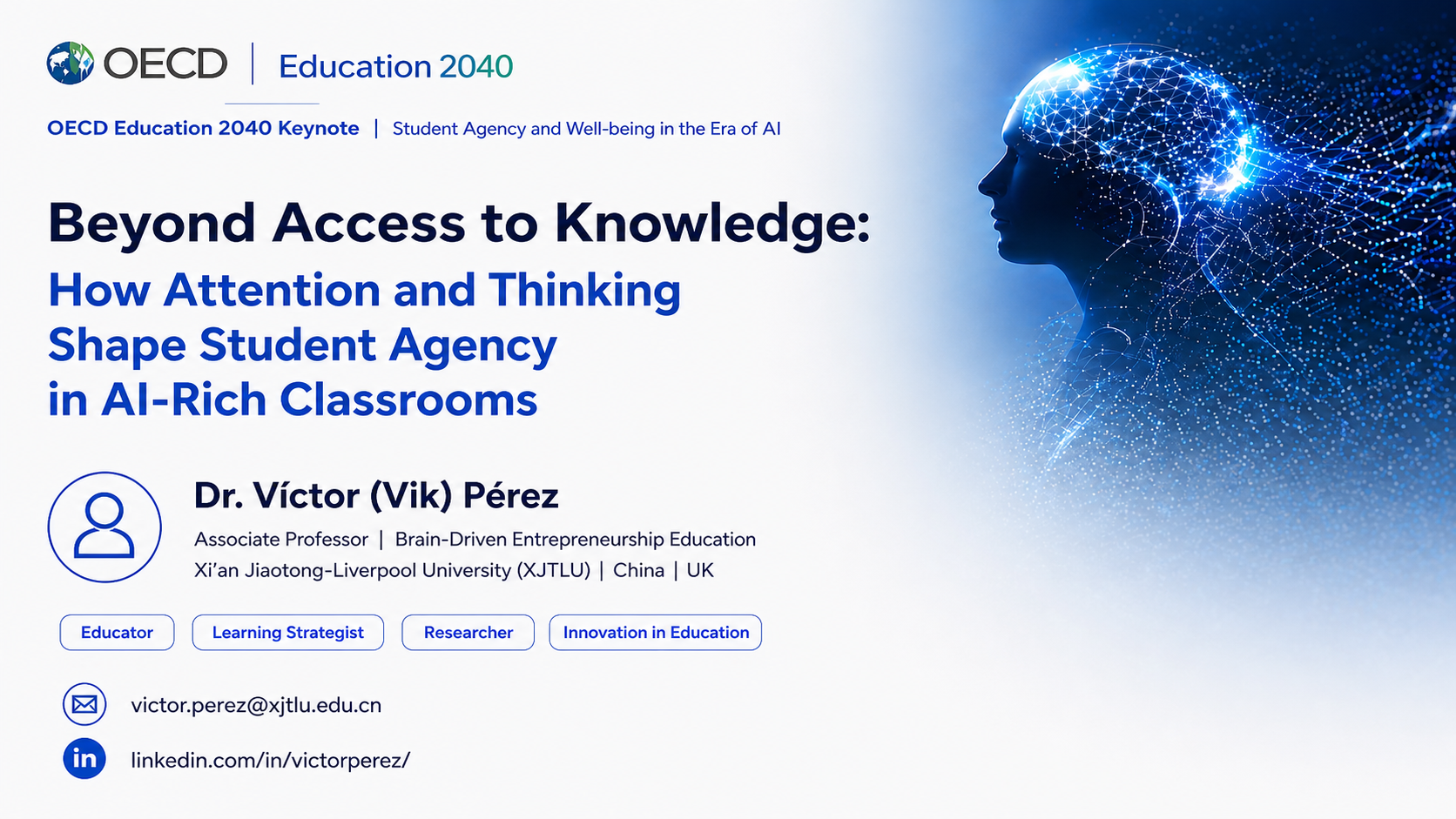
Exploring how attention, engagement, and cognitive readiness shape student agency in AI-rich classrooms
“The real question is no longer what students can access—but under what conditions they are able to think.”
Dr Victor (Vik) Perez, Associate Professor at Xi’an Jiaotong-Liverpool University (XJTLU), was recently invited as a keynote speaker at the OECD Education 2040 initiative, one of the world’s leading international platforms exploring the future of education, skills, and student agency.
The international workshop, titled “Student Agency and Well-being in the Era of AI” and held on 29 April 2026, brought together educators, school leaders, and international contributors to examine student agency and well-being in AI-rich classrooms. During the session, Dr Perez introduced a conceptual perspective centered on the cognitive conditions that shape attention, engagement, and meaningful thinking in contemporary learning environments.
Drawing on his keynote framework, Dr Perez argued that while artificial intelligence has radically expanded access to knowledge and learning tools, the deeper educational challenge now lies in understanding the conditions under which students are able to sustain attention, remain cognitively engaged, and stay with the thinking process itself .
“What often appears as a motivation issue is, in fact, a readiness issue—when and how attention, effort, and thinking are engaged.”
The keynote also introduced a series of practical, research-informed micro-interventions designed around three key moments of learning: before, during, and after a task. These included preparing students for sustained cognitive effort, protecting uninterrupted moments for thinking, and helping learners reflect on their own attention and engagement processes.
Through these deliberate shifts, Dr Perez highlighted how educators can begin to design the conditions that make deeper thinking possible.
The contribution builds on Dr Perez’s broader work in brain-driven entrepreneurship education, including the WNYLE Method™, and his work exploring the role of cognitive conditions in human performance, learning, and agency. His participation at the OECD reflects the growing international relevance of conversations surrounding cognition, attention, and student agency in increasingly AI-mediated educational environments.
“Agency does not emerge by default. It is enabled by how we design the conditions under which thinking becomes possible.”
Following the session, discussions continued around the implications of cognitive conditions for future educational design, particularly in relation to attention, engagement, and the growing presence of AI technologies in classrooms.
The contribution also reflects XJTLU’s continued engagement with international conversations exploring the future of education, cognition, and human-centered learning in rapidly evolving technological contexts.
By Victor (Vik) Pérez
Edited by Xiaolu Jiang
11 May 2026