




From chromosomes to construction: Professor Jionglong Su on interdisciplinarity

05 May 2026


A robotic dog patrols a construction site, carefully counting every single steel bar. This isn’t some scene from a virtual world – it’s an ongoing project by Professor Jionglong Su from the School of AI and Advanced Computing at XJTLU Entrepreneur College (Taicang).
It was one of Professor Su’s former students, who now works at China Railway, who first drew him into the field of intelligent construction site management. For this initiative, the robotic dog replaces manual patrol inspections, while computer vision technology counts the steel bars.
“I’ve never worked in civil engineering and architecture,” Professor Su says. “But that’s what interdisciplinarity is all about – you have to keep stepping into new territory.”
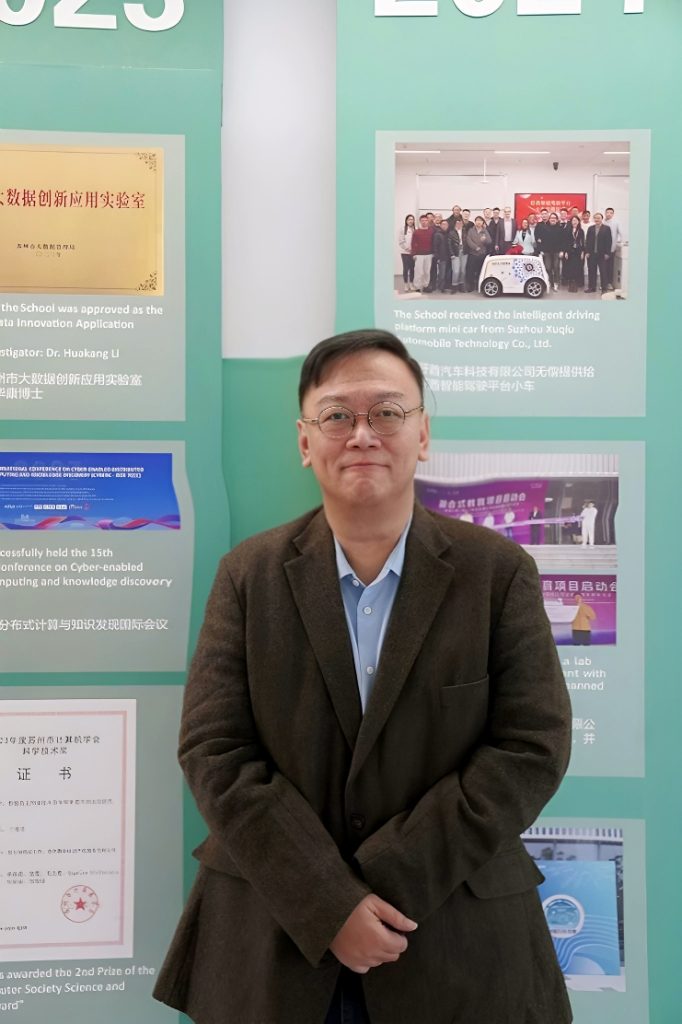
Professor Su joined Xi’an Jiaotong-Liverpool University (XJTLU) in 2014, having previously taught at the University of Warwick and University College London in the UK. He holds dual master’s degrees in Information Engineering and Mathematics, as well as two doctoral degrees: one in Statistics and another in Automatic Control and Systems Engineering. This cross-disciplinary background laid a solid foundation for his journey in research and teaching.
A blurry chromosome photo
In 2018, Professor Su undertook a medical project in collaboration with Suzhou Sano Precision Medicine Ltd. (SANO), focusing on chromosome image recognition.

Once a chromosome photo is taken, the computer can automatically identify the chromosome number and check for abnormalities. However, images aren’t always clear.
“Chromosomes are suspended in liquid, so when you image them, they can overlap, leaving the parts underneath completely obscured and out of view,” Professor Su explains.
“In statistics, we call this ‘missing data’,” he says. “In clinical terms, it’s just an unreadable image. You can’t solve this with AI algorithms alone, and you can’t solve it with medical expertise alone either.”
Professor Su and his partner company then brought together experts from different disciplines.
Statisticians were tasked with inferring what the unseen parts might be, AI specialists with “straightening” curved chromosomes to enable easier alignment, and medical professionals with checking whether the final results were clinically reasonable.
The final output was an algorithm that achieved higher accuracy than the original method.
The chromosomes remained the same, but the solution changed because different experts redefined the problem from different perspectives.
“That’s when it dawned on me that interdisciplinarity isn’t just bringing people from various disciplines together – it’s about redefining the problem from multiple angles,” Professor Su says.
Empowering students to cross boundaries
After the success of this project, Professor Su began to ponder: Can my students cross boundaries too?
He designed the General Technology Fundamentals course for Year Two undergraduates. His vision was to equip students with AI-oriented technical foundations, while also helping them build an understanding of market analysis and industry trends. Through this course, what was once an abstract interdisciplinary competency was reframed as concrete, “teachable, assessable, and iterable” course content.
One of Professor Su’s former PhD students, Dr Sifan Song, earned his bachelor’s degree in Biological Sciences at XJTLU, before going on to complete dual master’s degrees in Bioinformatics and Artificial Intelligence in the UK. He then returned to XJTLU to pursue his PhD in Computer Science and Software Engineering. Following his PhD, he conducted postdoctoral research at Harvard Medical School, and now serves as an Assistant Professor at XJTLU.
Professor Su and Dr Song went on to collaborate on an interdisciplinary project: AI-assisted fovea localisation to aid in the analysis of retinal diseases. The paper they developed from this work was shortlisted for the Best Paper Award at the International Symposium on Biomedical Imaging (ISBI).
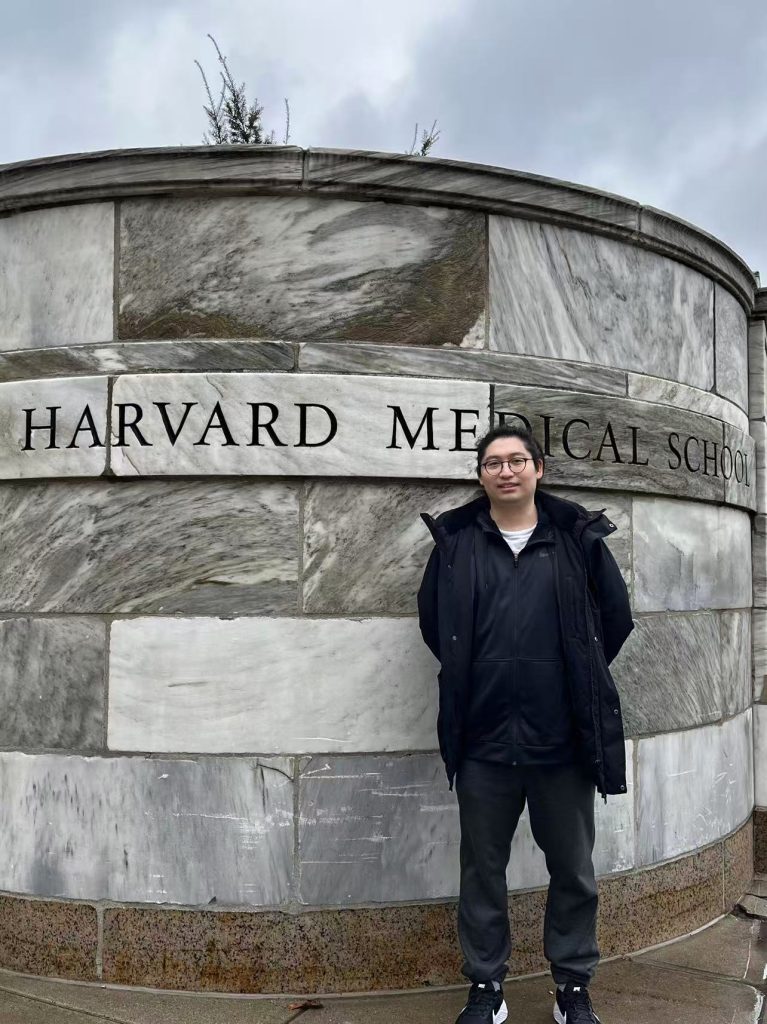
Dr Sifan Song at Harvard Medical School
Twelve years: from an implementer to a designer
Before joining XJTLU Entrepreneur College (Taicang), Professor Su served as Associate Head of the Department of Mathematics at XJTLU and as Programme Director for the Financial Mathematics programme.
In 2018, when preparations for the College first began, he chose to join the team that would be building it from scratch.
“The College’s focus on interdisciplinarity, project-based learning and industry linkage aligns perfectly with my philosophy of empowering students to solve real-world problems,” Professor Su notes.
“Back in the XJTLU 1.0 phase, I was mostly an implementer. The 2.0 model is a brand new exploration, and now I’m the designer – figuring out exactly what it should look like.”
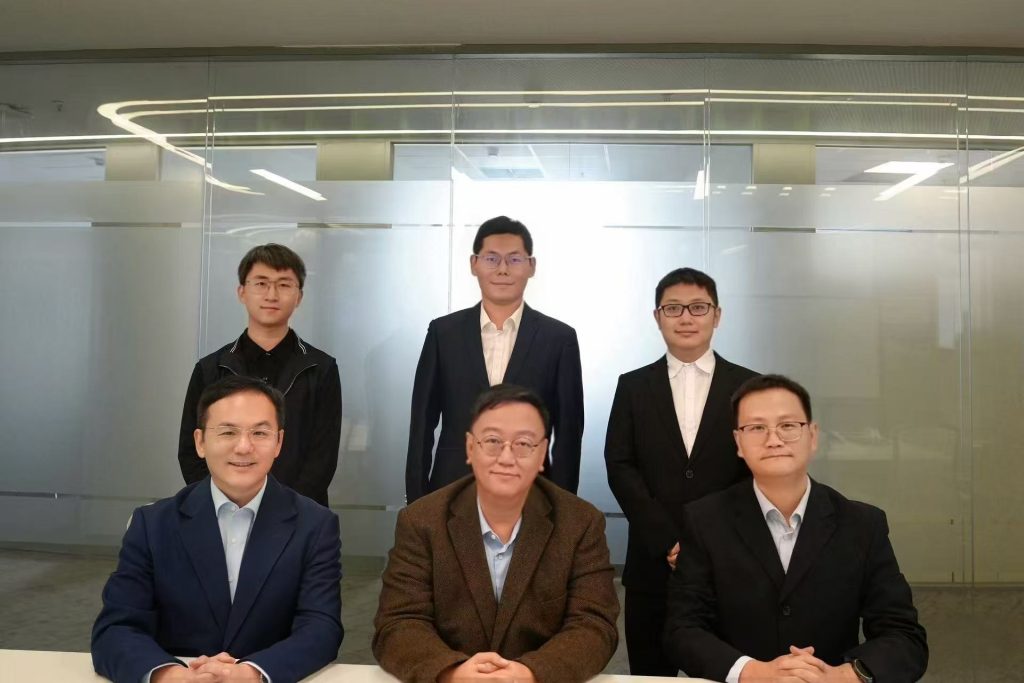
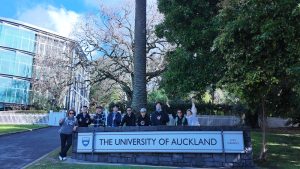
Professor Jionglong Su (middle of front row) with his colleagues
This year, Professor Su developed a new course, INF101TC, primarily targeted at Year Two students. Over a full academic year, students work on an authentic industry project, and the course’s standout feature is how it breaks down the complex, real-world problems brought by partner enterprises.
“My role has changed, because XJTLU is evolving too,” Professor Su says. “The most important shift XJTLU has undergone over the years is growing far more multifaceted and eclectic.”
For students, this translates to a wealth of options: they can pursue entrepreneurship, compete in academic competitions, take internships, or dive into research – free to explore different paths and test out different possibilities.
Unhurried and unceasing pace
Towards the end of the interview, Professor Su glanced at his phone.
His counterparts at China Railway were waiting on an update; the industry-university-research collaboration project they’d been discussing was still in its very early stages.
Professor Su was in no hurry, much like the robotic dog still being fine-tuned on the construction site – some paths have to be taken one step at a time.
Over 12 years at XJTLU, his journey has spanned from financial mathematics to artificial intelligence, from the SIP campus to the Taicang campus, and from academic papers to construction sites. None of these shifts happened overnight.
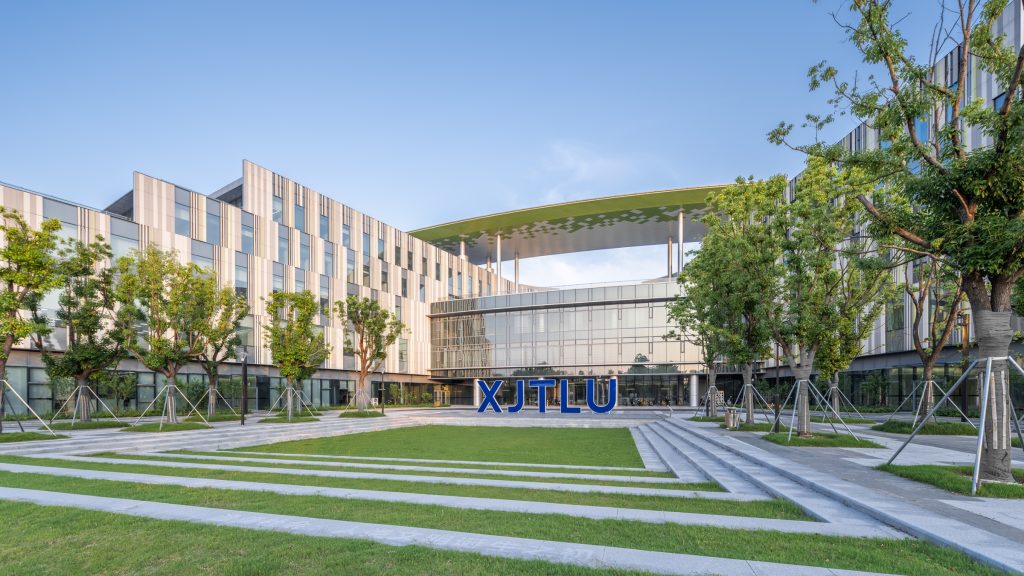
“Interdisciplinarity isn’t just a patchwork of different fields,” Professor Su says. “You have to align goals and interfaces from day one, build a minimum verifiable closed loop, and iterate fast.”
This is his methodology, and his steady pace.
By Jiayan Ji
Edited by Patricia Pieterse
Translated by Xueqi Wang
Photos courtesy of Jionglong Su
05 May 2026