




06 May 2026


As artificial intelligence continues to reshape both education and the workplace, how to plan effectively for further study and career development has become an increasingly important consideration for XJTLU students.
To help students navigate opportunities in the AI era and make informed decisions about their academic and professional development, the Student Development and Support (SDS) team at International Business School Suzhou (IBSS) recently hosted a panel session titled “Smart Strategies for Further Study in the AI Era.”
Rather than only focusing on application tips, the event encouraged students to think more broadly about how they build skills, experience and confidence in a fast-changing world shaped by AI. The session brought together four outstanding student and alumni guests, who shared honest reflections and practical insights on postgraduate applications and career preparation.
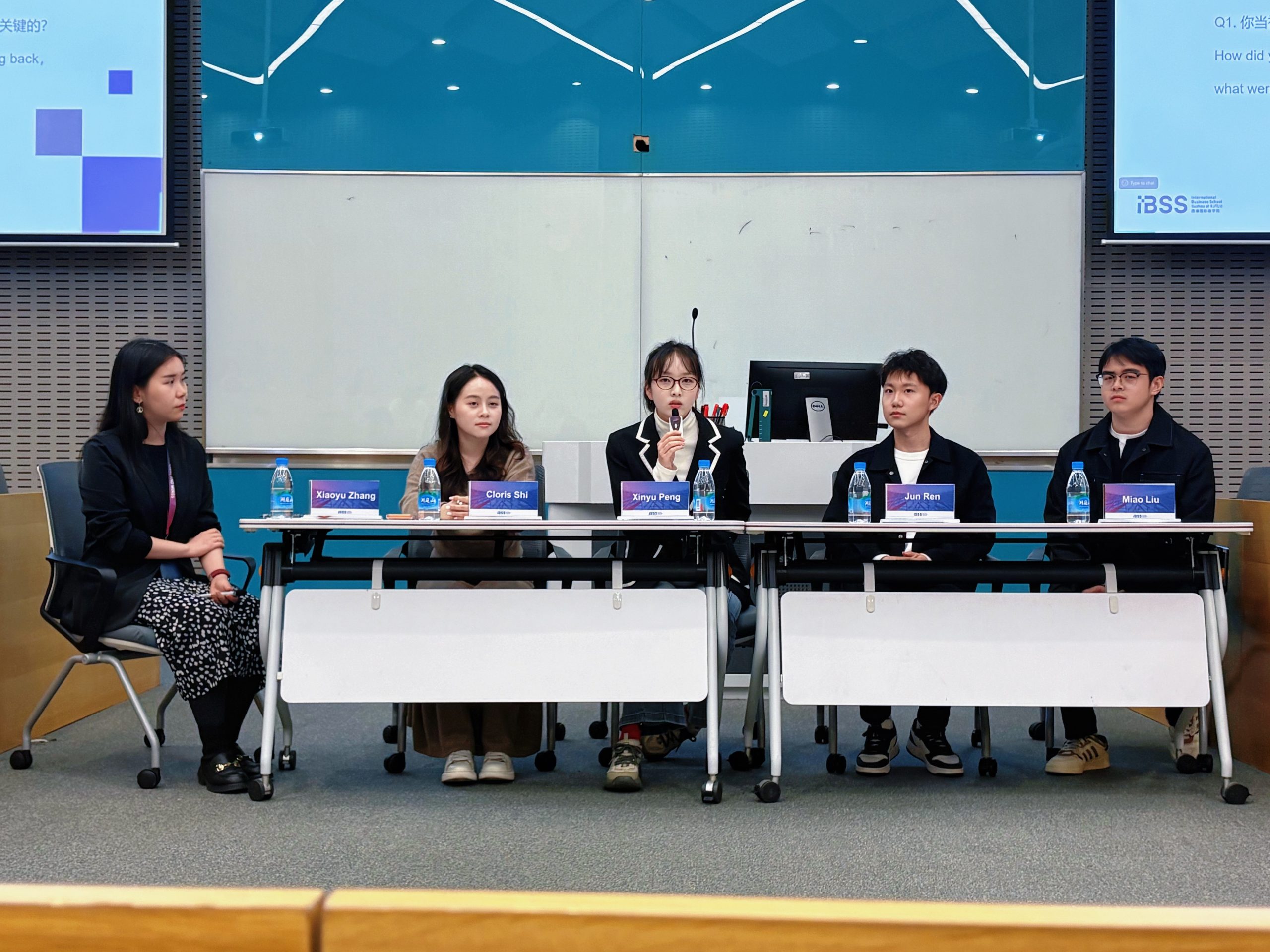
The discussion was moderated by Xiaoyu Zhang from the SDS team. The panel included Jingying Shi, an XJTLU graduate currently pursuing postgraduate study at Duke University, in the US, with internship experience at NIO and Siemens; Jun Ren, a final-year BSc Economics student who has completed three research projects and received several postgraduate offers, including a $30,000 USD scholarship for programmes in Business Analytics and Artificial Intelligence; Miao Liu, a final-year BSc Economics and Finance student with internship experience in investment banking and private equity who has also explored pathways in AI and entrepreneurship; and Xinyu Peng, a final-year BA Digital and Intelligent Marketing student with a background in digital marketing, branding and consulting. Drawing on their own application journeys and practical experiences, the speakers shared reflections on university and programme selection, profile building and application planning.
At the beginning of the session, Xiaoyu Zhang highlighted several key competencies that students should prioritise in the AI era, including informed decision-making, evaluate information critically, self-motivation, and the ability to work confidently with AI tools. She encouraged students to adopt a “end game in mind” approach when planning their academic and professional journeys.
Speakers emphasised that opportunities are rarely built through a single experience. Instead, coursework, internships, research projects, competitions and extracurricular activities all contribute to building one’s personal foundation and shapes future opportunities.
During the panel discussion, speakers reflected on a range of key questions related in further study planning. In terms of choosing universities and programmes, they emphasised the importance of aligning decisions with long-term career goals while considering factors such as institutional resources, location, and programme focus, rather than simply following trends. Jingying Shi noted that a deeper understanding of a university’s history and culture not only helps determine whether a programme is a good fit, but also enables applicants to present more thoughtful and distinctive perspectives during applications and interviews.
When discussing internships and research opportunities, speakers encouraged students to make full use of both University and external resources while actively building meaningful connections. Xinyu Peng shared that she began exploring internship opportunities early and developed a habit of seeking feedback and reflecting on her experiences throughout the process. She observed that sincere and proactive communication often opens doors to further opportunities. Miao Liu highlighted the importance of demonstrating initiative and practical problem-solving abilities in competitive application processes. He explained that presenting his own research projects to potential employers helped him secure an internship at a leading securities firm.
The role of AI in postgraduate applications was also discussed in a balanced and practical way. Speakers shared how AI tools can support tasks such as researching universities and programmes, comparing offers, refining application materials, and improving efficiency in academic work. At the same time, the panel also addressed concerns about becoming overly reliant on AI tools. As Jun Ren noted, while AI can enhance efficiency, it cannot replace individual curiosity and perspective, remarking that “what makes us unique cannot be replaced.”
The session concluded with an open discussion, during which students actively engaged with the speakers and raised questions about further study and career planning. Participants received tailored advice on topics ranging from programme choice and application preparation to interdisciplinary pathways and long-term career development. Alongside practical guidance, the discussion also reassured students whilst helping them gain greater clarity in shaping their own next steps.
Against the backdrop of rapid developments in AI, students today face both expanded opportunities and increased uncertainty when making decisions about further study and careers. In this way, the SDS team will continue organising similar initiatives to support students as they navigate their academic and professional journeys with confidence in the AI era.
By Kaizhang Li
Edited by Xiaoyu Zhang & Thomas Durham
Photography: Xiaoxi Du
Reviewed by Yifei Wu
06 May 2026