




A pillar inside the wall: How Dr Hui Liu helped build XEC from the ground up

29 Jun 2026


When Dr Hui Liu first joined Xi’an Jiaotong-Liverpool University (XJTLU) in 2009, students and staff still shared a solitary building. Years later, she would play a pivotal role in one of the University’s most ambitious expansion projects: XJTLU Entrepreneur College (Taicang) (XEC).

Dr Hui Liu
After initially joining as the Personal Assistant to Professor Minzhu Yang, then Vice President of XJTLU, Dr Liu went on to be part of the launch team for the International Business School Suzhou (IBSS), serving as School Manager from 2013 until her departure three years later to become Director of China Operations at the University of Leicester, UK.
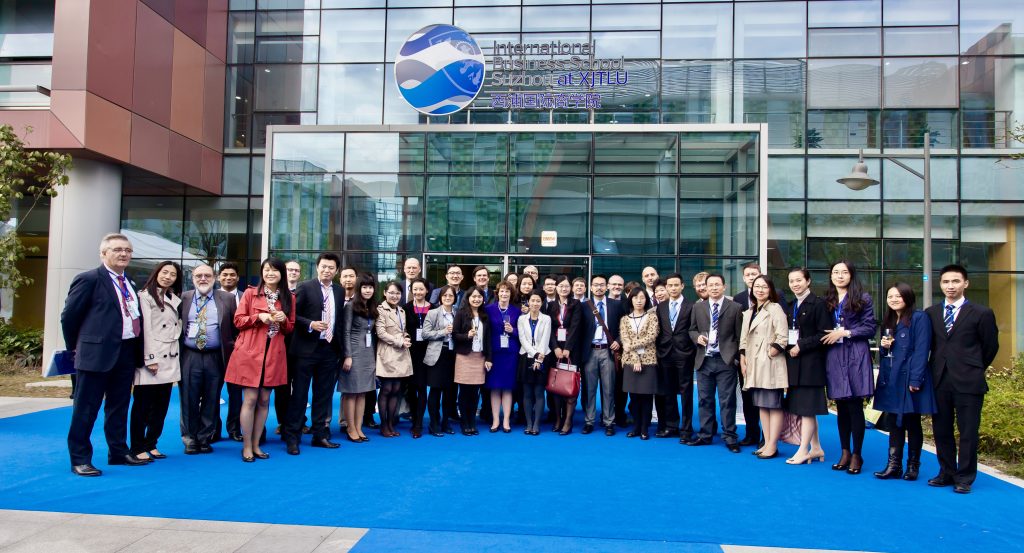
IBSS staff on the launch day
However, she felt a strong urge to return in early 2018 when XJTLU and the Taicang government signed a framework agreement for educational cooperation, paving the way for Syntegrative Education to take root. The educational philosophy had already begun to take shape during her time at XJTLU, but now there was an opportunity to put it into practice.
In June that year, Dr Liu became Chief Operating Officer of XEC, taking on a unique startup challenge.
‘XJTLU speed’
Following the framework agreement, work on XEC’s educational philosophy, academic development, and campus construction moved forward almost in parallel.
XJTLU Entrepreneur College (Taicang) was positioned to cultivate industry elites who could build on modern technologies such as robotics and artificial intelligence to pioneer new industries. To many, this was a novel idea – and it was Dr Liu’s task to make it a reality, and fast.
“At that stage, we did everything, and everything had to be done,” she says. “Efficiency came first.”
However, having witnessed IBSS receive accreditation from the Association to Advance Collegiate Schools of Business (AACSB) – an honour held by fewer than 5% of the world’s business schools – in just three years, Dr Liu was already familiar with the “XJTLU speed”.
With applications for XEC’s new programmes opened in 2018, Dr Liu was invited onto an informal, cross-departmental project team led by Professor David Goodman, then Vice President for Academic Affairs, and Professor Stuart Perrin, then Dean for International Affairs, to develop a curriculum framework.
“My understanding of talent development under Syntegrative Education is that, beyond disciplinary knowledge, students also need industry knowledge, general education, cross-cultural leadership, and an innovative and entrepreneurial mindset,” she says.
Based on this, the University’s academic development team designed a new curriculum structure: 75% of credits would come from the major, while 25% would come from entrepreneurship education. This would be complemented by no fewer than 600 hours of industry training, later becoming the Professional Development Programme (PDP).
In July 2019, XEC’s first six undergraduate programmes received approval from both China’s Ministry of Education and the University of Liverpool.
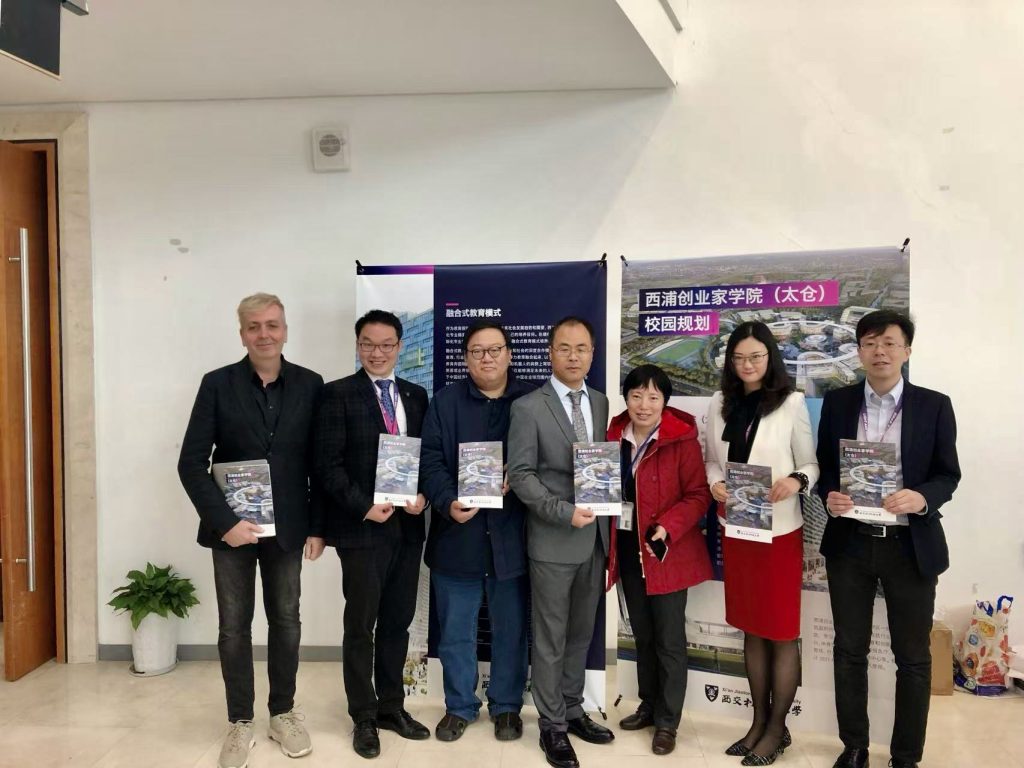
Dr Liu (second from right) with the programme directors of the first six approved undergraduate programmes
After that, XEC launched a global search for deans, began recruiting students, and unveiled its first six industry-themed schools, while campus construction entered a substantive phase.
The shape of the future
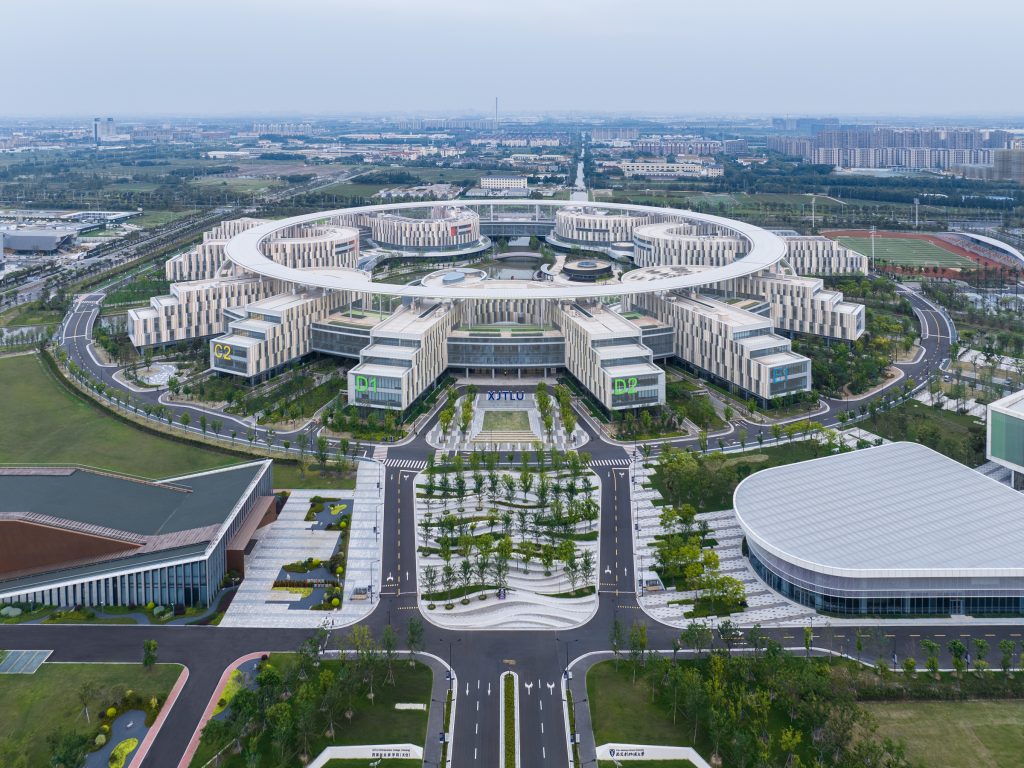
Six leading architectural firms bid for the campus master plan, with the joint proposal from Germany’s HPP Architekten and Tongji University ultimately standing out. Drawing on the ideas of philosopher Gilles Deleuze, the design featured a large circular ring linking seven U-shaped buildings.
This proposal faced a practical challenge, however. The Taicang government had planned to build a conventional campus in phases, with the first phase to be delivered within 18 months. The ring design could not be built that way, with construction set to last more than two years, making funding and implementation more complex.
Dr Liu recalls Professor Youmin Xi, Executive President of XJTLU, saying at the time, “Are we choosing a campus that will still amaze people 100 years from now, or a standardised campus that can be delivered in 18 months? This choice will determine our impact for decades to come.”
Professor Xi explains that one of the founding intentions of XEC was to be a model for the university of the future, and its physical form needed to embody the philosophy of Syntegrative Education.
After multiple discussions, the University and the local authority finally agreed on the ring design, and the new campus was officially opened in September 2022. Today it stands as a city landmark, and has received the World Architecture News (WAN) Future Projects (Education) Bronze Award and LEED Gold certification.
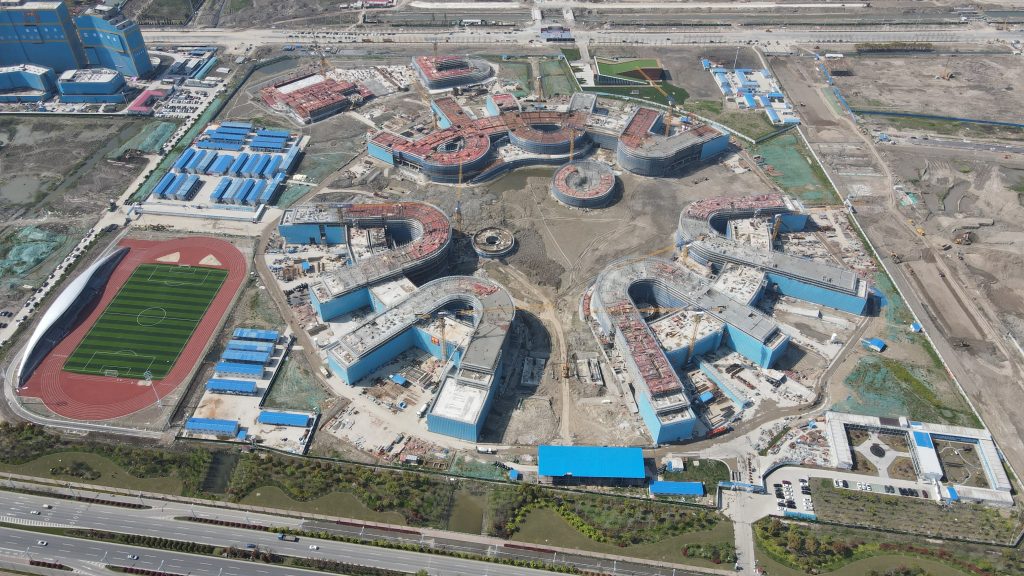
The Taicang campus during construction
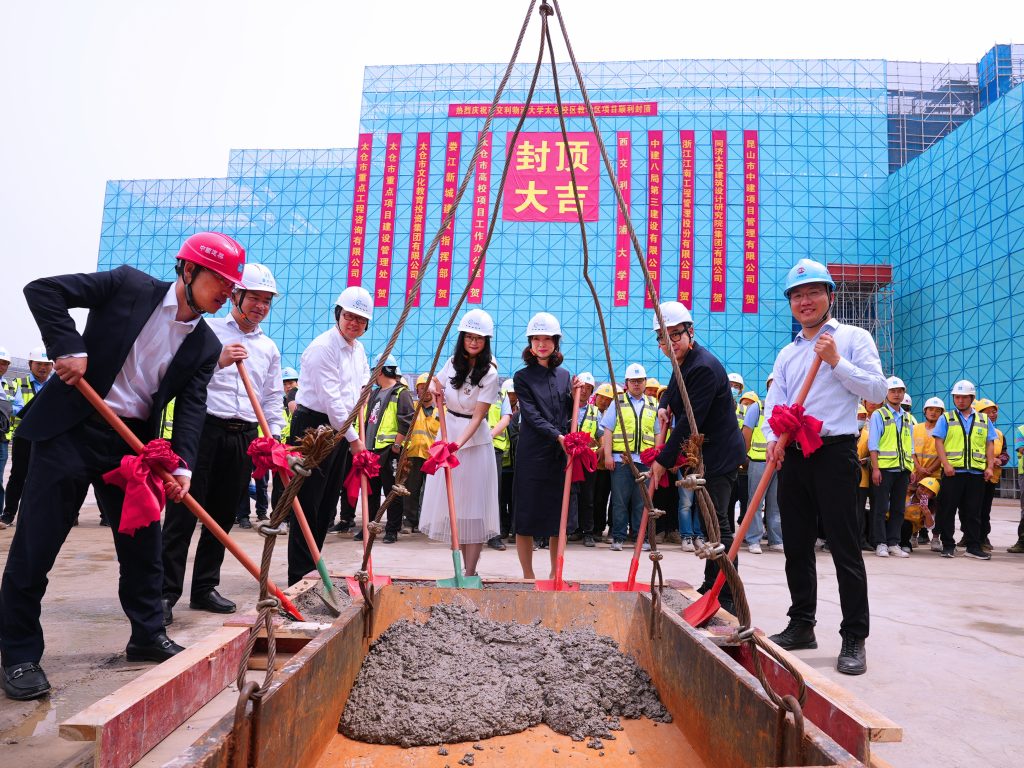
Dr Hui Liu (fourth from left) at the topping-out ceremony for XJTLU Entrepreneur College (Taicang)
Invisible support
Alongside campus construction, institutions and service systems were also being developed. Although the Taicang campus and the main campus at Suzhou Industrial Park (SIP) are more than 60 km apart, they needed to remain strategically aligned while giving staff, students, and industry partners moving between them a sense of an integrated XJTLU.
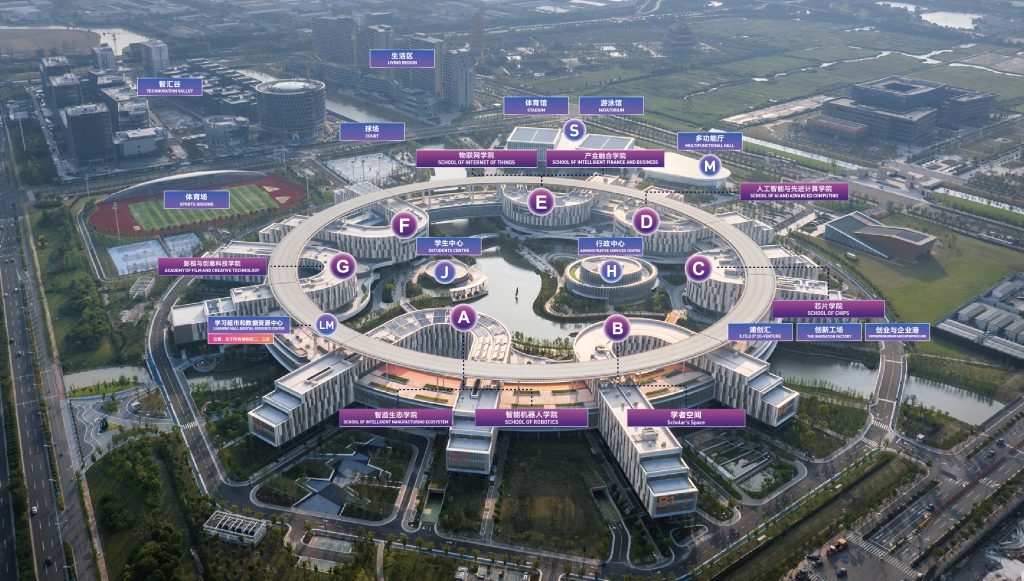
XJTLU Entrepreneur College (Taicang)
To achieve this, Dr Liu led a systematic review covering the University’s major functional units to determine which services could be centralised at the SIP campus or moved online, and which had to be deployed locally in Taicang.
Each office helped clarify the boundaries of responsibility. For example, student affairs required in-person support, so the Centre for Student Affairs built a local Taicang team offering development advisers, one-stop services, student club support, and career support, while the Registry Office adopted a “two-campus connection” model, placing a manager on-site in Taicang.
These discussions ultimately formed a virtual Syntegrative Services Platform, an operating mechanism integrating SIP-based affairs with local Taicang services, while also connecting with the needs of the local government and industry partners. “It’s invisible, but it can truly carry the weight,” Dr Liu says.
At the same time, she devoted considerable energy to establishing regular working mechanisms with the Taicang authorities and the campus asset owner, Taicang Cultural and Educational Investment Group, laying the groundwork for future collaboration.
Before the deans of the industry-focused schools had arrived, Dr Liu began drafting institutional documents, including the Industry-themed School Charter and the Taicang Campus Operations Guide. These documents clarified the responsibilities and boundaries of key roles including deans, directors of the Education, Research, and Development Institutes, and joint-venture companies.
Learning on the front lines
Shortly after graduating its first cohort of 229 students in the summer of 2023, XEC released a three-year development plan, setting out the direction for the implementation of Syntegrative Education.
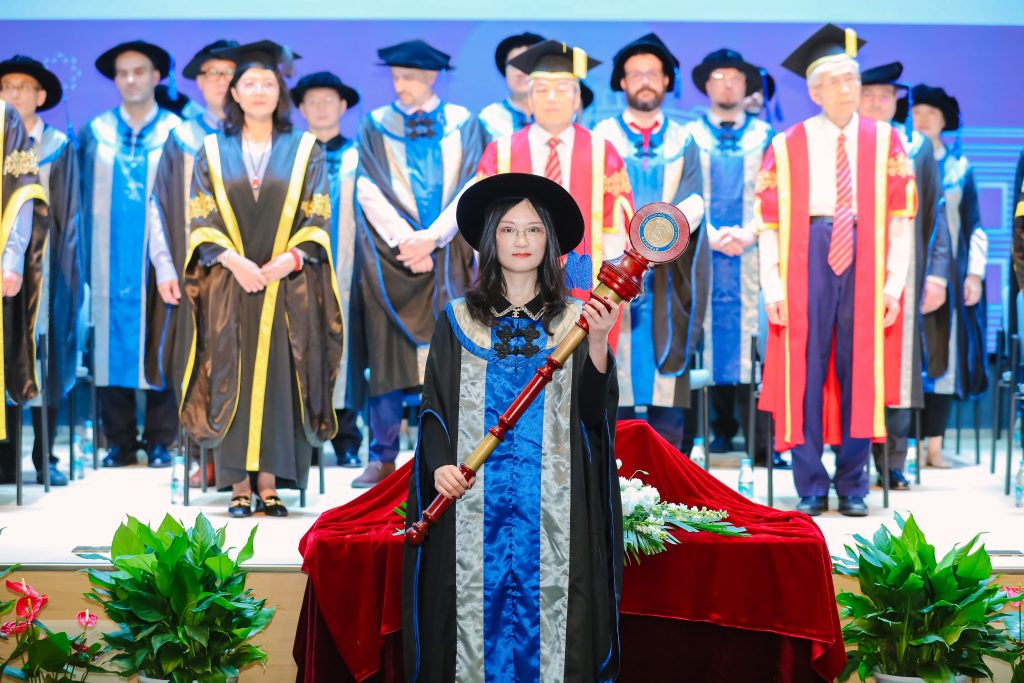
Dr Liu serves as mace bearer at the College’s first graduation ceremony
This saw Dr Liu’s focus shift to supporting the creation of campus-level innovation and entrepreneurship platforms such as Innovation Factory, X3 Co-Venture, and the industry executive education team; seeking solutions to the “negative list” of concerns raised by staff and students; improving the learning and living experience as well as campus culture; and promoting organisational and institutional alignment between the Taicang and SIP campuses.
After more than three years, daily operations at XEC have become increasingly stable. For Dr Liu, her main responsibilities have been building mechanisms, clarifying processes, and coordinating across units and campuses to ensure that each initiative can be implemented.
Her work has also been intertwined with her academic pursuits. In December 2024, she received her Doctor of Education from the University of Liverpool, having used XJTLU as a case study and organisational readiness for change as her research focus, examining management practice through an academic lens.
Growing together
Dr Liu sees her 15 years at XJTLU as a continuous state of “being present”: taking part in different things at different stages, witnessing ideas move from paper into the real world, and constantly revising her understanding of education and organisations.
XJTLU is always doing things that have not been done before, building a distinctive space amid uncertainty. Dr Liu says she prefers to be a pillar inside the wall: unseen, but strong enough to carry the weight.
“Growing together with XJTLU is not a slogan – it’s the reality of the past decade and more,” she says, adding that she feels fortunate to have remained “present” throughout this irreplaceable experience.
By Jiayan Ji
Edited by staff editor and Xinmin Han
Photos courtesy of Dr Hui Liu
29 Jun 2026