







18 Jun 2026


Recently, Professor Jintai Ding, Dean of the School of Mathematics and Physics at Xi’an Jiaotong-Liverpool University and Director of the Post-Quantum Migration Interdisciplinary Laboratory, delivered a special presentation entitled PQC Migration in China’s Bank Industries at the 2026 ETSI/IQC Quantum Safe Cryptography Conference. He joined experts from academia and industry to discuss cybersecurity challenges in the era of quantum computing.
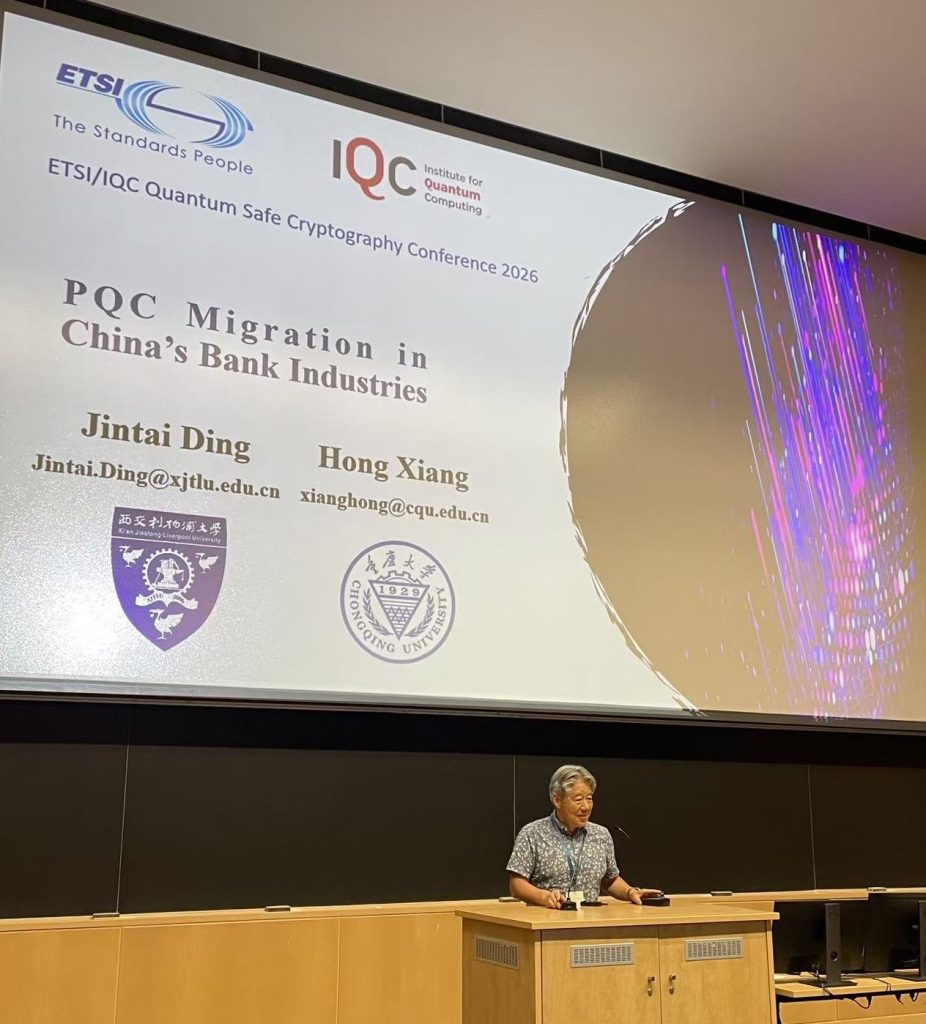
As quantum computing technology continues to advance, some cryptographic systems currently widely deployed in internet communications, digital identity authentication, and financial transactions may face new security threats. How to complete the upgrade before such risks actually materialize has become a major concern for the global cybersecurity community. It is against this backdrop that post-quantum cryptography (PQC) migration has been proposed, aiming to help existing information systems transition gradually to a new generation of cryptographic technologies capable of withstanding attacks from quantum computers.
From Algorithm Upgrades to System Migration
In his presentation, Professor Ding pointed out that post-quantum cryptography migration is not a simple algorithm replacement, but rather a systems engineering task that involves technical architecture, systems management , and implementation pathways. For large organizations, cryptographic technologies are often deeply embedded in networks, software, and business systems. How to carry out the upgrade while ensuring the stable operation of existing services is a challenge that has drawn widespread attention internationally.
Addressing this issue, Professor Ding presented his team’s recent research on post-quantum cryptography migration, including cryptographic asset identification, design of a migration framework, system assessment, and studies of implementation pathways. He noted that the key to migration lies not only in developing new cryptographic algorithms, but also in helping organizations understand “where upgrades are needed, how to upgrade, and how to mitigate migration risks.”
The presentation also shared practical experience gained through the team’s participation in projects under the National Key R&D Program of China. These projects, carried out jointly by multiple financial institutions and research organizations, focus on the technical and managerial challenges encountered when critical infrastructure migrates to post-quantum cryptographic systems. As a partner institution, XJTLU’s PQC-X continues to research migration methodologies, risk assessment, and verification mechanisms, providing technical support to the relevant sectors.
About the ETSI/IQC Quantum Safe Cryptography Conference
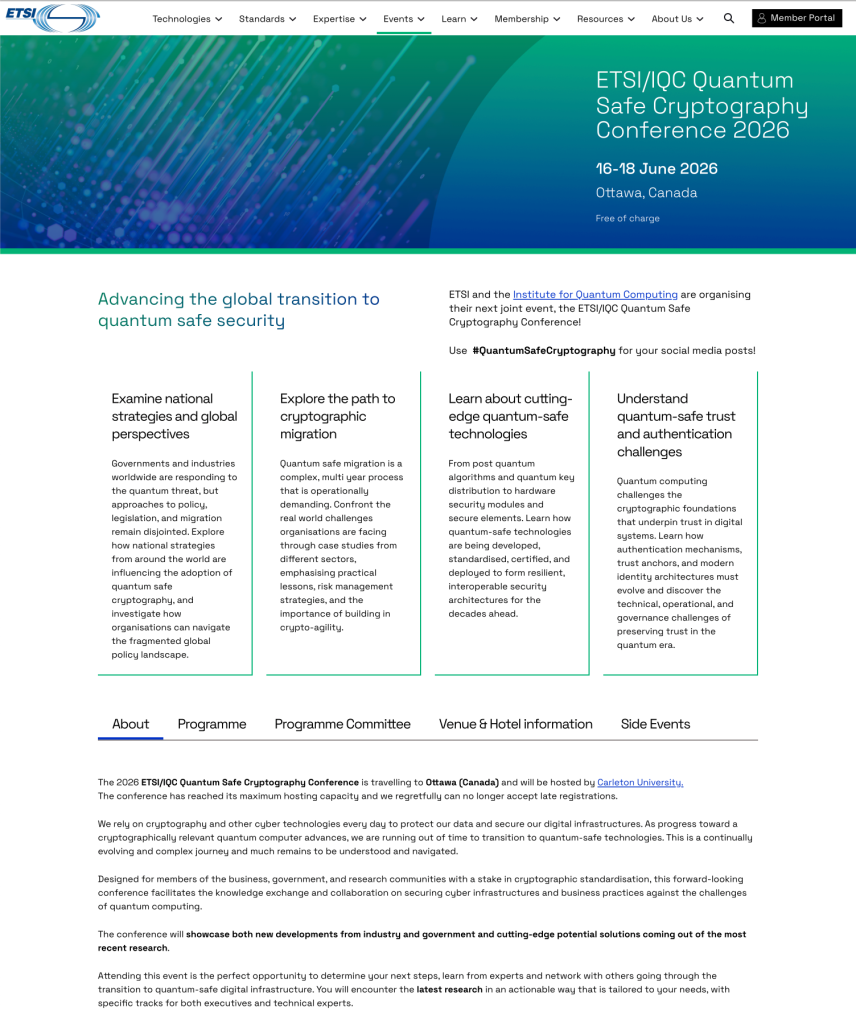
The ETSI/IQC Quantum Safe Cryptography Conference, co-hosted by the European Telecommunications Standards Institute (ETSI) and the Institute for Quantum Computing (IQC) at the University of Waterloo, and organized this year by Carleton University, serves as a vital forum for confronting cybersecurity challenges in the quantum computing era.
The conference agenda covered cutting-edge topics such as quantum-safe migration, cryptographic standards development, critical infrastructure protection, crypto-agility, and Post-Quantum Cryptography (PQC) and Quantum Key Distribution (QKD).
By Qinru Liu
18 Jun 2026