







26 Jun 2026


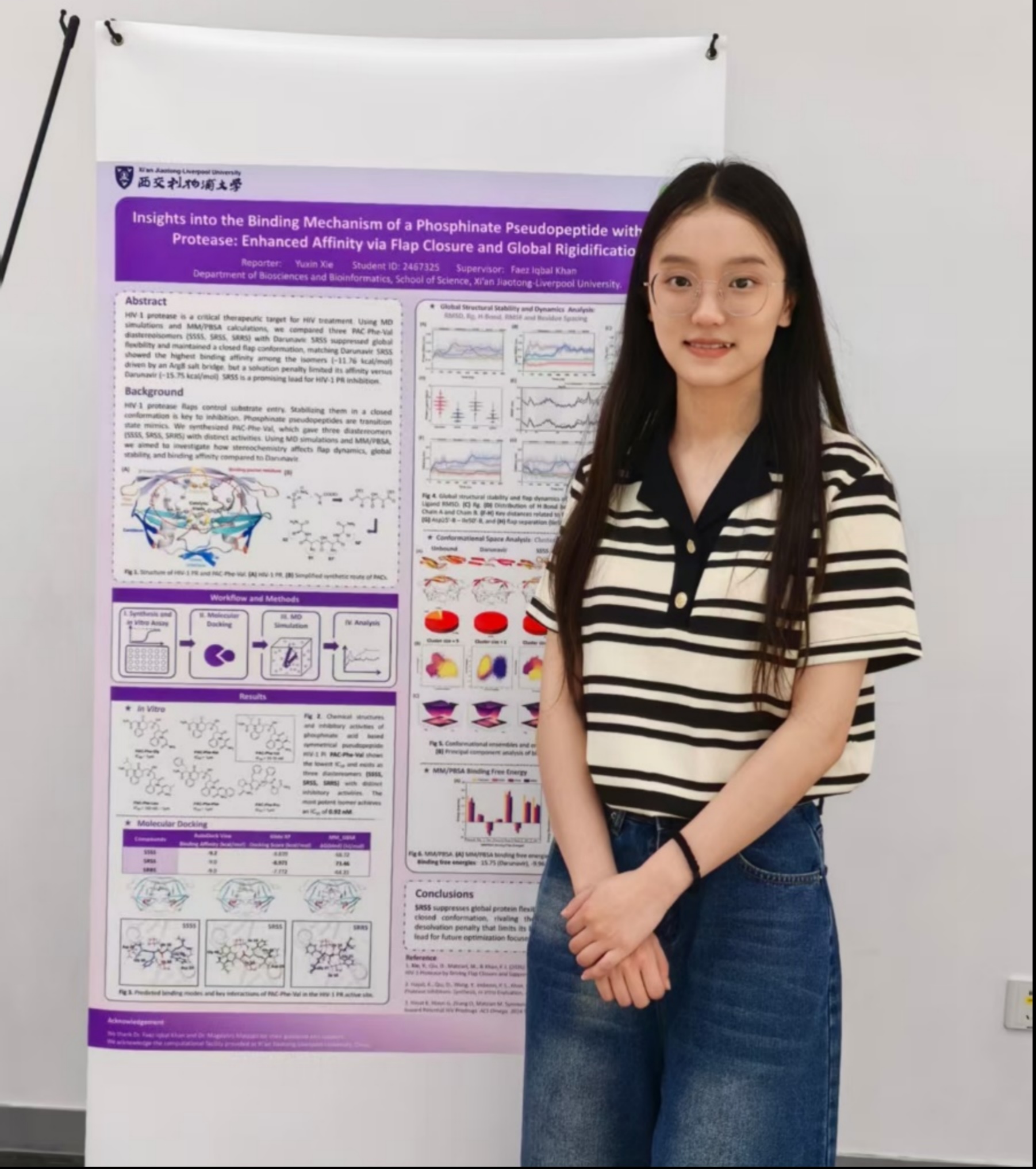
Recently, a remarkable milestone was accomplished in the School of Science, with a pioneering initiative which is causing an inspirational major shift in how postgraduate research can be structured, documented, and communicated at Xi'an Jiaotong-Liverpool University (XJTLU). Within this aspirational environment, under the supervision of Dr. Faez Iqbal Khan, Assistant Professor, Department of Biosciences and Bioinformatics at XJTLU, had his Master’s student Ms. Yuxin Xie achieve a notable academic accomplishment by submitting her Master’s dissertation in manuscript format, where three peer-reviewed publications were directly integrated as core thesis chapters. This approach reflects a strong commitment to high quality research, remarkable productivity and a coherent development of scientific thinking at the Master’s level.
From Early Training to a Coherent Scientific Direction
Yuxin Xie’s research journey began with her initial project focusing on Aurora kinase B stability using spectroscopic experiments combined with molecular dynamics simulations. At this early stage, she developed an understanding of how computational and experimental approaches can complement and validate each other. This foundational work was subsequently published in the International Journal of Biological Macromolecules, marking her entry into peer-reviewed publishing and shaping her motivation toward a more structured research direction. As her technical skills developed, she moved beyond isolated projects and began constructing a coherent scientific theme across her work. With academic guidance from Dr. Faez Iqbal Khan, her research focus was refined toward phosphorus-containing pseudopeptide inhibitors. This transition was the result of deliberate planning and continuous discussion on building a unified research trajectory across different biological targets.
Expanding Research Across Biological Targets
Following this direction, she investigated phosphinate pseudopeptide inhibitors targeting HIV-1 protease. In this study, she performed molecular dynamics simulations and binding free energy analyses to explore conformational changes within the protease binding pocket. One of the key findings was the identification of an inhibitor capable of inducing closure of the protease “flaps,” a mechanistic insight that contributed to a first-author publication in Protein Science.
Building on this work, she extended her computational framework to a second biological system, MMP-13, where she participated in the design and evaluation of serine-derived phosphinic peptide inhibitors. She also incorporated ADMET prediction tools to assess drug-likeness and strengthen translational relevance. This integrated computational strategy, combined with communication within the research team, resulted in another publication in Bioorganic Chemistry. Collectively, these studies demonstrate that her methodological approach can be systematically transferred across different protein systems.
The Decision to Adopt a Manuscript-Based Thesis Format
When the School of Science introduced the manuscript-based thesis option, Yuxin Xie reviewed the requirements, which included a general introduction and a final discussion section framing the published papers. Although she initially hesitated, she ultimately decided to adopt this format after discussions with her supervisor Dr. Faez Iqbal Khan, who emphasized that her most challenging academic work had already been completed through the publication process. In his view, the thesis was not an additional burden but an opportunity to coherently present an already established and quite successful scientific story. This guidance played a decisive role in reframing the thesis as an exercise in synthesis and narrative construction of completed research.
A Different Experience of Thesis Writing
Unlike the conventional perception of thesis writing as a period of last-minute pressure, Yuxin Xie’s experience focused on intellectual integration rather than stress-driven writing. She dedicated her time to connecting three independent studies into a unified scientific narrative, structuring how each publication contributed to an overarching research question. She also extracted cross-project insights linking methodologies, biological targets, and interpretations across systems. This process transformed thesis writing into a reflective academic exercise, where the thesis became a synthesis of continuous research rather than a separate writing task.
Reflections on Research Training and Scientific Growth
Yuxin Xie’s journey highlights that a thesis is best understood not as a document produced at the end of a degree, but as a structured representation of continued improvement, focused effort and sustained scientific excellence. Her experience demonstrates that when research is designed with coherence and long-term direction, publication output and thesis completion become naturally aligned. It also underscores the importance of supervisory guidance from Dr. Faez Iqbal Khan in shaping research direction, maintaining continuity across projects, and enabling a publication-driven strategy that supported the manuscript-based thesis outcome.
Closing Perspective
Professor John Moraros, Dean of the School of Science stated: “This major achievement illustrates an innovative and evolving model of postgraduate research training, where publication-integrated pathways can lead to more structured and higher quality academic outputs. It highlights how Dr. Faez Iqbal Khan and his Master’s student Ms. Yuxin Xie engaged in careful and thoughtful supervision, research planning, and sustained effort to transform the traditional thesis into a more coherent and highly productive streamlined process. It is my expectation that many other faculty and their Master’s and PhD students will follow this inspirational path moving forward. In this case, the manuscript-based thesis reflects a landmark moment in disciplined scientific development, research outputs and effective academic mentorship at XJTLU.”
Content:Dr. Faez Iqbal Khan
Review:Professor John Moraros
26 Jun 2026