




Professor Yunrui Han: Keeping questions alive beyond the classroom

02 Jun 2026


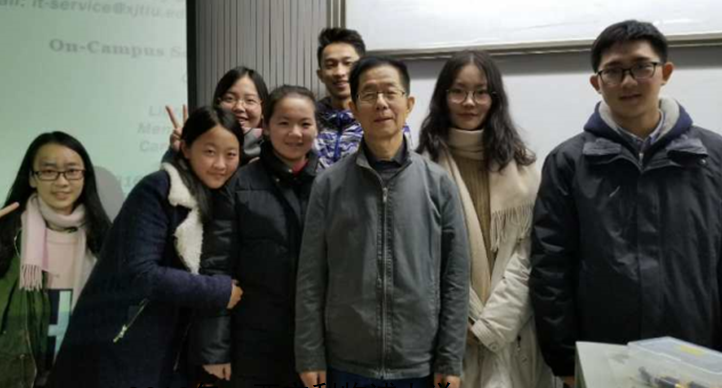
As retirement approached, Professor Yunrui Han still had the same questions that had followed him through decades of teaching..
What should a university help students become? What should a teacher truly give them?
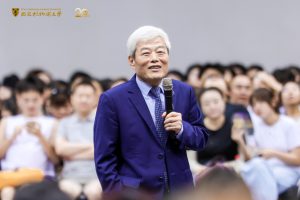
By then, Professor Han had spent 26 years in the Department of Mathematics at Tsinghua University, served as a teaching director, and had been named by students among their favourite teachers.
In 2007, at the invitation of Professor Zhien Ma from Xi’an Jiaotong University, Professor Han came to Suzhou to join XJTLU. XJTLU was still a young university then. For Professor Han, that was part of its appeal.
It was a place where ideas he had carried for years could finally be tried in class. He had long followed changes in higher education and inspired Professor Youmin Xi’s philosophy in education. At XJTLU, those reflections found room in daily teaching.
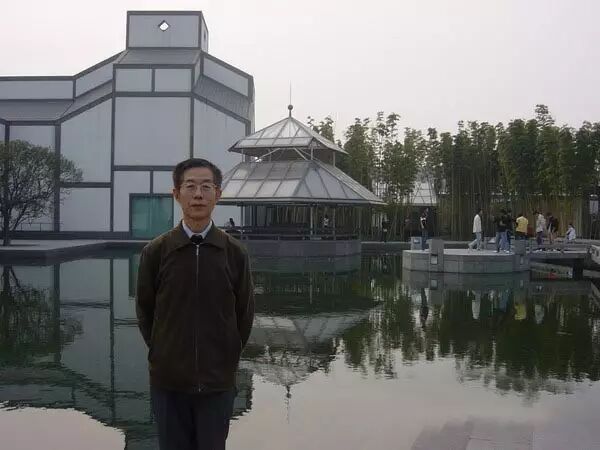
从“被动学习”到“主动学习”
From waiting for answers to taking responsibility
Many students entered university still carrying the habits of secondary school: listening to what teachers explained, completing what teachers assigned, and waiting for answers to be given. Professor Han wanted them to move beyond that.
He strongly agrees with Professor Xi’s view that when students enter Xi’an Jiaotong-Liverpool University from high school, one of the most important transitions they need to make is from “passive learning” to “active learning.”
Over the years, he has consistently reflected on how to guide, support, and even “push” students to complete this transition as early as possible. In his view, it affects not only their university studies, but also their future development.
Before each class, he would tell students what the next session would cover, what they should read and what questions they should think about, so that when they arrived, their own thinking had already begun.
The shift was not always easy.
One year, a student came to him asking for the answer to an exercise. Professor Han did not give it to him. Instead, he asked the student to complete a full solution on his own and bring it back three days later.
The student returned with a dense, neat and complete answer. Professor Han told him it could almost serve as a standard solution.
At the end of the semester, Professor Han created a “special award”. The winner was that student. The award was not for the highest score. It was for a change that Professor Han had been waiting to see.
The student himself was surprised. Professor Han still remembers the moment. For him, growth can begin quietly when a student starts to think independently.
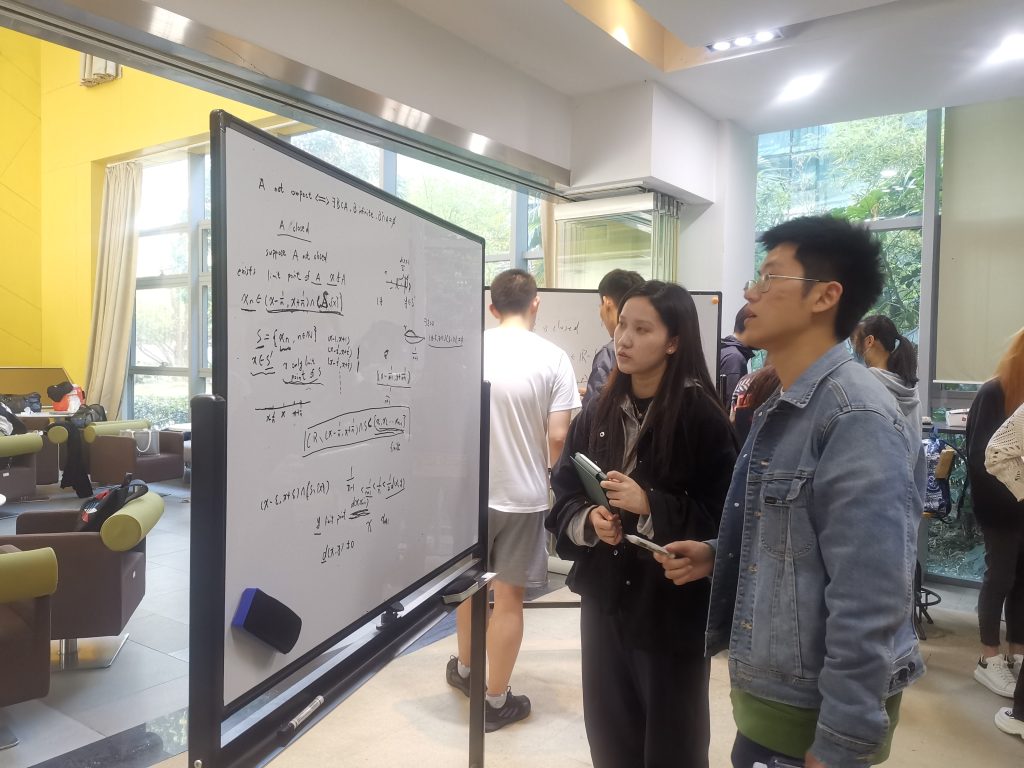
Mathematics students discussing after class
Making room for inquiry
Years later, Professor Han was still looking for ways to make that shift possible.
In 2021, while teaching linear algebra, he faced a familiar constraint. In a course with a unified textbook, exam and schedule, Professor Han had little room to change the framework, so he looked for room inside the learning process.
He created a full set of course videos, hoping students could learn basic knowledge before class. Class time could then be used less for repeating content and more for discussion, questioning and research.
He also asked students to form a WeChat group. They called it the “Linear Algebra Warrior Group”, where 38 students discussed open-ended questions beyond class time. Later, during the pandemic, Professor Han helped reorganise another learning group named after XJTLU’s motto, “Light and Wings”.
The WeChat groups were not simply places to send notices. Professor Han used them to keep questions alive after class.
Learning what it means to study a problem
One question he gave students was about the condition number of a matrix.
The concept is related to numerical algebra, and not part of a standard linear algebra course. But Professor Han saw that studying it could bring many core ideas in linear algebra back to life. Students also had to learn how to observe a mathematical phenomenon, raise a question and present their inquiry in the form of a paper.
The topic was advanced, but Professor Han’s purpose was not to turn first-year students into numerical algebra researchers. He wanted them to experience what it means to study a problem.
In the end, eight students submitted complete research papers. The papers did not create new mathematical knowledge. That was not the point. What mattered to Professor Han was that the students had, perhaps for the first time, worked through a question for themselves.
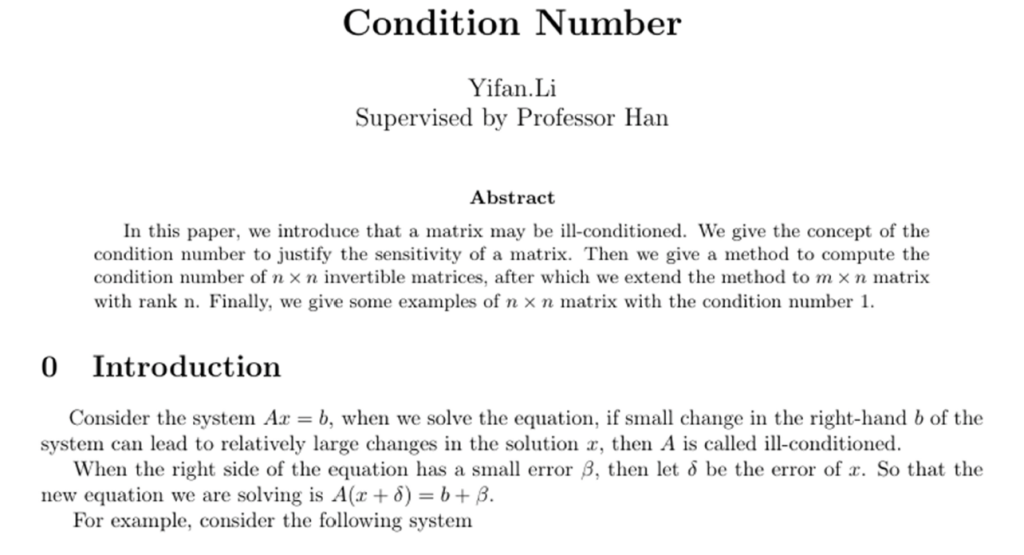
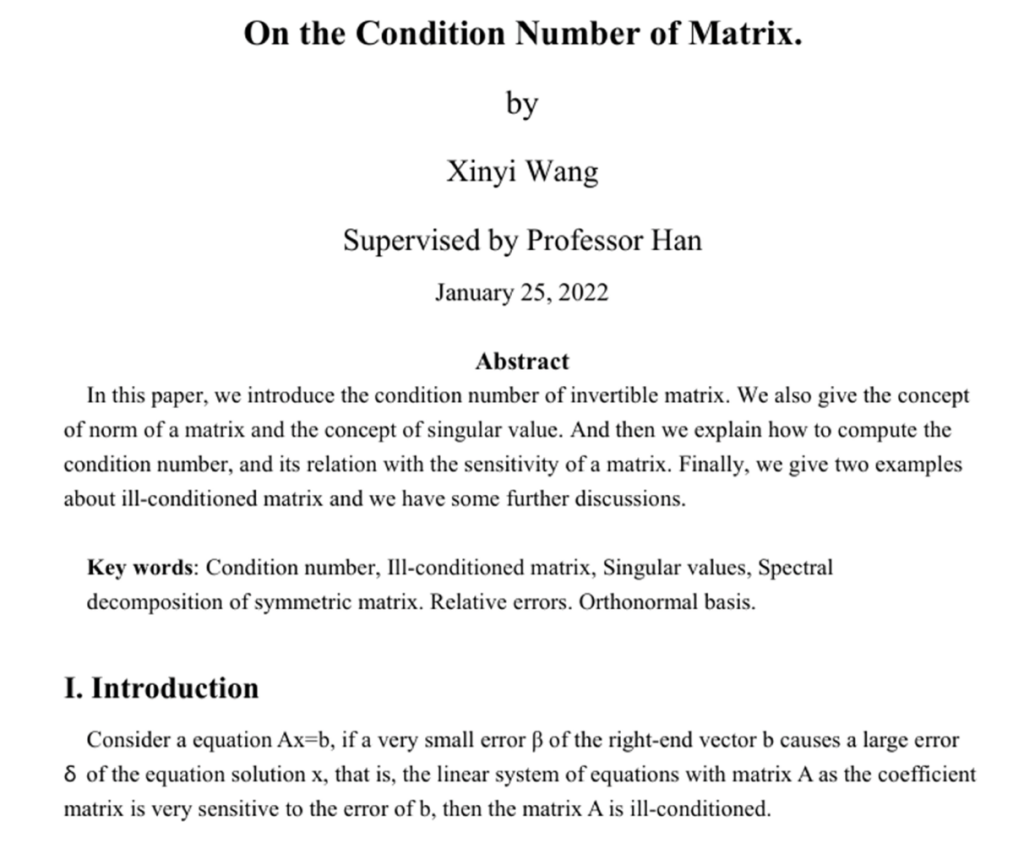
Abstracts of two students' papers
Small designs, one larger aim
During his 15 years at XJTLU, Professor Han came to feel more strongly that education itself was changing.
He still remembers Professor Xi raising a question many years ago that sounded ahead of its time: in an age of networks and information technology, could universities be defeated by the internet if they failed to keep pace?
For Professor Han, the answer could be found in the small designs of daily teaching: preparation before class, discussion during class, open-ended questions, inquiry-based learning and collaboration among students. Together, they pointed to one aim: to let students become the subjects of their own learning.
Over the years, Professor Han witnessed XJTLU’s growth and the growth of generation after generation of students. Some experiments that once seemed bold gradually became part of the University’s educational ecosystem.
Looking back, Han speaks less about what he published or how many students he taught than about the hours spent with students around questions neither side wanted to close too quickly.
In his memoir, 往日好时光(Good Times Past), Professor Han described his 15 years at XJTLU as an “open, free, warm and harmonious” period, with every day filled with new possibilities.
By Qinru Liu
Edited by Bo Kou and Patricia Pieterse
Photos courtesy of Yunrui Han
02 Jun 2026