








Locking down proteins to prevent their activity

05 Jun 2026


Researchers develop new enzyme that ties up proteins, offering a fresh strategy for studying and treating disease.
Proteins are the machinery of life. Within each of our cells, proteins are constantly moving and changing shape, acting as molecular motors and tiny gates, among countless other vital functions. “Those movements drive life processes and disease,” says Dr Kozo Hamada of Xi’an Jiaotong-Liverpool University, China.
“If we could stop the motion of specific proteins, we might be able to control health and disease.”
That’s what Dr Hamada and undergraduate student Yiying Li set out to do in a study published in FEBS Letters. “We designed an artificial enzyme that forms covalent links between proteins, effectively locking them in place. It’s similar to how a spider traps its prey with threads, preventing it from escaping the web,” explains Dr Hamada.
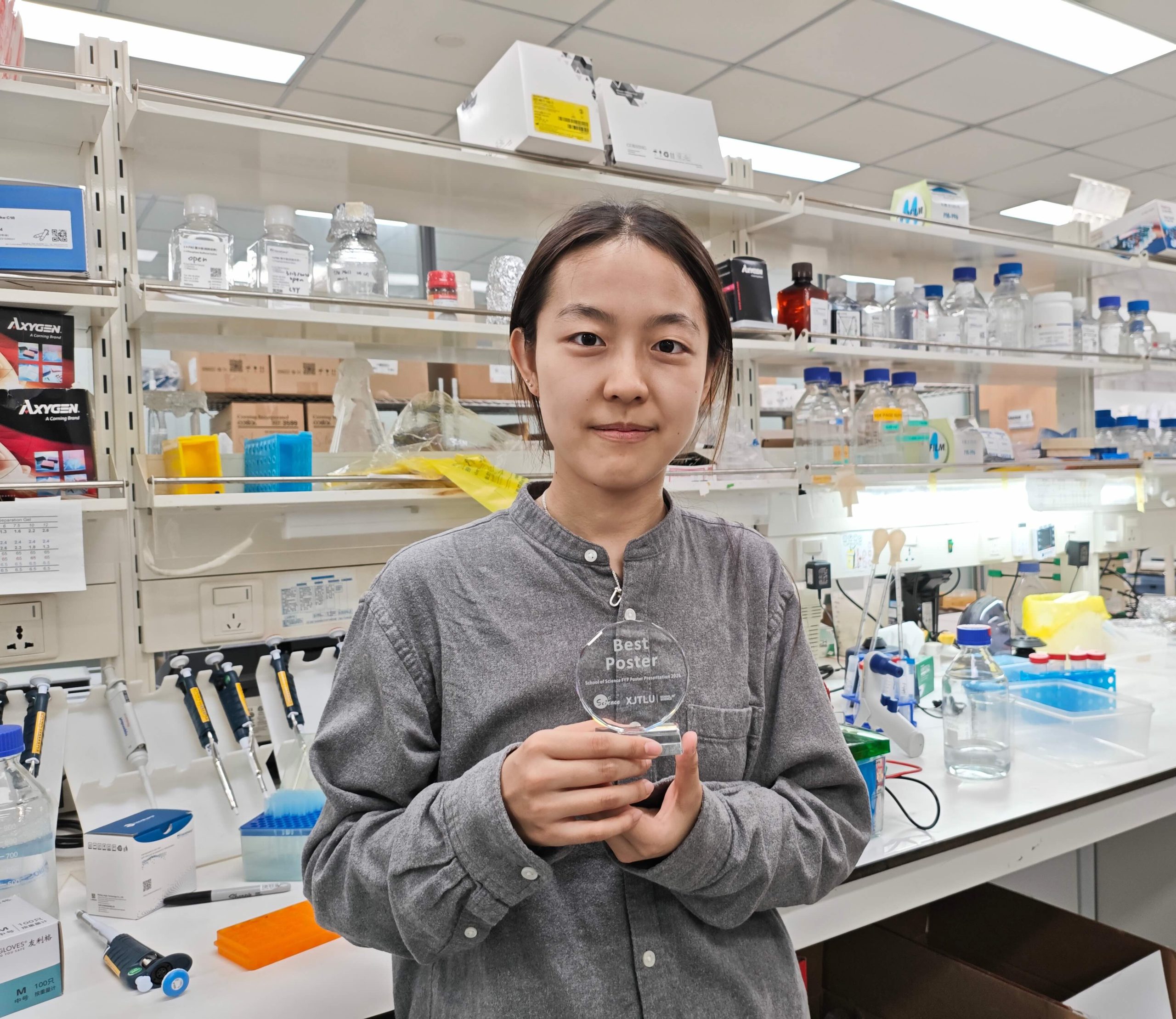
Li and Dr Hamada developed an enzyme that blocks the movement of a protein called SERCA, which normally pumps calcium into specific parts of a cell, keeping the cell ready for calcium signalling – an important process in nerve and muscle activity. The team used bioinformatics to identify a small protein – originally from a bacterium – that can form links between proteins. They then engineered this candidate protein into a tool that could selectively lock down SERCA. Introducing the tool into cells blocked SERCA’s movement and therefore reduced calcium pumping.
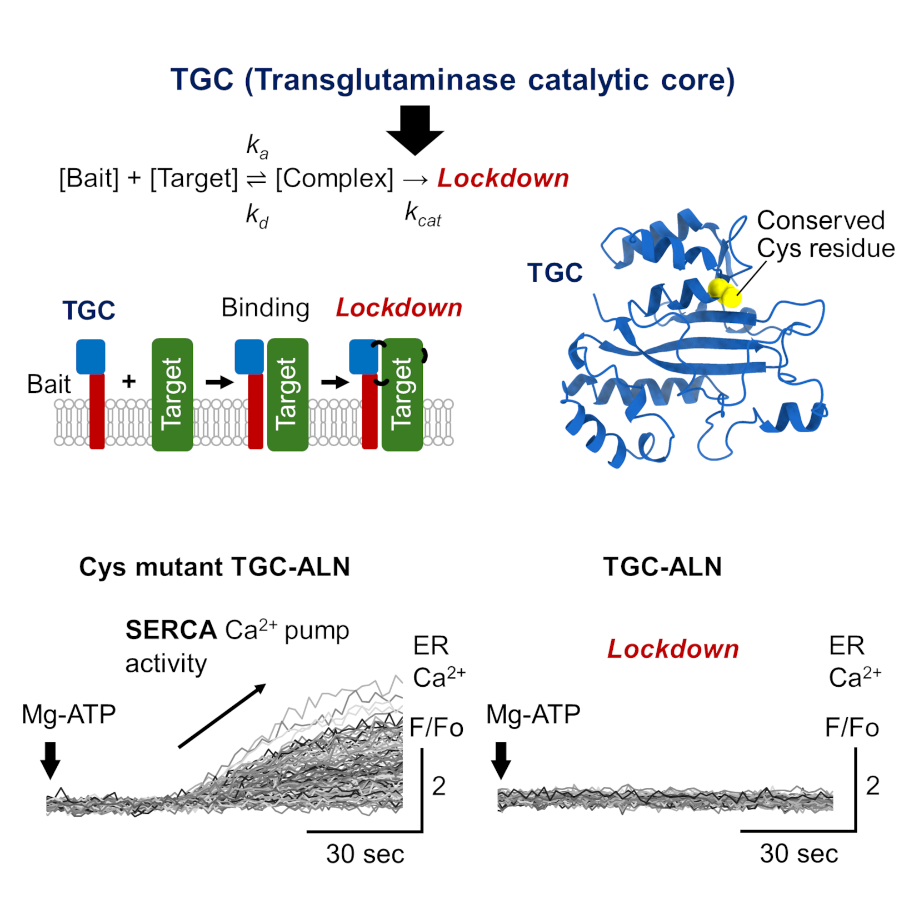
Upon expression of TGC fused to a bait protein, proximal target proteins are covalently locked without cofactors. When the association constant (K = ka/kd) is sufficiently high, TGC can catalyze spontaneous lockdown. Mutation of the conserved cysteine in TGC–ALN preserved SERCA function, whereas functional TGC–ALN completely inhibited SERCA activity.
Researchers already have tools to stop proteins from working. The two main approaches are to knock out the protein through genetic engineering or to interfere with its activity by using a small molecule that binds to the protein’s active region. These are powerful techniques, but it takes time to develop them for each protein and, like any tool, they can have unintended side effects. “Our method introduces a new strategy: instead of removing or blocking the protein, we directly freeze its structural changes. This allows us to stop protein activity in a fundamentally different and more direct way,” says Dr Hamada.
The tool can be adjusted to lock down other proteins by simply changing the targeting module, swapping out the SERCA-specific unit for one that targets another protein. The researchers are continuing to refine the approach so the tool can target additional proteins precisely and efficiently. “Overall, I see this work not as a final achievement, but as a starting point for my life as a young researcher,” says Li.
The team also hopes that this technology could open up new therapeutic strategies based on directly controlling protein activity. Locking down disease-related proteins may be a valuable approach for treating certain conditions in the future.
05 Jun 2026