




Understanding Others, Embracing Difference: Xia Jia's Vision of Chinese Science Fiction

08 Jun 2026


“The most important lesson science fiction has taught me is not how to predict the future, but how to embrace difference, communicate with others, and have the courage to knock on unfamiliar doors.”
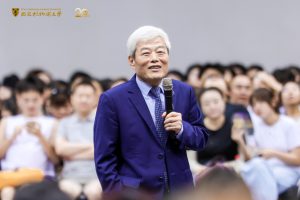
With these words, Professor Wang Yao, better known by her pen name Xia Jia, opened her lecture at Xi’an Jiaotong-Liverpool University on 21 May.

Professor Wang, Head of the Department of Chinese Literature at Xi’an Jiaotong University, is one of China's leading scholars and writers in the field of science fiction. Alongside her academic research on contemporary Chinese science fiction, she has published numerous award-winning works of science fiction and fantasy under the name Xia Jia. Her books include Odyssey of China Fantasy: On the Road, The Demon Enslaving Flask, and AA Time Beyond Your Reach, etc. She has won the Chinese Galaxy Award eight times and has been shortlisted four times for the Chinese Nebula Awards. Her works have been translated into multiple languages and published internationally.
Invited by the Modern and Contemporary Literature module in the Department of China Studies at the School of Humanities and Social Sciences, Professor Wang delivered a lecture entitled "Crossing Boundaries: Welcome to Invisible Chinese Science Fiction", sharing her reflections on science fiction, the development of Chinese sci-fi literature, and cross-cultural communication.

Science Fiction Is More Than Imagining the Future
Professor Wang began by tracing the history of science fiction worldwide and in China, before reflecting on her own journey from reader to writer and, eventually, researcher.
Drawing on her short story "Let's Have a Talk" (2015), she introduced the audience to a young Chinese female linguist who encounters a talking artificial intelligence. Faced with the unknown, the protagonist chooses to speak in her mother tongue, saying “Hello” and “Let's have a talk.”
In Wang's view, language in the story serves as more than a communication tool. It becomes a bridge across different forms of life, cultures, and worlds.
She also shared a behind-the-scenes story about the publication of the work. Although the first-person narrator's gender is never explicitly stated, the illustrator initially depicted the protagonist as a man.
“I immediately wrote to the editor,” she recalled. “Gender, language, and cultural background matter. A young Chinese woman studying the humanities has her own unique courage to knock on the door and begin a conversation with the unknown.”
The illustration was eventually revised.
“It was a small victory,” she said, “but it reminds us that the default protagonist in science fiction should not always be male.”
When Chinese Science Fiction Reached the World
Reflecting on the rise of Chinese science fiction, Professor Wang recalled attending the World Science Fiction Convention (Worldcon) in 2015.
That year, Liu Cixin's The Three-Body Problem won the Hugo Award for Best Novel, marking the first Hugo Award for a Chinese science fiction work and the first time a translated novel had received the honour.
“It proved that science fiction is not written only for the English-speaking world,” she said. “It belongs to all humanity.”
The same year, her own novella "Spring Festival" received 42 nomination votes in the Hugo Awards selection process, narrowly missing the final ballot.
Speaking about the number, she joked:
“Forty-two is the answer to life, the universe, and everything, so I've always been quite happy with that result.”
For Wang, the global success of Chinese science fiction lies not only in its grand visions of the future, but also in the distinctive cultural experiences and social observations embedded within its stories.
How Technology Quietly Changes Everyday Life
Since 2015, Professor Wang has been working on an ongoing story cycle titled "The Chinese Encyclopaedia", which she plans to develop into twelve stories.
The series follows a female linguist known simply as “Xiao Wang”.
“In every story, she travels to a different city and meets different people,” Wang explained. “Through her perspective, I want to observe how technology quietly changes our everyday lives.”

Two stories from the series, "Goodnight, Melancholy" and "The Monk of Lingyin Temple", have already been published in English.
According to Wang, the most fascinating aspect of Chinese science fiction is often not the distant future, but the transformations already taking place in contemporary society.
Using the Chinese New Year as an example, she described what she called a “magical moment”. During a Spring Festival Gala broadcast, viewers across the country were invited to shake their phones to receive digital red envelopes. Overnight, mobile payment technology evolved from a tool used mainly by younger generations into something embraced by grandparents as well.
“This kind of large-scale, cross-generational adoption of technology could only happen in China,” she said.
From mobile payments and humanoid robots to AI-generated family portraits, technology has become deeply embedded in the experience of celebrating the Spring Festival. For Wang, the coexistence of tradition and futurity makes the festival itself inherently science fictional.
This observation led her to remove the year “2044” from the original title of "Spring Festival".
“The future changes every year,” she explained. “What interests me more is how our everyday lives are quietly reshaped by technology year after year.”
What Does Chinese Science Fiction Care About?
During the discussion session, an international student asked what themes contemporary Chinese science fiction is most concerned with.

Professor Wang highlighted two major areas.
The first is war and human dignity. Many Chinese science fiction works explore how people maintain dignity, agency, and cultural identity when confronted by overwhelming forces.
The second is family and technology. As artificial intelligence and robotics become increasingly integrated into daily life, questions surrounding family relationships, ageing populations, gender, and declining birth rates have become recurring themes in contemporary science fiction.
For Wang, Chinese science fiction remains deeply connected to social reality.
“It is not only about future worlds,” she suggested. “It is also about the issues people are facing right now.”
Finding Science Fiction in Everyday Life
For students interested in writing science fiction, Professor Wang offered a simple piece of advice:
“Take a new piece of technology and place it in an ordinary family setting. Then watch how your parents or grandparents react. That alone can become a great story.”
She also reflected on her own creative inspirations. Although she grew up in Xi’an, her family originally came from Shanghai. Family gatherings during the Spring Festival, conversations spoken in southern-accented Mandarin, and memories of migration and belonging have all become recurring sources of inspiration in her writing.
“Those voices and those moments of reunion, such as the birth of a child, birthdays, or class reunions, often make me think about the contrast between the past and the present,” she said.
Professor Wang concluded the lecture with a sentence displayed on her final slide:
“Welcome to the invisible planet. And have a nice trip!”
She expressed her hope that more readers would discover Chinese science fiction works that have yet to be widely translated, and encounter the diversity, courage, and humanity they contain.
As her lecture suggested, science fiction is not merely about imagining the future. It is a way of crossing boundaries, understanding those who are different from ourselves, and seeing the world through new perspectives.

Contributed by Dr Xi Liu, the Department of China Studies
Edit by Yiyi Gu
08 Jun 2026