The Centre focuses on two complementary research directions: Data-Driven Collaborative Simulation and Embodied Interaction, and Micro/Nano Devices and Intelligent Instrumentation.
Research Area 1: Data-Driven Collaborative Simulation and Embodied Interaction
This direction focuses on data-driven modelling, collaborative simulation, and embodied interaction as core technologies. It aims to develop intelligent simulation, perception-interaction, and decision-optimisation platforms for embodied AI, robotics, autonomous systems, and complex automation scenarios. Key research methods include multi-source data fusion, AI-assisted physical simulation, task planning, robot learning, and autonomous decision-making. This direction supports intelligent systems in learning and optimising within simulated environments, and in transferring these capabilities to real-world physical scenarios for perception, interaction, and execution. Potential applications include intelligent manufacturing, mobile robotics, smart laboratories, intelligent warehousing, human-robot collaboration, and autonomous operations in complex environments. It is closely integrated with the robotics, intelligent manufacturing, industrial software, high-end equipment, and embodied AI industries to support the development and industrial upgrading of intelligent automation systems.
Research Area 2: Micro/Nano Devices and Intelligent Instrumentation
This direction focuses on micro/nano devices, intelligent detection, and automated instrumentation systems as core technologies. It seeks to develop highly sensitive, high-throughput, automated, and intelligent sensing devices and scientific instruments for applications in life sciences, healthcare, advanced manufacturing, environmental monitoring, and functional evaluation. Key research areas include micro- and nano-structured sensors, chip-based sample processing, AI-assisted signal analysis, automated experimental platforms, and intelligent detection equipment. Potential applications include biomedical testing, functional food evaluation, drug screening, environmental toxicology analysis, early disease screening, semiconductor inspection, and process monitoring in advanced manufacturing. This work will support innovation and industrialisation across the life sciences, healthcare, functional food, nutrition, biopharmaceutical, environmental monitoring, semiconductor, and high-end scientific instrumentation industries, supporting the development, translation, and industrialisation of intelligent instruments and advanced sensing technologies.








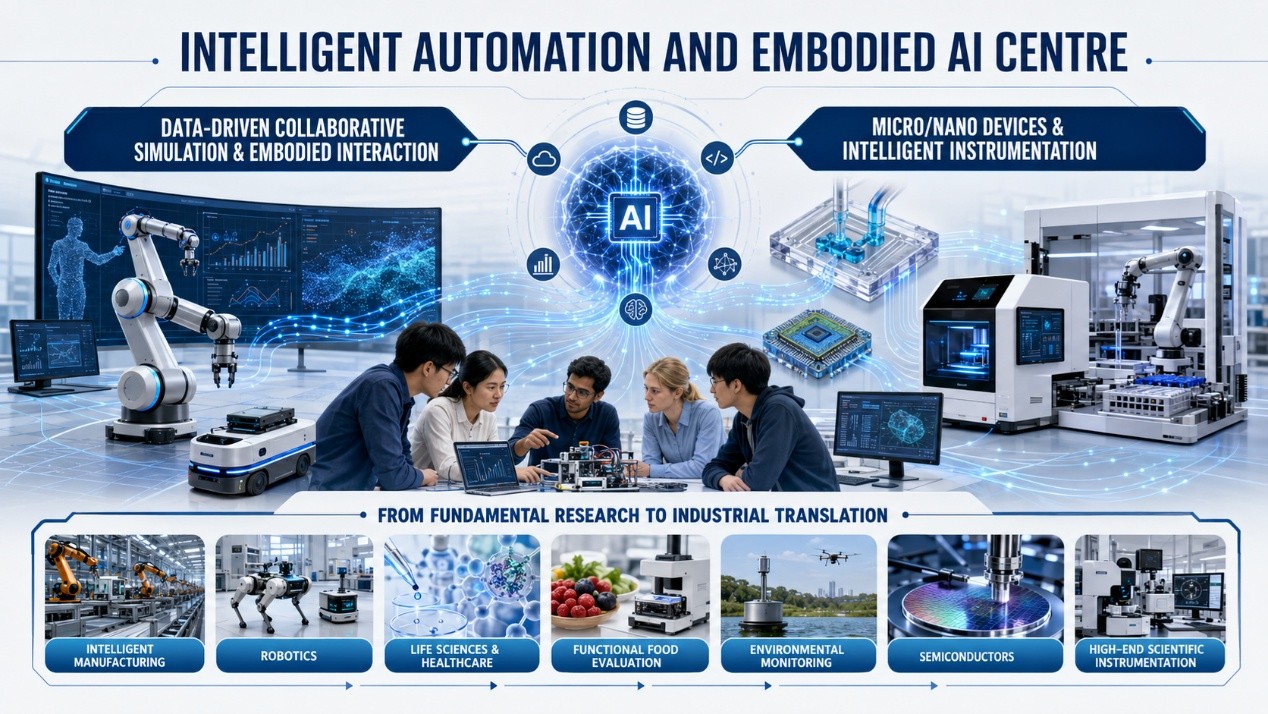

The Centre focuses on two complementary research directions: Data-Driven Collaborative Simulation and Embodied Interaction, and Micro/Nano Devices and Intelligent Instrumentation.
Research Area 1: Data-Driven Collaborative Simulation and Embodied Interaction
This direction focuses on data-driven modelling, collaborative simulation, and embodied interaction as core technologies. It aims to develop intelligent simulation, perception-interaction, and decision-optimisation platforms for embodied AI, robotics, autonomous systems, and complex automation scenarios. Key research methods include multi-source data fusion, AI-assisted physical simulation, task planning, robot learning, and autonomous decision-making. This direction supports intelligent systems in learning and optimising within simulated environments, and in transferring these capabilities to real-world physical scenarios for perception, interaction, and execution. Potential applications include intelligent manufacturing, mobile robotics, smart laboratories, intelligent warehousing, human-robot collaboration, and autonomous operations in complex environments. It is closely integrated with the robotics, intelligent manufacturing, industrial software, high-end equipment, and embodied AI industries to support the development and industrial upgrading of intelligent automation systems.
Research Area 2: Micro/Nano Devices and Intelligent Instrumentation
This direction focuses on micro/nano devices, intelligent detection, and automated instrumentation systems as core technologies. It seeks to develop highly sensitive, high-throughput, automated, and intelligent sensing devices and scientific instruments for applications in life sciences, healthcare, advanced manufacturing, environmental monitoring, and functional evaluation. Key research areas include micro- and nano-structured sensors, chip-based sample processing, AI-assisted signal analysis, automated experimental platforms, and intelligent detection equipment. Potential applications include biomedical testing, functional food evaluation, drug screening, environmental toxicology analysis, early disease screening, semiconductor inspection, and process monitoring in advanced manufacturing. This work will support innovation and industrialisation across the life sciences, healthcare, functional food, nutrition, biopharmaceutical, environmental monitoring, semiconductor, and high-end scientific instrumentation industries, supporting the development, translation, and industrialisation of intelligent instruments and advanced sensing technologies.