






09 Dec 2025


A recent graduate of XJTLU’s School of Advanced Technology (SAT), has earned a spot at the flagship IEEE Photonics Conference 2025 (IPC 2025) in Singapore for her trailblazing research in how to make compact, energy-efficient silicon photonic chips. It coincides with the 60th anniversary celebration of the IEEE photonics community’s journey of light-based technologies.
Wenli Zhou, who received a BEng Electrical Engineering from Xi’an Jiaotong-Liverpool University in 2025, has had her photonic design showcased at the event for a multi-layered microdisk resonator. It is a device that realises artificial molecule-like systems which are useful for quantum technology and optical computing.
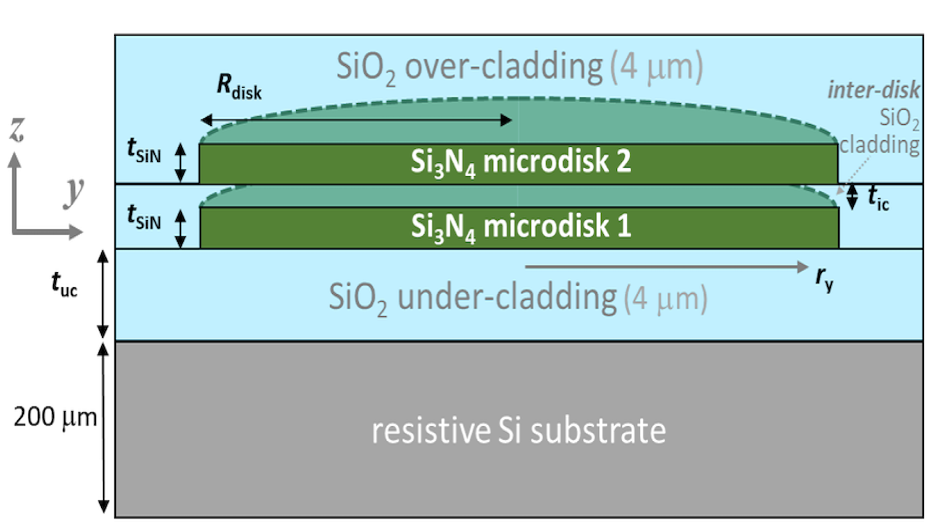
A silicon nitride microdisk resonator. Optical signals shift direction along its curved path.
Unlike traditional integrated electronic chips, which use metal interconnects to shuttle signals and are affected by heat buildup, silicon photonic chips route data using light, with lower energy use and faster speeds.
However, achieving high-speed optical signal processing presents technical challenges, such as how to control light to navigate within a compact chip and to circulate at closely spaced sharp wavelengths.
This is the role of microdisk resonators coupled to each other. Typically using a single-layer planar layout, they interact with each other through sideway coupling, allowing selection of light signals at extremely sharp wavelengths in a very close range.
Zhou’s innovation is in using silicon nitride material and a 3D stacked design, creating a multi-layered interchange. With this, light signals travelling on different layers and at varying heights can be processed at precisely selected wavelengths. This design not only saves chip area but also enhances coupling efficiency to control light signals of close yet distinct wavelengths.
To optimise the resonator’s performance, she processed massive datasets, adjusting parameters such as disk thickness, cladding width, and etching angles in simulation software.
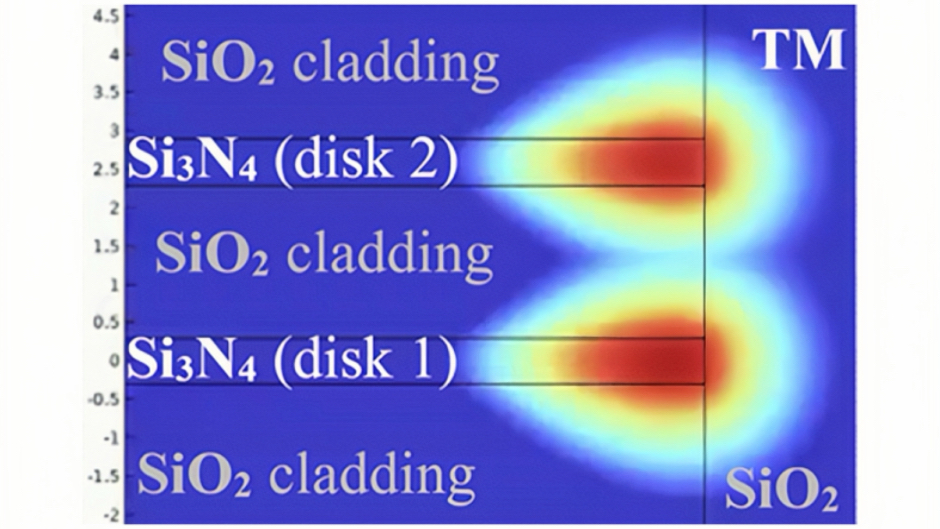
Simulating the impact of distance changes between microdisk resonators in chip operation. Red areas show the resonators’ electric field distribution characteristics. Based on these changes, the spacing parameters can be optimised to achieve a 3D stacking of photonic devices.
Zhou’s research also considers the realities of the existing industry ecosystem. Rather than aiming to “replace electricity with light,” she says her work explores how to enable the co-evolution of photonic and electronic chips.
“Electronic chips excel at processing and storing information, while photonic chips specialise in high-speed transmission,” Zhou says. “What we’re doing is integrating silicon photonics into modules like high-speed data transfer and interconnects, allowing it to upgrade within existing electronic structures, forming ‘hybrid optical-electronic chips.’ This is a pragmatic and promising incremental approach, enabling photonic chips to develop gradually within the ecosystem.”

Zhou’s supervisor, Dr Sang Lam, Senior Associate Professor in the Department of Electrical and Electronic Engineering, describes Zhou’s inclusion in the top-tier IPC 2025 a few weeks ago as an exceptional achievement in a student’s BEng studies.”
“It fully demonstrates the innovativeness and technical rigour of Wenli’s research, which was completed with great diligence during her bachelor’s studies, and highlights our students’ potential in advanced scientific fields like nanophotonics,” he adds. The support from the EEE Department and SAT deserves appreciation, especially that from the Department Head, Dr. Fei Xue.
Quantum leap
Zhou’s research journey began in her third year at XJTLU when she contacted Dr Lam to discuss research mentorship, and he suggested focusing on photonics. After digesting vast amounts of literature, she later shared her understanding of the field at a project group meeting, and by graduation she had authored multiple IEEE conference papers on integrated photonic devices.
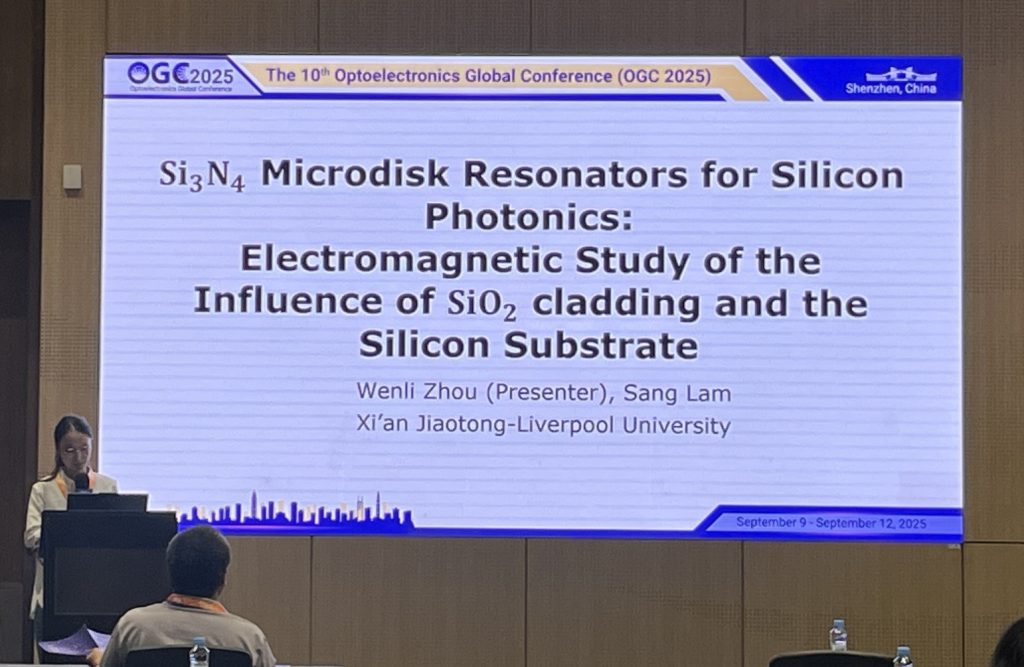
Photo of Wenli Zhou presenting related microdisk resonator work at another IEEE conference
During her studies, she also took courses in quantum mechanics through XJTLU’s Enhanced Study Scheme, which supports students in taking classes from other schools for interdisciplinary research.
This year, Zhou goes to Germany to pursue advanced research in quantum chip technology.
“The academic staff at XJTLU taught us not only how to conduct research well but also shaped our values as researchers,” she says. “Dr Lam emphasised initiative and a spirit of exploration. He told us that good research comes from having our own ideas, staying curious — you cannot wait for answers from others.”
By Huatian Jin
Translated by Xiangyin Han
Edited by staff editor
09 Dec 2025