







2026 Spring Festival Greetings: Breaking Through the Deadlock of Future Education Reform

17 Feb 2026


Future education has become a widely used term.
We talk about artificial intelligence, interdisciplinary learning, and core competencies; we design smart classrooms, introduce project-based curricula, and explore industry–education integration. On the surface, it may seem that everything is moving toward the future.
Yet a closer look reveals a paradox. Most imaginations of—and experiments with—future education remain deeply embedded in the logic of today’s mainstream system. We are drawing new routes on an old map without recognising that the terrain of the world has already changed.
The Invisible Grip of Old Logic: When the “Future” Wears the Clothes of the Past
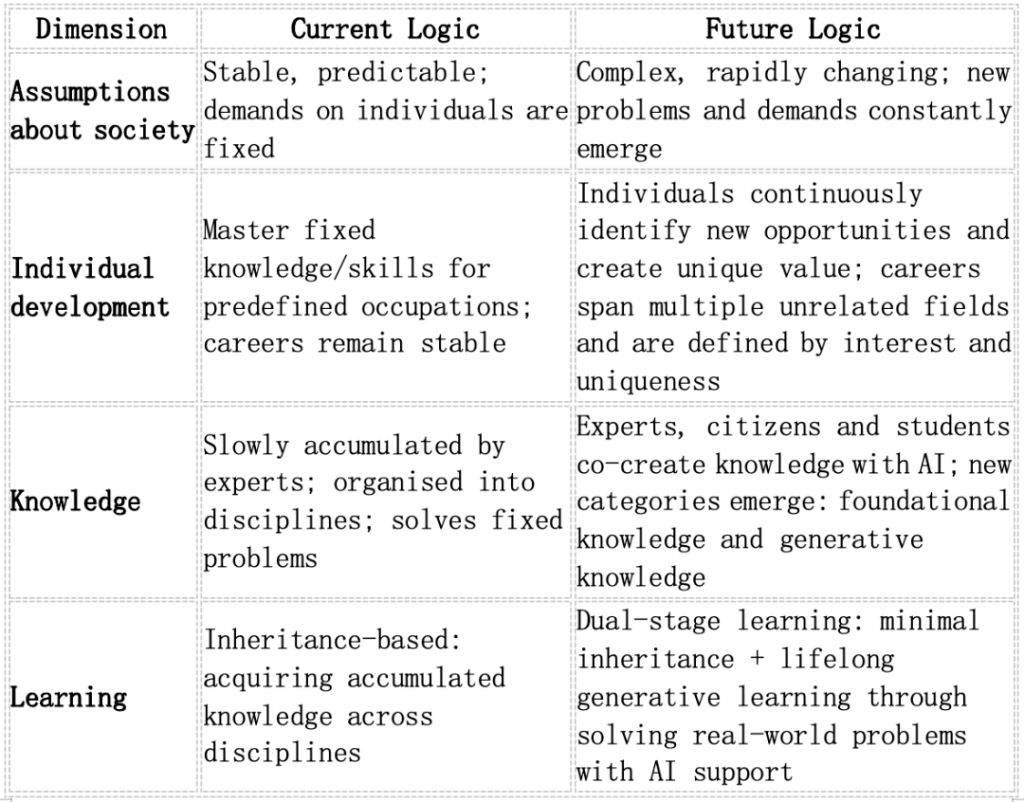
Mainstream education is still built on assumptions inherited from the industrial era: that society is stable and predictable; that the purpose of education is to transmit established knowledge and produce standardised talent to fill predefined positions in the social machine. Its core logic is knowledge, efficiency, and inheritance.
Today, many reforms branded as “future-oriented” are in fact only technical optimisations or decorative upgrades to this old framework.
For example:
- Tablets and online platforms are introduced, yet the content remains subject-based, fixed, and exam-driven.
- Project-based learning is implemented, but final evaluation still centres on standardised tests; projects become “desserts” rather than a central learning paradigm.
- “Personalisation” is emphasised, yet students simply move at slightly different speeds along the same track toward the same exams and rankings.
The root problem is that the underlying logic of educational institutions and educators has not been upgraded. We still ask, “How can we more efficiently deliver existing knowledge?” instead of “How can we help individuals continuously construct meaning and create value in an uncertain world?”
The Key to Breakthrough: Rethinking Education’s Underlying Assumptions
- Rethinking our assumptions about society
- Redefining individual development
- Re-understanding knowledge
- Redesigning learning
Awakening the Self to Embrace New Logic
The greatest challenge in pursuing future education is not technology, funding or policy—but the self-awakening of educators, a renewed understanding of the fundamental issues beneath daily routines.
Most frontline teachers ask:
“What content should I teach? How should I assess students? How should I use AI in class?” These are valid but remain within the old logic. To embrace new logic, educators must ask different questions:
“What will matter most to students in the future world? Which of these skills can my classroom meaningfully support? How can my course guide students toward the future rather than pull them back into the past?”
These questions may seem lofty, yet they sit beneath many everyday teaching concerns. Reflecting on them can trigger genuine innovation. But not every teacher can easily break through the demands of daily work to see these deeper issues—which is why the ecosystem that triggers self-awakening is essential.
Building an Ecosystem for Educator Awakening
The Academy of Future Education at XJTLU aims to serve as an ecosystem that triggers, supports, and accompanies the self-awakening of educators. We look forward to working with more like-minded partners in 2026 to explore new practices and solutions that genuinely lead the future of education—grounded in self-awareness, aligned with future logic, and responsive to the real needs of learners.
By Professor Xiaojun Zhang
Translated by Xiaoyan Jin
17 Feb 2026