






PhD student develops “owl-eye” chip for clearer night vision

27 Mar 2026


A research team led by Xi’an Jiaotong-Liverpool University (XJTLU) has developed a novel neuromorphic near-sensor device that allows machines to see and process information in near-total darkness. Inspired by owls’ natural night vision, the findings were recently published in Nature Communications.
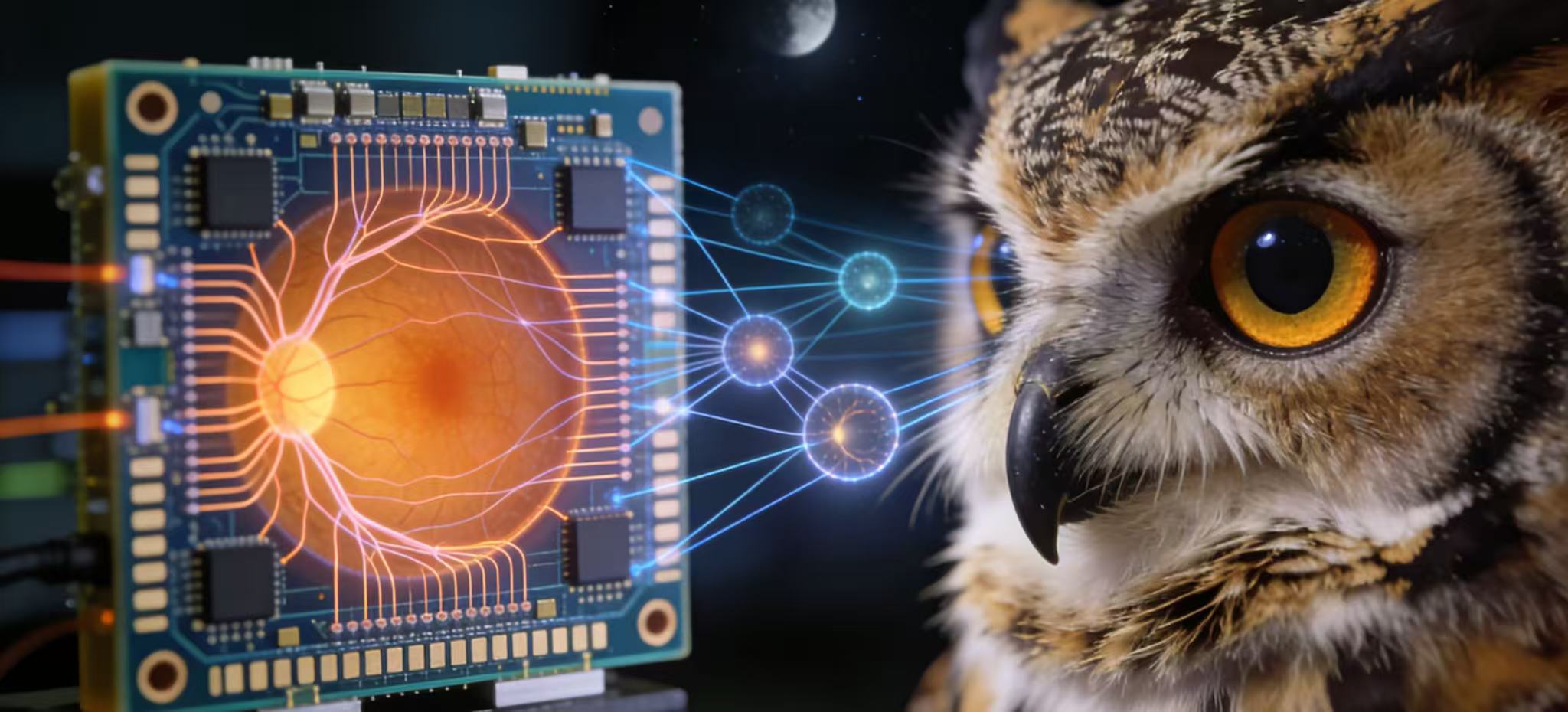
AI-generated illustration
Seeing the unseen
Most modern cameras and AI systems struggle in low light. To solve this, a team led by Professor Chun Zhao from XJTLU, in collaboration with Dr Mario Lanza from the National University of Singapore, and Professor Wei Deng from Soochow University, studied how owls hunt in the dark. They found the answer in the owl’s specialised eye cells and their ability to adapt to low-light conditions.
The team developed a new “smart” transistor called ODAS (owl-inspired dual-mode adaptive synapse). Unlike conventional sensors that only detect light, this chip combines sensing and processing – functioning like both an eye and a brain. This makes it faster and more energy-efficient than traditional systems.
Experiments show the chip can detect light levels 1,000 times weaker than those visible to standard cameras, even surpassing the natural limits of owl vision.
“The breakthrough lies in its ultra-low-light perception,” says Zishen Zhao, the study’s first author and a PhD student at XJTLU’s School of Advanced Technology. “The device can adapt to darkness within tens of seconds. With longer observation, the captured images will gradually become clearer, revealing more details from a once blurred view.”
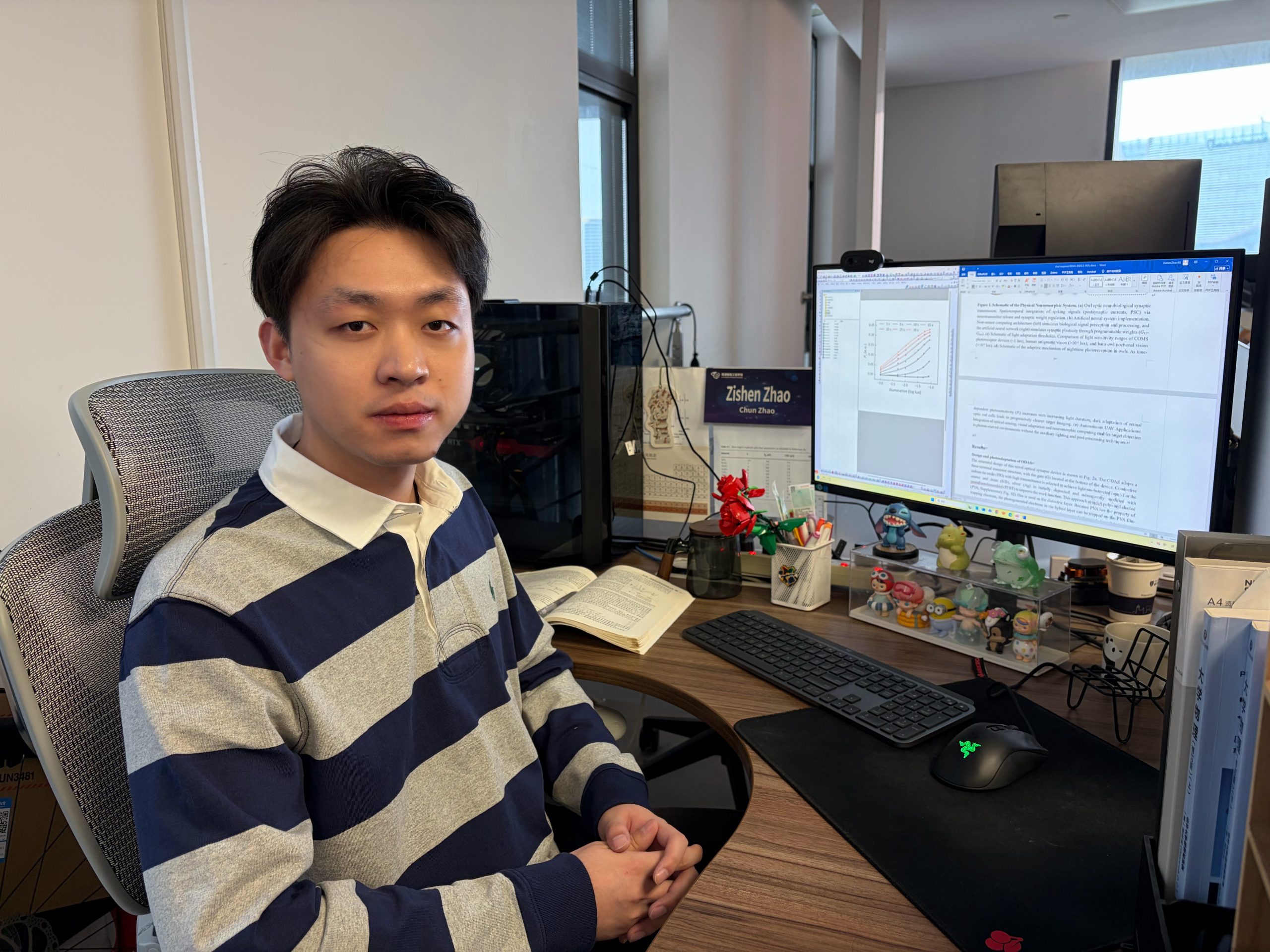
Zishen Zhao
Because the chip processes data at the point of capture, it avoids sending large amounts of information elsewhere. This “near-sensor computing” significantly reduces energy use. “It enables simultaneous sensing and computation,” Zhao adds.
A future without flashlights
The technology has wide potential applications, from drones navigating dark forests to search-and-rescue robots operating in collapsed buildings. In simulations, the system identified ground targets with over 95% accuracy even in extreme darkness.
“These capabilities mean future robots could perform recognition tasks at night without additional lighting,” Zhao says. The team also plans to integrate other sensing abilities, such as heat and touch, to support exploration in environments like the deep sea or outer space.
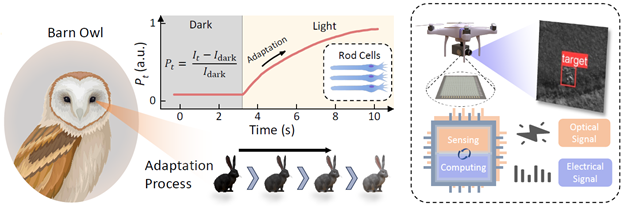
The owl’s night-vision adaptation mechanism and the team’s chip design applied in drones. By integrating light sensing and computation, the chip enables drones to recognise targets even in near-dark environments.
Empowering Young Scientists
The project also highlights student involvement in research. Professor Zhao notes that many undergraduate students contribute to key experiments and data analysis, gaining hands-on experience before moving on to leading universities worldwide.
“The undergraduate stage is critical for developing problem-solving and innovative thinking. We will continue to provide internationally aligned research platforms that allow students to grow rapidly while working on real scientific challenges,” says Professor Zhao.
Professor Zhoulin Ruan, Vice President for Academic Affairs at XJTLU, adds: “This achievement represents not only a technological breakthrough but also a successful example of collaborative and interdisciplinary research of XJTLU. We encourage our academic staff and students to address real-world challenges with a global perspective. The project demonstrates the University’s continued advances in micro-nano electronics and neuromorphic computing, and exemplifies XJTLU’s efforts to integrate education, science and technology, and talent development.”
By Huatian Jin
Edited by Xinmin Han
Translated by Xiangyin Han
Photos courtesy of Zishen Zhao
27 Mar 2026
RELATED NEWS

Seeing Alzheimer’s Disease Earlier Through Multimodal AI Data Fusion
As global ageing accelerates, Alzheimer’s disease (AD) has become one of the most pressing health challenges affecting older adults worldwide. Because early ...
Learn more