




27 Mar 2026


From 2–6 March 2026, the international joint urban design workshop “SIP 2050: A Global Vision for a High-Tech, Livable Future” was held across Shanghai and Suzhou. The workshop was jointly organised by the University of Pennsylvania, National University of Singapore, Southeast University, Tongji University, and Xi’an Jiaotong-Liverpool University (XJTLU), with XJTLU serving as host. It forms a core component of the 2026 international collaborative design initiative “2050 Spatial Reconfiguration: A Holographic Projection of Future Multi-dimension Cities.”
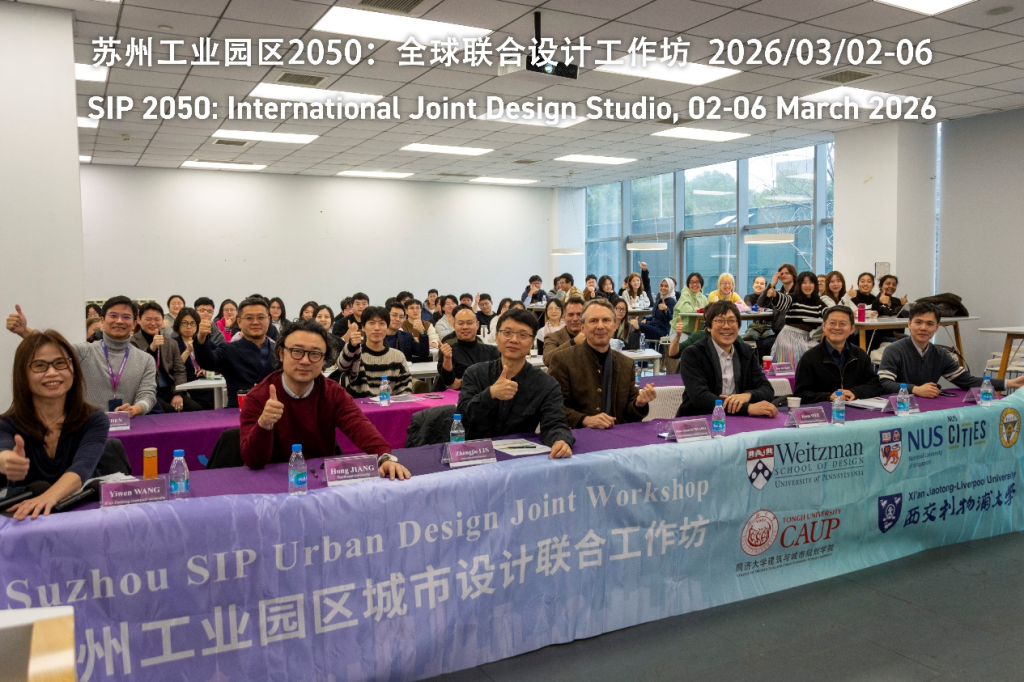
The workshop focused on a key milestone in the development of Suzhou Industrial Park (SIP), marking its 30th anniversary and its transition from a mature industrial park to a future-oriented, high-tech and livable urban district. This transformation is taking place in the context of shifting global trade patterns, uneven urban development, demographic change, and the rapid advancement of digital technologies and artificial intelligence, bringing both challenges and opportunities. It calls for new approaches that combine international perspectives with locally grounded practice.
The workshop received strong support from the Suzhou Municipal Government, Singapore State and City Planning (SCP) Consultants, Shanghai FTA Group, SIP Urban Reconstruction and Development Co., Ltd., and Suzhou Aviation Industry Group. It brought together academic research, industry practice, and policy considerations around real urban issues, forming an integrated “government–industry–academia–research” collaboration. The event was also supported by the XJTLU Learning Mall team.
On 2 March, as a preliminary activity, students and staff from the University of Pennsylvania, National University of Singapore, and Tongji University gathered in Shanghai for an exchange session and urban field study. Professor Feng Yuan, Dean of the College of Architecture and Urban Planning at Tongji University, welcomed the visiting participants and discussed with faculty the importance of international collaborative design in developing students’ interdisciplinary skills and cross-cultural communication. The group visited sites including West Bund, Rock Bund, Sihang Warehouse, M50 Art District, and Tian An 1000 Trees, engaging in on-site discussions on waterfront regeneration, adaptive reuse of industrial heritage, and urban renewal, which helped build a foundation for the joint design workshop.
The subsequent activities in Suzhou included site visits, lectures from practitioners, academic discussions, and group work, all following a carefully structured programme. At the opening session, Professor Marc Aurel Schnabel, Dean of the Design School at XJTLU, reflected on the achievements of SIP over the past 30 years and encouraged participants to see Suzhou as a “living laboratory,” exploring future possibilities by integrating advanced technologies such as artificial intelligence and autonomous mobility into design proposals.
Mr Qining Chen from Singapore SCP, a member of the Industry Advisory Committee of XJTLU’s Department of Urban Planning and Design, delivered a lecture titled “Planning & Development of Industrial Townships through International Cooperation: A Case Study of Suzhou Industrial Park,” offering a systematic overview of SIP’s development and providing a strong foundation for the workshop.
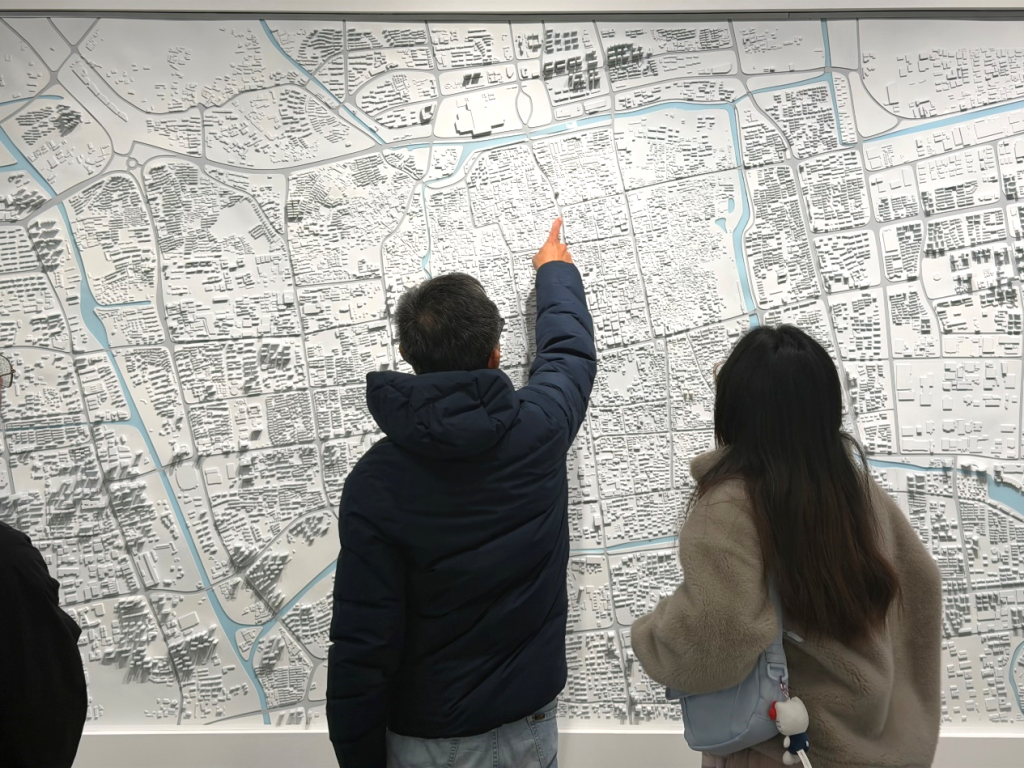
To help participants better understand Suzhou as a city that brings together historical and contemporary urban forms, the workshop organised a city walk covering both new and old districts, including the West and East CBDs of Jinji Lake in SIP, as well as Shantang Street and Yipu Garden in Gusu District. A guided visit to the Suzhou Planning Exhibition Hall further deepened participants’ understanding of the city’s development.
On 4 March, participants carried out site investigations across four project areas: the Loubei area (industrial land regeneration), Xincheng neighbourhood centre and surrounding residential areas (housing renewal), Sangtiandao (innovation-oriented industrial clusters), and the north area of the SIP railway station (CBD commercial and office redevelopment). They also visited the low-altitude economy industrial park in Xinshengli and a cultural industry park represented by He Ren Embroidery, an example of intangible cultural heritage, which provided first-hand insights for future industrial planning and urban design.
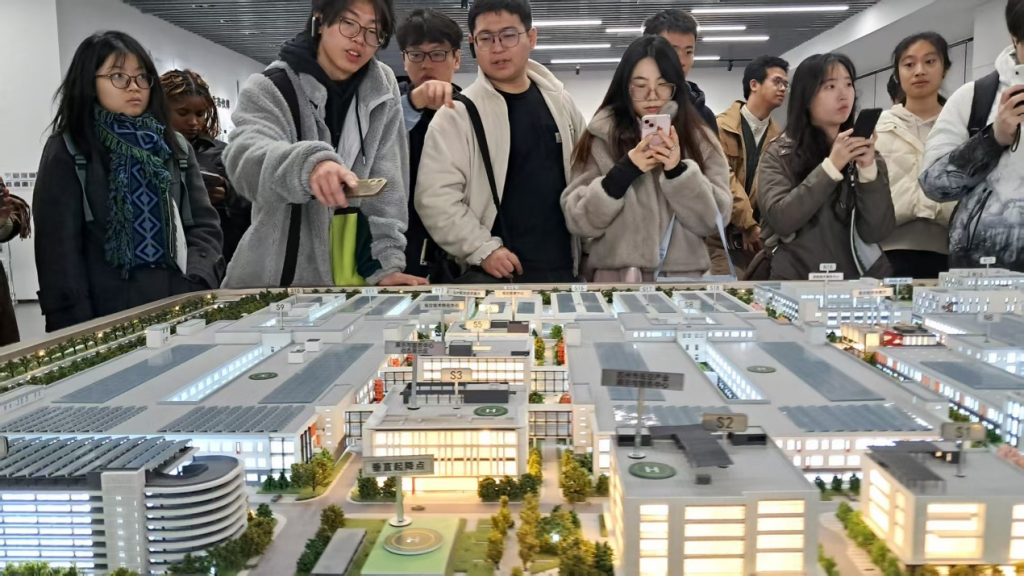
Over the following two days, students from the five universities formed mixed teams and used AI tools alongside field data and prior research from the University of Pennsylvania and the National University of Singapore to develop ideas, explore future scenarios for SIP, and establish preliminary design frameworks.
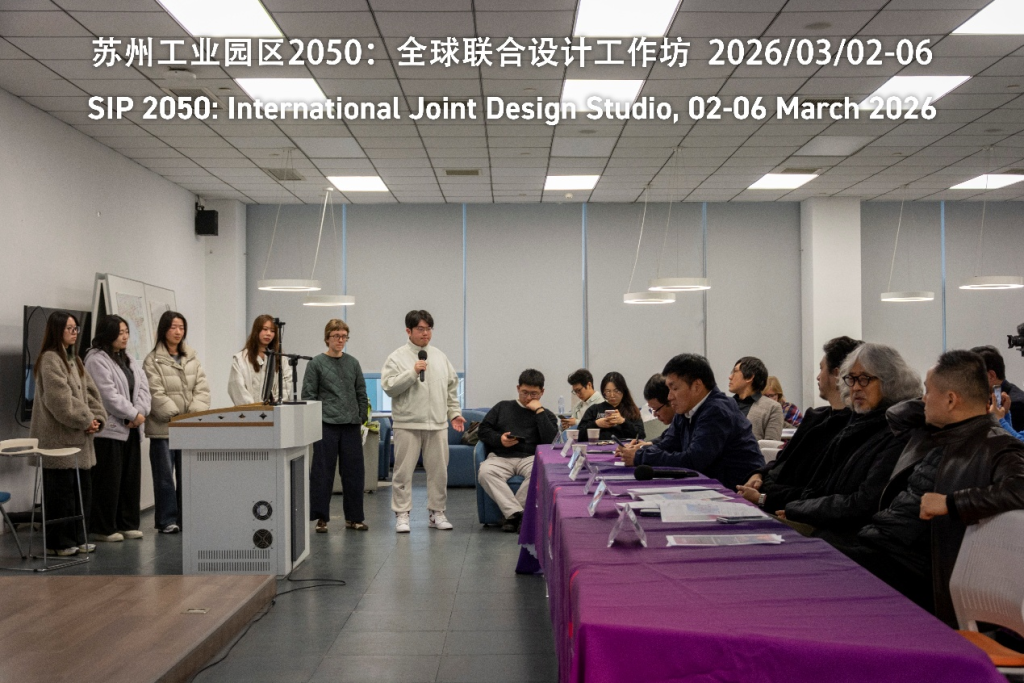
Mr Daohong Shi from FTA Group delivered a lecture titled “Design Breakthrough: Return to Essence, Reshape Value,” broadening students’ perspectives. Final reviews were attended by experts from both academia and practice, including Mr Yingpeng Zhang (Chief Architect of 9-Town Design Studio for Urban Architecture Co., Ltd. and Jiangsu Provincial Design Master), Professor Ying Hu (Suzhou University of Science and Technology), Mr Gang Wang (STWD Architects), Mr Ziqiang Wang (Jiangsu Urban Planning and Design Institute, Suzhou Innovation Research Institute), Mr Shunjie Jiang (Singapore SCP), Mr Tongsheng Shen (adjunct assistant professor of National Cheng Kung University, former KPMG advisory partner China, former AECOM vice president Greater China), and representatives from Suzhou Industrial Park Urban Reconstruction and Development Co., Ltd., including Ms Haixia Liu, Ms Juan Li, and Mr Jiemin Wang.
The workshop was also attended by Mr Jiahong Shi, Vice Mayor of Suzhou, and Professor Tong Zhang, Dean of the School of Architecture at Southeast University. Vice Mayor Shi encouraged participants to contribute diverse and forward-looking design perspectives to the regeneration and spatial restructuring of Suzhou Industrial Park, and to produce proposals that are both innovative and implementable through cross-institutional collaboration and human–AI co-design.
Following the completion of the one-week joint workshop, participants from the five universities will continue to develop their design proposals. The broader project will culminate in an international symposium and a travelling exhibition, with key outcomes expected to be released in June 2026.
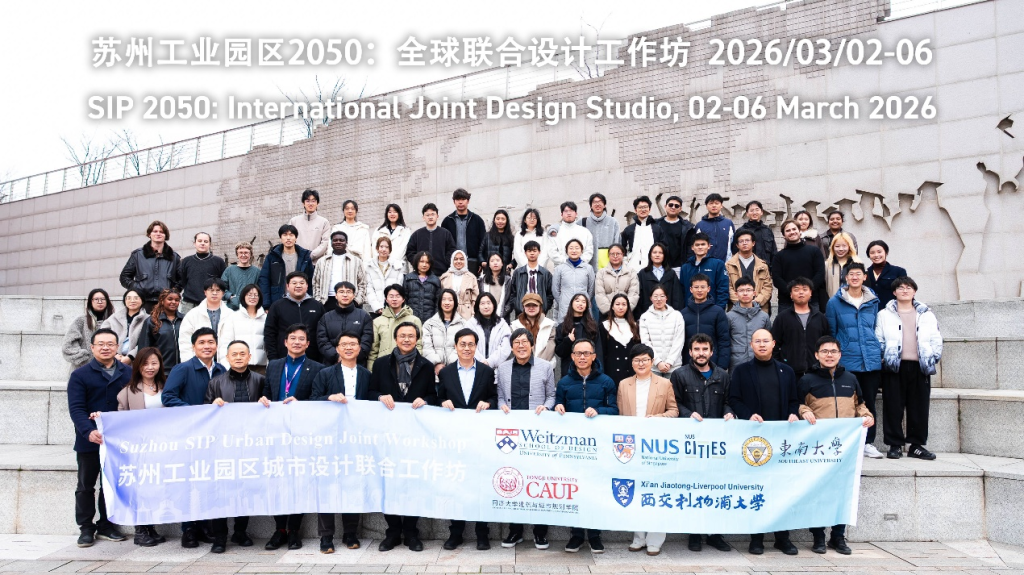
(图文来源:城市规划与设计系, 编辑:寇博、钱懿)
27 Mar 2026