







From a Linguistics PhD to an Industry Expert: How She Transitioned into Educational Evaluation

01 Apr 2026


Are career paths for linguistics graduates limited to teaching and the public sector? This question was further explored in a recent career forum hosted by the Department of Applied Linguistics.
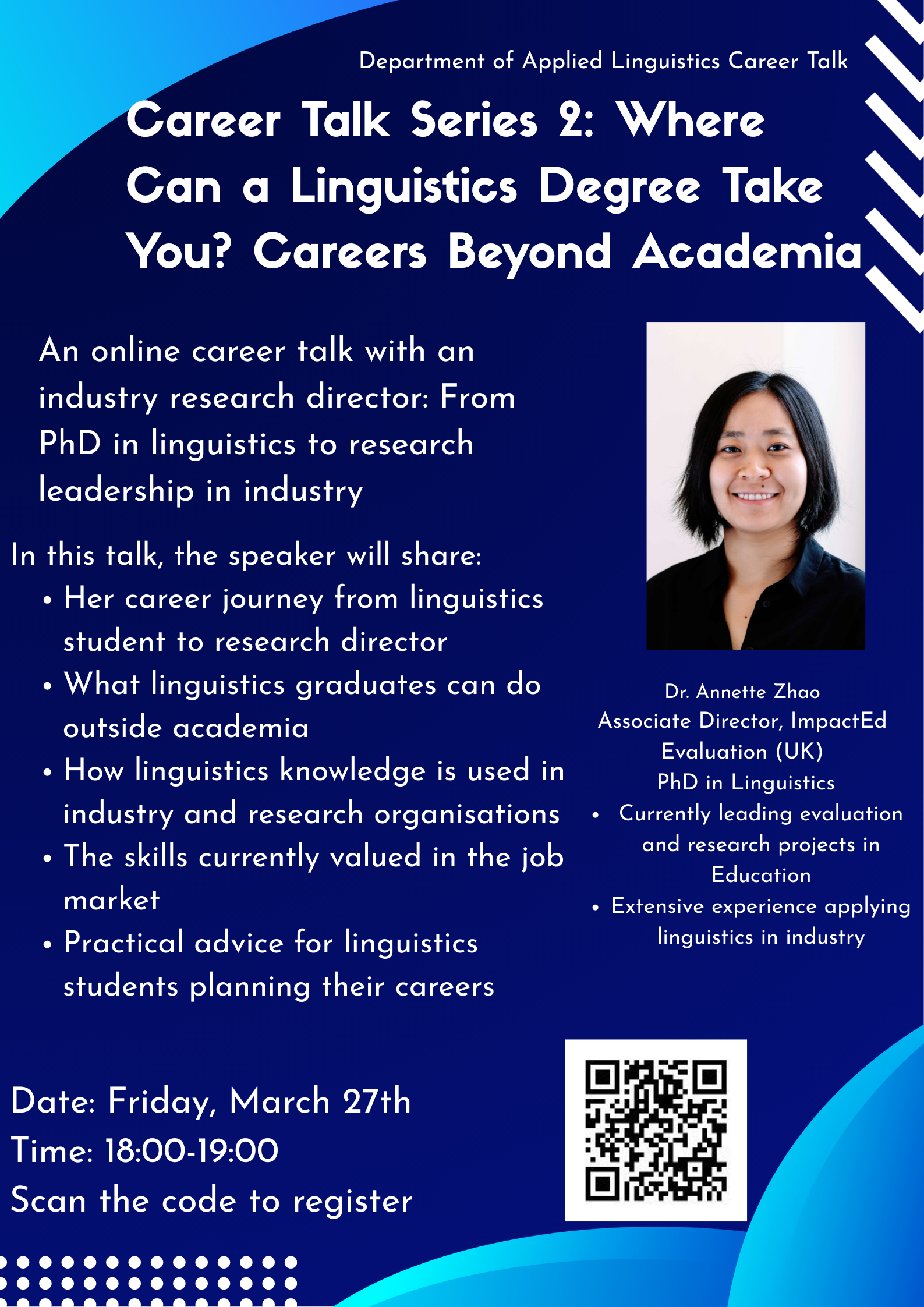
Last Friday, a talk titled “Where Can a Linguistics Degree Take You? Careers Beyond Academia” was held. Dr Annette Zhao (Hui Zhao) drew on her own experience to outline her transition from a linguistics PhD to an educational evaluation specialist, while also analysing how linguistic expertise can be applied in industry settings.
From Academic Training to Industry Application
Dr Zhao completed her undergraduate degree in English at Wuhan University, with a minor in Japanese, before pursuing both her master’s and doctoral studies at Queen Mary University of London, focusing on bilingualism, multilingualism, and their cognitive mechanisms.
During her postdoctoral research at the University of Nottingham, she continued her work on bilingualism while also collaborating with schools across the UK to promote multilingual awareness in education.
Following a conventional trajectory, she was expected to remain in academia. However, changes brought about by the pandemic, together with a reassessment of her career goals, led her to step away from established academic opportunities and move into industry. This shift became a defining moment in her professional development.
Transferable Skills: The industry value of linguistics training
Dr Zhao emphasised that the core competencies developed through linguistics training are highly transferable across sectors.
Hard skills: Research design and data analysis
Training in research design, including quantitative and mixed methods, as well as data analysis and interpretation, formed the foundation of her transition into educational evaluation. In practice, these skills are used to assess the effectiveness of educational programmes, such as determining whether tutoring interventions lead to measurable improvements in learning outcomes.
Soft strengths: Human-centred perspective and systemic thinking
Linguistics fosters a human-centred analytical approach, enabling practitioners to understand complex causal relationships within educational systems, such as how language proficiency influences performance in other academic subjects. This systemic perspective allows issues to be understood within broader structures rather than in isolation.
At the same time, her work in developing language-related policies places strong emphasis on inclusive and non-discriminatory language, reflecting the sense of social responsibility cultivated through linguistic training.
Career Trajectory: From Project Execution to Management
Dr Zhao began her industry career at the international development organisation Jigsaw, working on educational project evaluation. She later joined ImpactEd Evaluation, where she now serves as Associate Director, overseeing the evaluation and management of educational interventions.
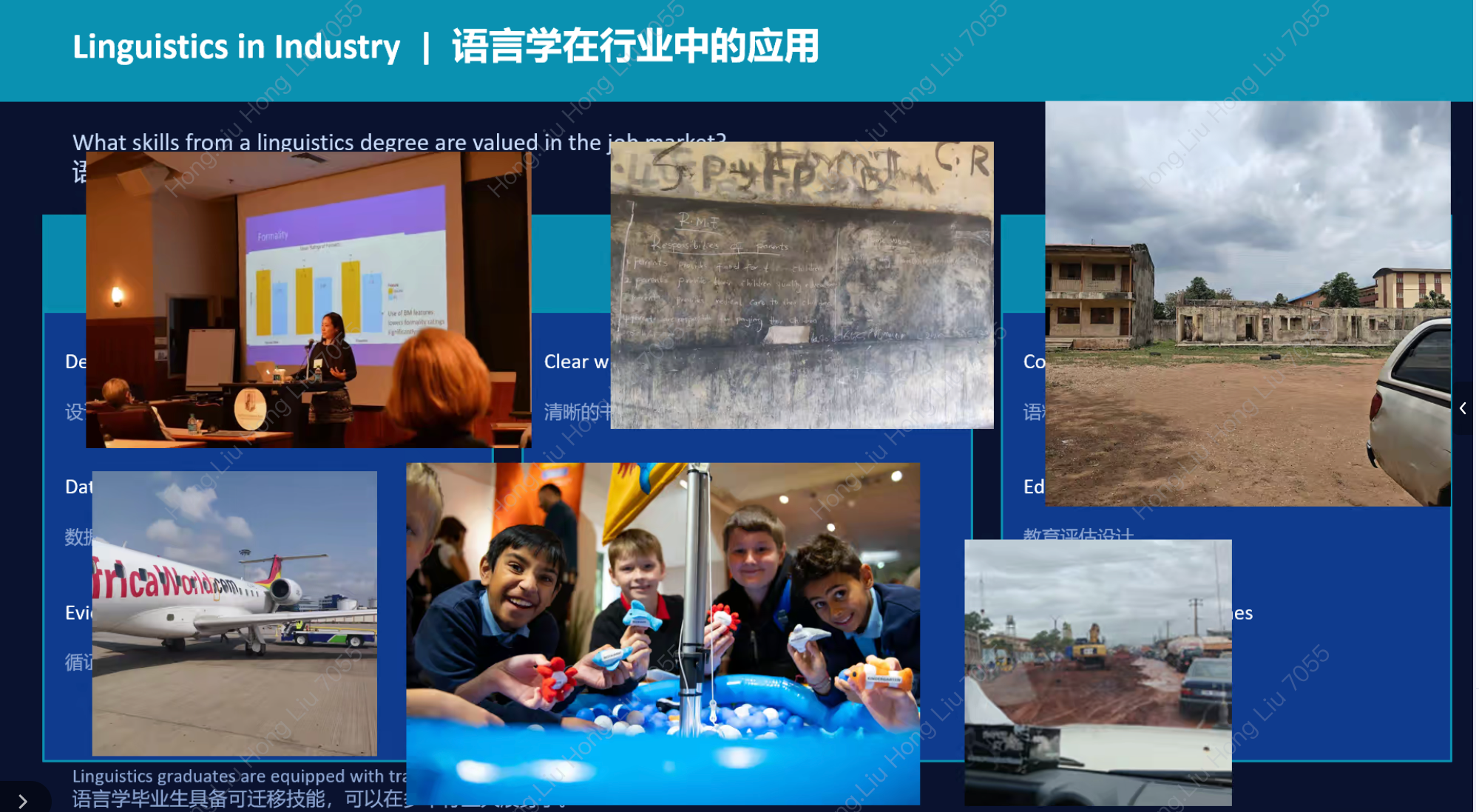
Her career path demonstrates the potential of a linguistics background in fields such as educational evaluation, public policy, and related sectors.
Advice for Students: Making Your Skills Visible
Drawing on her own experience, Dr Zhao offered several practical suggestions for current students:
Shift from “experience-oriented” to “skills-oriented” thinking
Rather than simply listing academic experiences, CVs should highlight the competencies developed through them, such as data analysis, communication, and project collaboration.
Align closely with job requirements
In application materials, use keywords from job descriptions to directly address role expectations, improving both relevance and success rates.
Expand career imagination
Beyond teaching and government roles, students should also consider fields such as edtech, non-profit organisations, and consulting, where linguistic expertise and analytical thinking are equally valuable.
Test directions through practice
Use elective courses and internships to gain interdisciplinary experience and gradually refine career goals through exploration.
“Linguistics is not only about language, but also about understanding human cognition and social behaviour. These capabilities have real significance across a wide range of societal and professional contexts,” concluded Dr Hong Liu, organiser of the event and Programme Director of Applied Linguistics at XJTLU.
Reporter: Yiyi Gu
01 Apr 2026