







New tool tracks RNA modification dynamics in single cells

02 Jul 2026


If DNA is the master instruction manual inside a human cell, RNA can be thought of as a working copy that helps cells use genetic information to produce proteins and carry out essential processes.
RNA can acquire chemical modifications as it is produced and processed. These modifications act like small marks on the working copy: they do not change the underlying DNA instructions, but they can influence how RNA is processed, used, and how long it remains stable within a cell.
RNA modifications are involved in processes that help cells develop, respond to their environment and change from one state to another. They have also been linked to cancer, neurological disorders and other diseases.
Recently, a research team led by Professor Jia Meng and including PhD student Haozhe Wang from the Department of Biosciences and Bioinformatics at Xi’an Jiaotong-Liverpool University has developed VeloRM, a computational tool for tracking changes in RNA modifications in individual cells.
Understanding when these modifications appear and how they change may help researchers investigate disease mechanisms and, in the longer term, explore new treatment opportunities.
Tracking RNA changes
Previous studies have often provided only a snapshot of RNA modifications at a single point in time. This makes it difficult to understand when a modification appears and how it changes as RNA is processed or as a cell develops.
VeloRM moves beyond this static view by separating RNA modification signals found before and after splicing, a process in which cells remove some sections of RNA and join the remaining sections together.
“RNA modifications are not static marks,” says Wang. “With VeloRM, we hope to offer researchers a new way to examine how these modifications emerge and change within cells, and how they may affect cellular states.”
The researchers studied two forms of RNA modification: N⁶-methyladenosine, known as m⁶A, and adenosine-to-inosine, or A-to-I, RNA editing.
m⁶A is a chemical mark that can influence how RNA is processed, used to produce proteins and broken down. A-to-I editing changes how part of an RNA molecule is read, which can affect the information available to the cell.
Using VeloRM, the researchers identified a group of sites near splice junctions – the points where sections of RNA are joined during splicing – where pre-splicing RNA carried higher levels of m⁶A than post-splicing RNA. This suggests that some modifications may be added before RNA processing is complete and may be connected to the regulation of splicing.
The finding helps researchers better understand when RNA modifications occur, rather than showing only whether they are present.
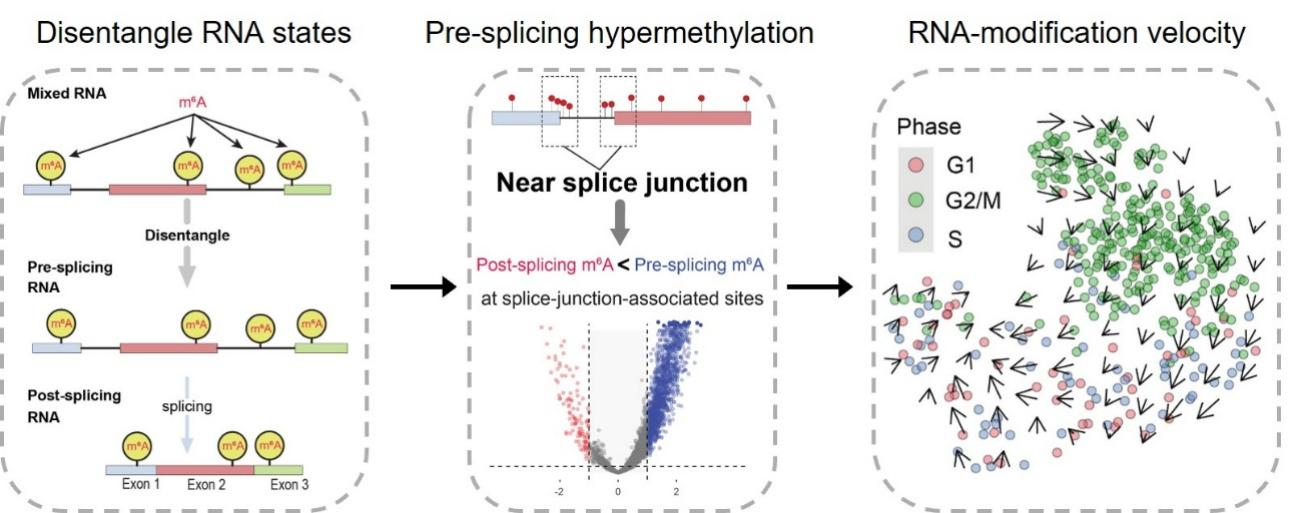
VeloRM disentangles pre- and post-splicing RNA modification signals, identifies pre-splicing m⁶A hypermethylation near splice junctions, and infers RNA-modification velocity during cellular transitions. Credit: Meng et al. DOI: Credit: Meng et al. DOI: 10.1093/nar/gkag645
Understanding how cells change
Using single-cell m⁶A data, VeloRM identified patterns of RNA modification associated with the cell cycle, the process through which cells grow and divide. These patterns were broadly consistent with known stages of the cell cycle.
The analysis also highlighted a potentially important stage in this process.
“The approach identified a transient cellular state associated with RNA modification regulation, during which RNA modification levels undergo rapid changes. This state may represent an optimal window for therapeutic intervention,” says Professor Meng.
The researchers also applied VeloRM to A-to-I RNA editing data and captured changes associated with cell differentiation, in which cells develop specialised functions. This suggests that the tool could be used to study different types of RNA modification and a range of biological processes.
“We hope this tool will help researchers better understand the roles of RNA modifications as cells change, rather than viewing them only as static signals captured at a particular moment,” says Wang.
This knowledge may eventually help researchers understand how normal cellular processes become disrupted in diseases such as cancer and neurological disorders, and support future research into RNA-based treatments.
As VeloRM is a computational framework, further experiments will be needed to confirm the biological roles suggested by its analyses.
More broadly, the study demonstrates how RNA biology, single-cell sequencing and computational modelling can be combined to reveal new insights from complex biological data.
The study, titled “VeloRM: Disentangling pre- and post-splicing RNA modification dynamics at single-cell resolution”, has been published in Nucleic Acids Research.
By Luyao Wang
Edited by Patricia Pieterse
Header picture:Unsplash
02 Jul 2026