








Birds respond quicker to predators in habitats with greater species diversity

25 Nov 2026


Study shows improved flow of information, threat alerts among more diverse bird communities
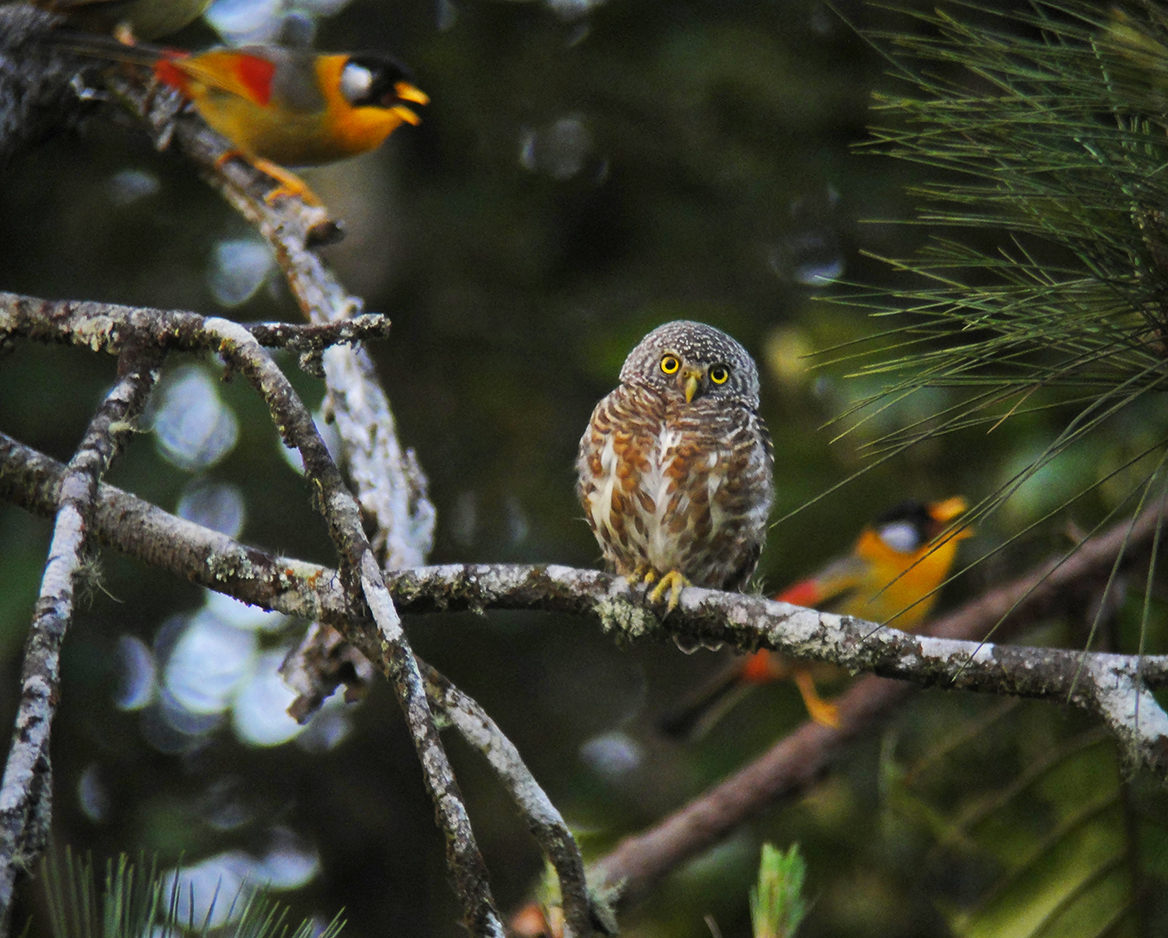
A Collared Owlet (Taenioptynx brodiei) is mobbed: mobbing involves prey birds detecting a stationary predator and recruiting other birds to come and harass it, and thus is an important example of information flow in animal communities
The diversity of species in a habitat is a common focus of conservation efforts. Local biodiversity has been shown to influence important ecosystem functions like pollination and pest control. In this study, Agnishikhe Kumar, a PhD student at XJTLU and her colleagues investigated the impact of diversity on the flow of ecological information in the form of defensive bird calls.
The team conducted several hundred experiments across ten nature reserves in eastern China. In the first round of experiments, researchers used flying hawk models and sitting owl models to encourage prey birds to respond either with alarm calls, which alert fellow birds to flee, or mobbing calls, which recruit other birds to gather around the predator and repel the threat. In the second round, the team played recorded mobbing calls on speakers to invoke responses from local birds, varying the number of species that were included in the sounds, from one to eight. The team found that increased species diversity in the recorded call playback was strongly correlated with larger mobbing groups, as well as faster and more response calls.
These results further highlight the importance of local biodiversity, indicating that in habitats with reduced species richness, local prey might exhibit weaker responses to danger thanks to diminished flow of community information. The authors note that future research might identify similar patterns with regard to other information such as valuable resources or habitat space, and in other groups of influential animals such as insects.
The authors add, “The number of birds signaling about predation increases with the species diversity of the community, even in the high-risk context of alarm calls. Further, we show using a manipulative playback experiment that the more species that signal in mobbing contexts, the larger the response, demonstrating that species diversity can influence the transmission of information.”
Read the study “Species diversity increases information flow about predation in bird communities” here.
Written by PLOS Biology
Edited by Vionna Fiducia Theja
Images courtesy of Khoo Siew Yoong
25 Nov 2026
RELATED NEWS
Wildlife import linked to higher risk of animal-human disease outbreaks
The 21st-century epidemics of animal-human diseases, or zoonotic pathogens, such as MERS, SARS, and Covid-19, have demonstrated how pathogen spillover from a...
Learn more

Can AI read conflicting emotional signals?
When people communicate, words may not tell the whole story. A person may say “I’m fine” while speaking in a low, unhappy voice and looking tired. Humans...
Learn more