




09 Feb 2026


By bridging consumer behavior and innovation adoption with urban planning and transport studies, a new interdisciplinary study from Xi’an Jiaotong-Liverpool University demonstrates how cross-school collaboration can generate innovative insights into complex urban challenges.
Titled “Anticipation of urban mobility futures beyond adoption: User segmentation across scenarios in two pioneering Chinese cities”, the study is based on a large-scale survey of 1,968 residents in Shanghai and Suzhou and moves decisively beyond conventional adoption models.
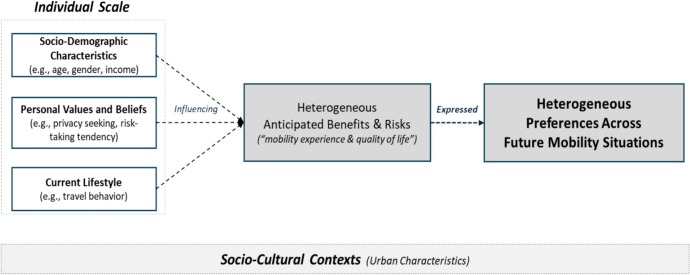
Rather than asking whether people would use autonomous vehicles, it examines how different social groups evaluate future mobility scenarios through anticipated impacts on daily life, including time use, stress, safety, social connection, and congestion.
The research brings together Dr Eunkyung Lee and Dr Yang Lu from the Department of Intelligent Operations and Marketing (International Business School of Suzhou), and Dr Juhyun Lee and Dr Hyung-Chul Chung from the Department of Urban Planning and Design (Design School), combining expertise that is rarely integrated in mobility research. The result is a novel framework for understanding how people anticipate future mobility - not merely as a technology to adopt, but as a system shaping everyday quality of life.
Insights into urban mobility preferences
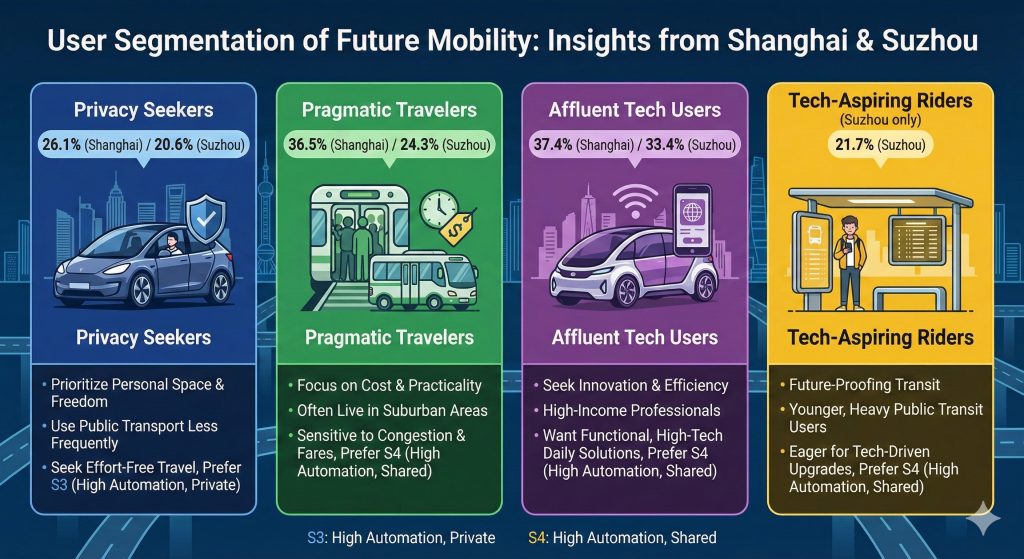
The study shows that urban mobility users are highly diverse. In both Shanghai and Suzhou, similar types of anticipation for future mobility use can be identified - for example, those who value privacy, and those who care about saving money and time.
However, Suzhou stands out with the emergence of a distinct group of younger public-transit users who are open to new technologies and future-oriented services, underscoring Suzhou’s position as a fast-growing, innovation-driven satellite city. The contrast suggests how mobility expectations are shaped not only by age or income, but by urban structure, labor-market dynamics, and everyday travel realities.
More importantly, the study shows that residents do not assess future mobility as just another transport option. Instead, they evaluate it as an integral part of everyday life and urban well-being. Anticipated impacts on safety, mental health, and privacy play a decisive role in shaping preferences, revealing why uniform, one-size-fits-all mobility solutions do not work well in complex urban transitions.
Bridging disciplines in mobility studies
Traditional mobility studies often focus on infrastructure efficiency or technology acceptance, while consumer research tends to examine individual preferences and adoption in isolation. By integrating these perspectives, the XJTLU team was able to reveal different user segments whose expectations for future mobility are shaped by values, lifestyles, and urban and transport context - not just socio-demographic factors like income or age.
This cross-school approach enabled the researchers to combine scenario-based mobility futures from urban planning with preference-based segmentation methods from marketing and consumer research. It also links mobility choices to broader quality-of-life outcomes, rather than treating transport as a standalone service.
Implications beyond mobility
This study is part of an ongoing future mobility research agenda launched in 2023, through which the team has been systematically exploring how emerging mobility technologies intersect with everyday quality of life and what inclusive AI-enabled service means.
Beyond its substantive findings, the research stands as a proof of concept for cross-school collaboration in tackling complex societal transitions. It shows how integrating methods and theories across disciplines can generate richer, more policy-relevant knowledge - particularly for challenges such as autonomous mobility, smart cities, and sustainable urban transitions.
Ultimately, the study demonstrates that successful mobility futures - and successful urban research -depend not on single disciplines, but on meaningful collaboration across them.
Story and images provided by Dr Juhyun Lee and Dr Eunkyung Lee
Edited by Yi Qian
09 Feb 2026