




11 May 2026


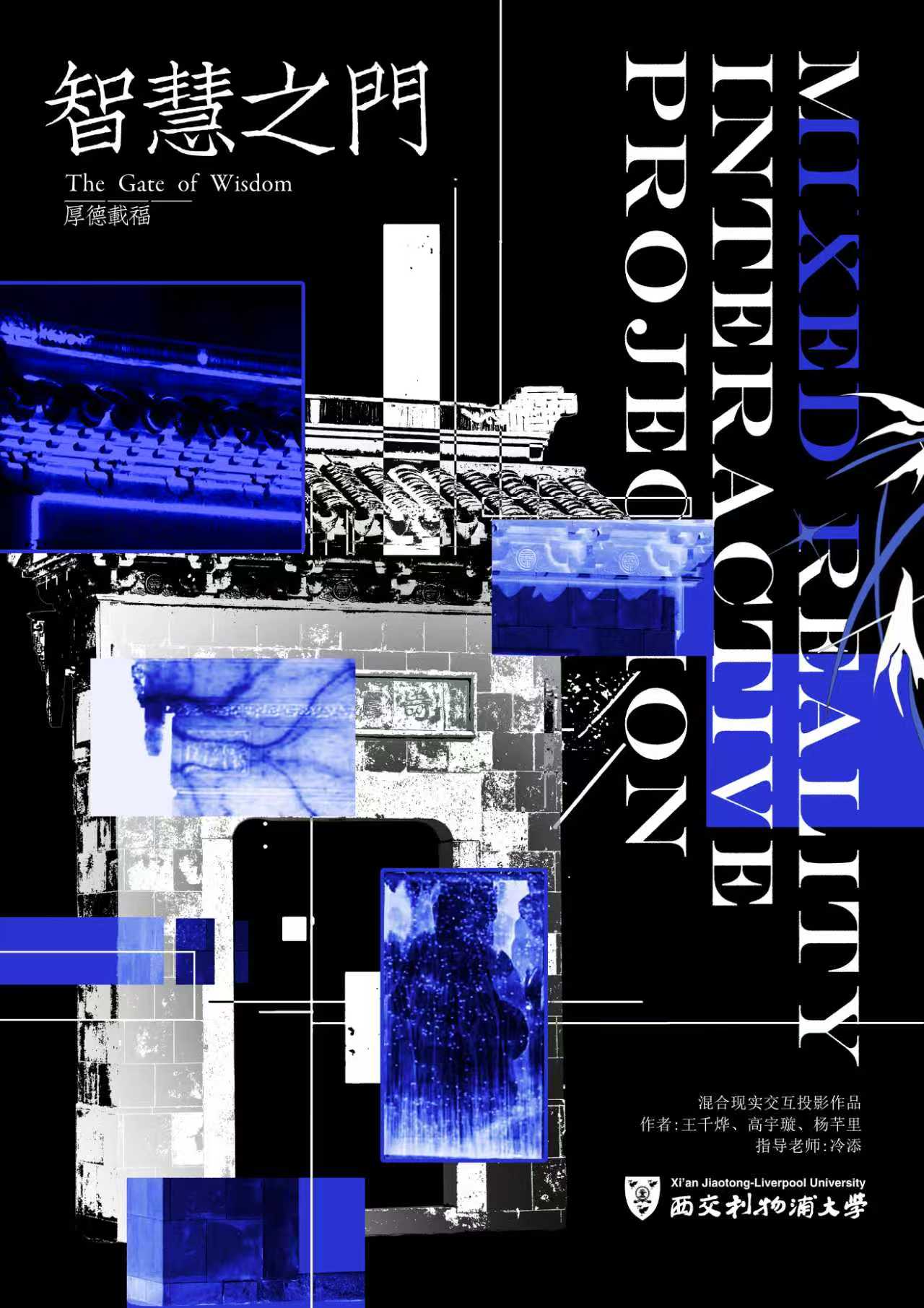
Three final-year students from Xi’an Jiaotong-Liverpool University’s Academy of Film and Creative Technology (AFCT) have won a national second prize in the Digital Media Arts category at the fourth China Brand Design Awards with their project Door of Wisdom: A Mixed-Reality Interactive Projection Mapping.
Created by Yuxuan Gao and Qianye Wang from the Digital Media Arts programme, and Qianli Yang from the Art and Technology programme, the project originated from a Summer Undergraduate Research Fellowship (SURF) led by Tian Leng in 2025. Through continued refinement and on-site experimentation, it developed from a research project into a complete work combining cultural expression with spatial interaction.
Starting from a research question
The project takes the Door of Wisdom, a landmark structure on the XJTLU campus, as its creative site. With its distinctive three-dimensional form and layered spatial qualities, the building also carries cultural associations with Suzhou and symbolic significance within the University, providing a rich foundation for digital creation.
Leng says that the project was designed to move beyond conventional projection mapping, in which animation is simply projected onto a surface. Instead, the team sought to treat the building itself as a three-dimensional canvas.
He explains that the project had three main aims: to create with architecture as a three-dimensional space, to introduce real-time interaction so that the work could respond to audience input, and to ensure that the digital expression engaged with the cultural meaning of the Door of Wisdom itself.
In this sense, the project’s “mixed-reality interaction” was not intended as a simple overlay of virtual imagery onto a real building. Rather, it aimed to activate a relationship between digital content, architectural space and audience participation.
Following this approach, the students first examined the history, symbolism and cultural significance of the Door of Wisdom before moving on to visual design and interaction development.
“The Door of Wisdom carries the cultural depth of Suzhou, but it also represents XJTLU’s spirit of continually striving upwards and pursuing wisdom,” says Wang. “That was one of the key reasons we chose it.”
Responding to architecture and culture through digital technology
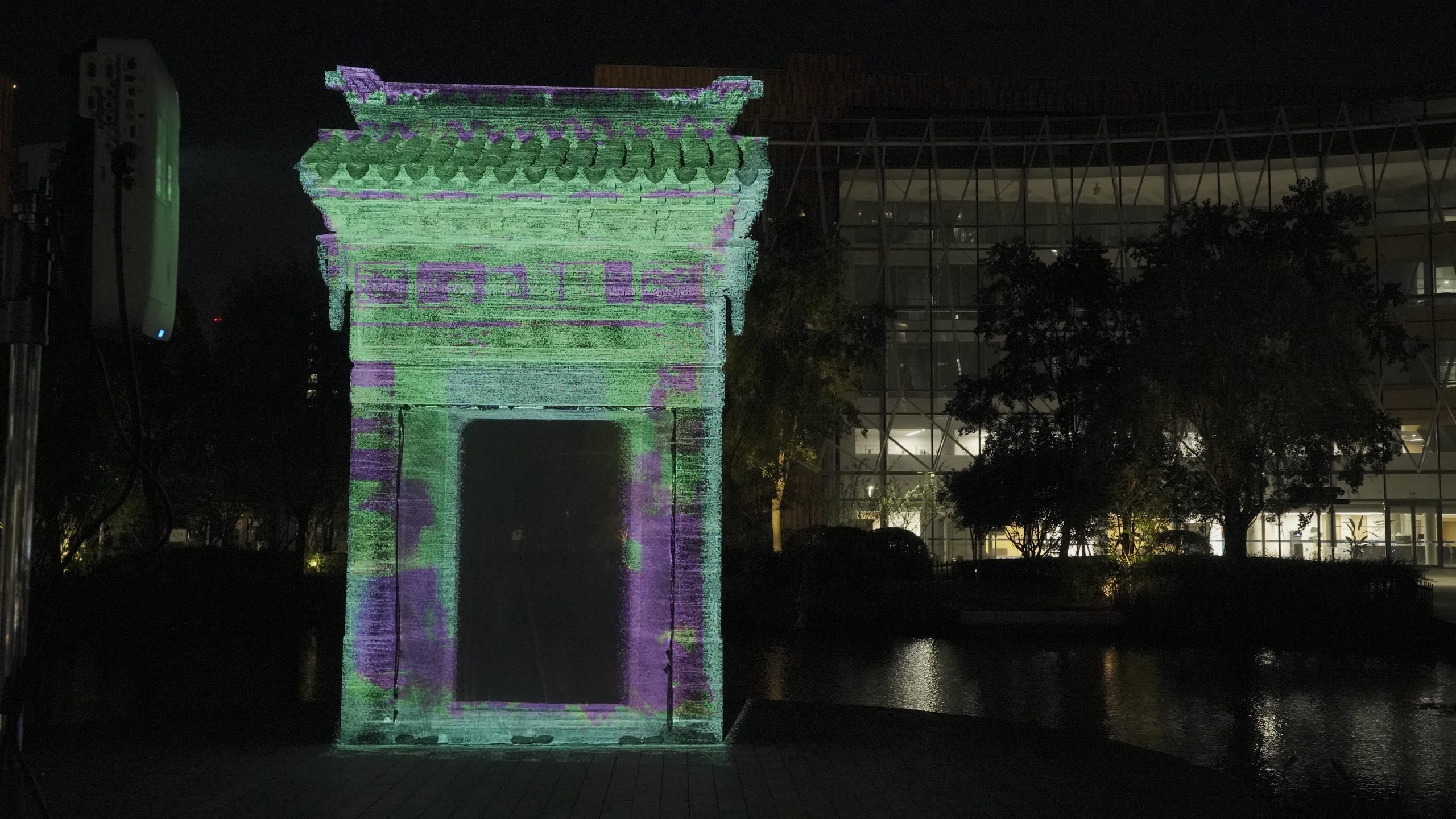
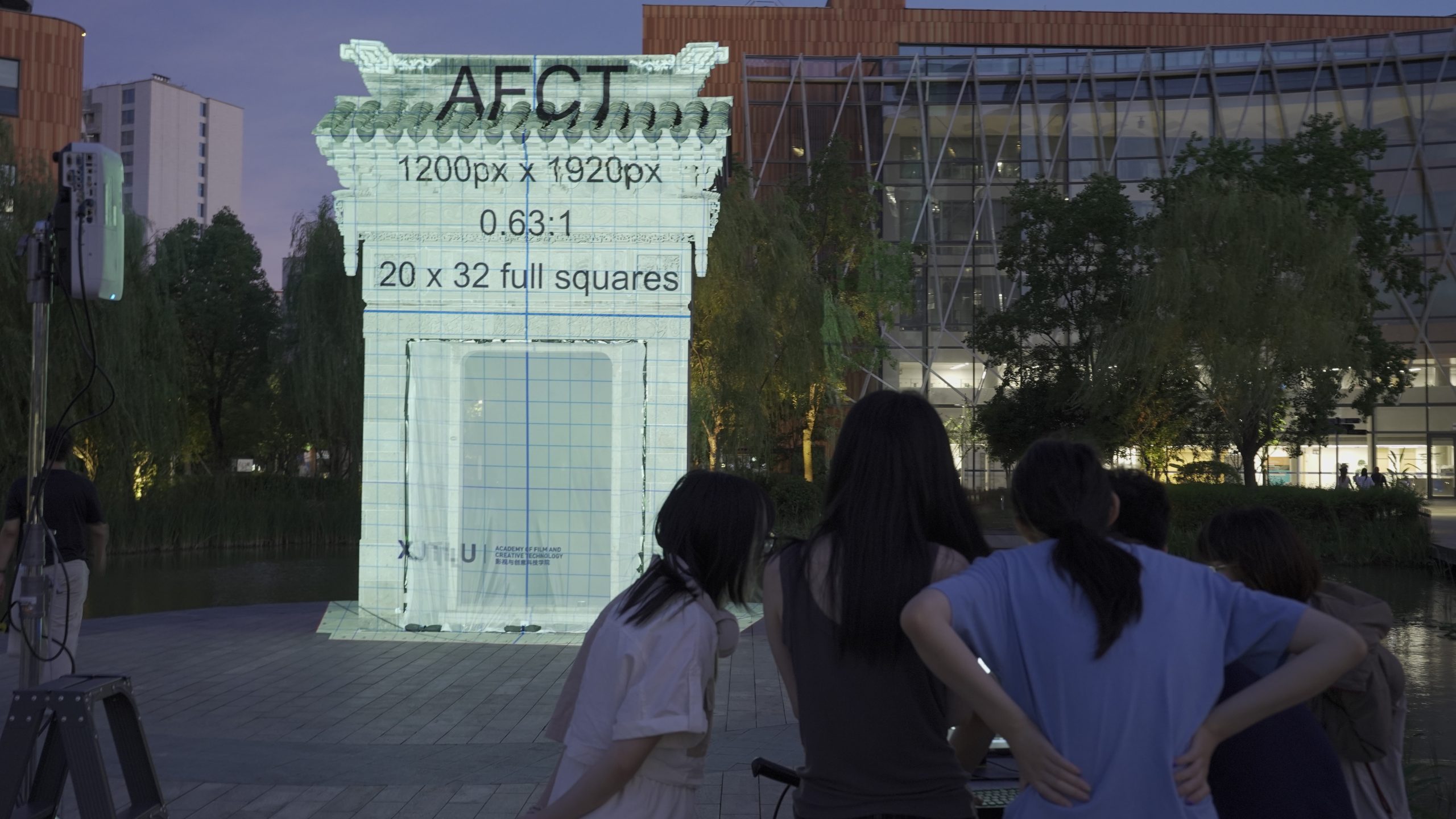
A key stage of the project was the high-precision digital reconstruction of the Door of Wisdom. Using DSLR cameras and drones, the team captured the structure from multiple angles, then carried out colour correction, 3D reconstruction and post-production refinement to create a textured digital model that became the basis for the later projection design.
“That 3D model functioned like a digital canvas,” says Leng. “All of the later projection design was developed on that basis.”
Building on this foundation, the three students developed their work in different directions, together creating a layered and varied visual language.
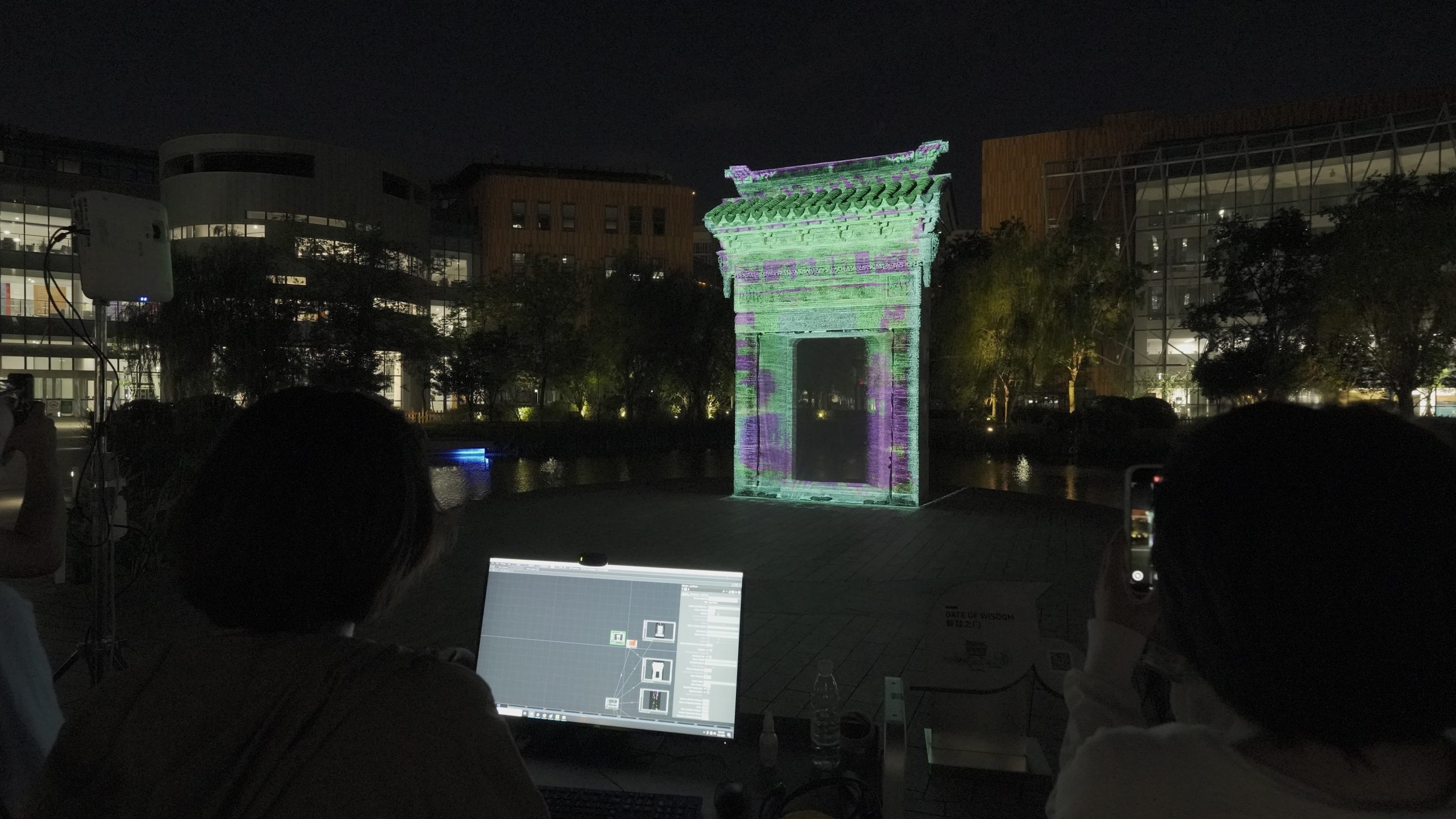
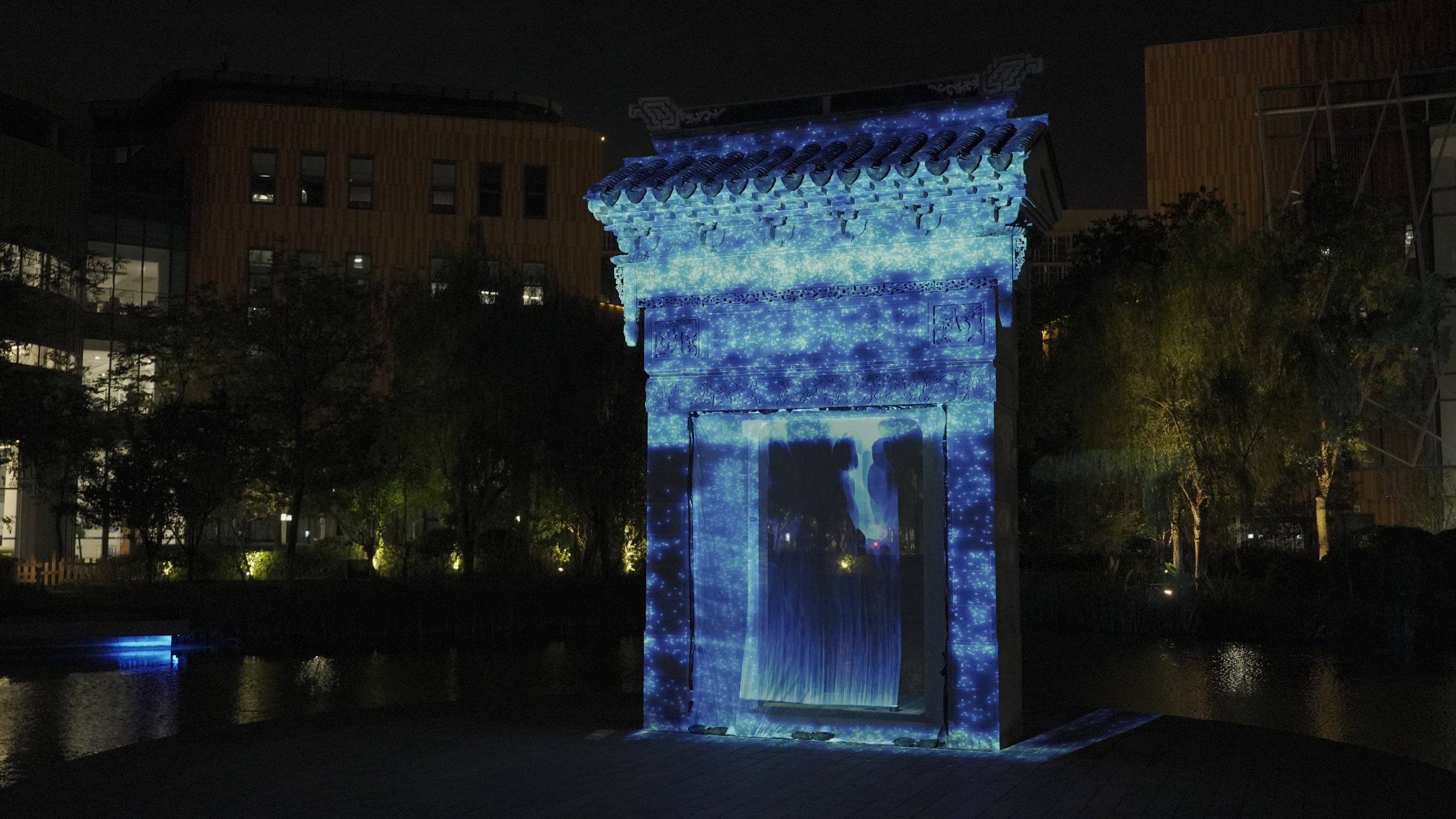
Wang was responsible for architectural scanning, 3D reconstruction and ink-wash interaction design. Using sound as a trigger, she created a dynamic ink-flow effect inside the archway, while particles around the frame changed in response to variations in volume.
“I chose ink elements partly for aesthetic reasons, but also because I wanted the work to echo Suzhou’s cultural atmosphere and allow the digital imagery to blend more naturally with the traditional architectural character of the gate,” she says.
After learning during her research that the original Door of Wisdom had experienced destruction and restoration, Yang transformed this historical thread into a visual sequence based on the dispersal and re-formation of particles.
“I wanted the particles moving from dispersal to aggregation and back again to reflect that history of destruction and reconstruction,” she says.
Gao focused on the structure, outline and materiality of the gate. She developed multiple visual sequences based on stacking, weaving and geometric construction, and also experimented with keyboard-and-mouse interaction and camera tracking to allow audience movement and input to influence the work in real time.
Leng says that although the three students’ works differed in form, they came together like “three chapters of the same piece”: one foregrounding a contemporary digital visual language, one drawing on Jiangnan cultural imagery, and one using particles and motion to highlight the architecture’s sense of transformation and reconstruction.
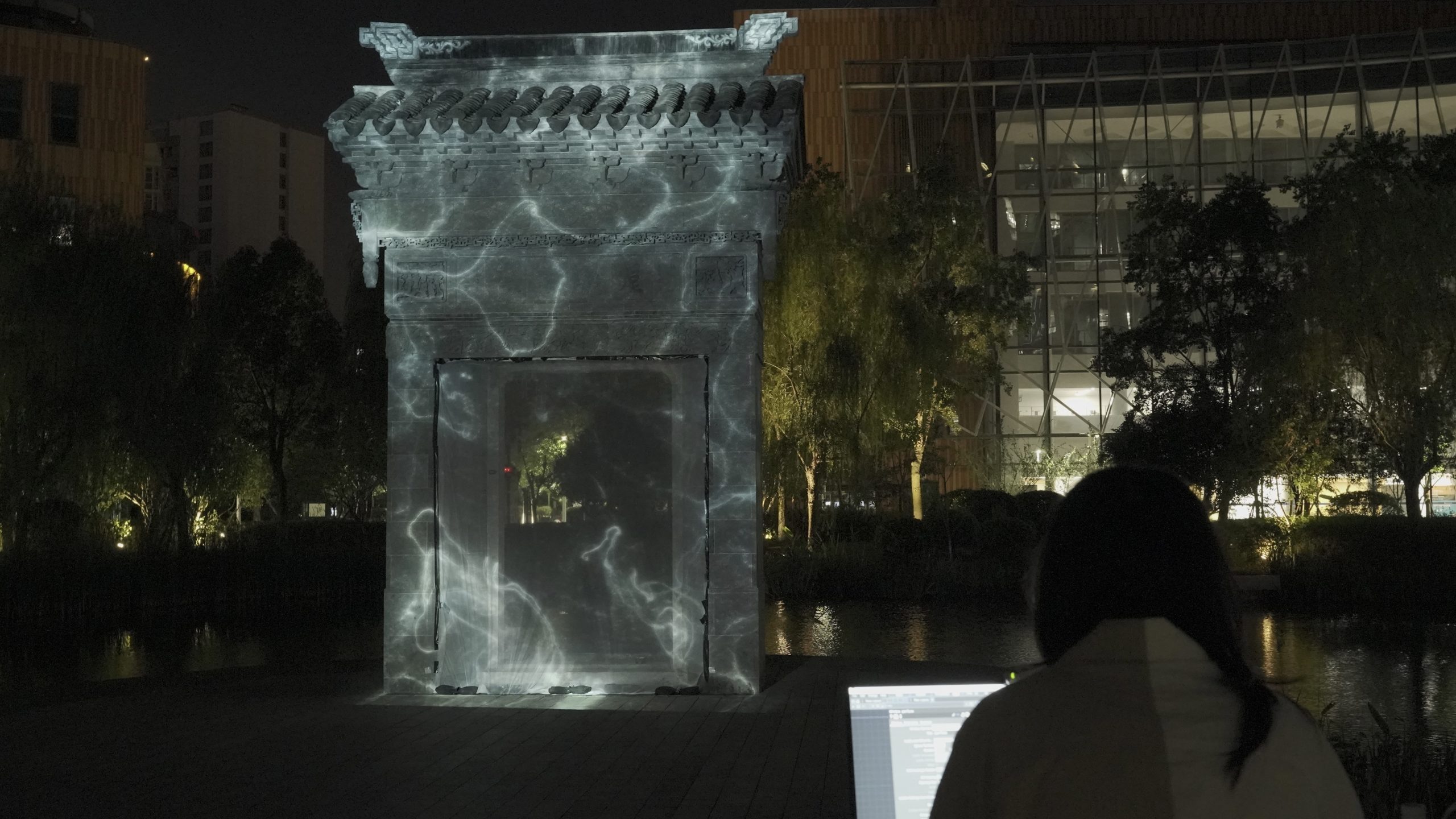
Realising the work in a real-world setting
Projecting the work into a public campus space proved far more challenging than testing it in the controlled conditions of a lab. In the early stages, the team rehearsed workflows on rockery forms and projection walls, simulating projector placement, brightness, interaction logic and coordination between multiple devices. At the actual Door of Wisdom site, they also had to transport and assemble equipment, coordinate power access, manage cabling and calibration, and respond to weather, wind and changing light conditions.
One planned projection test had to be cancelled because of bad weather. It was only on a second attempt, under suitable conditions, that the team completed a full on-site experiment in the South Campus square. The transition from laboratory testing to a real-world setting further highlighted the project’s research-based nature.
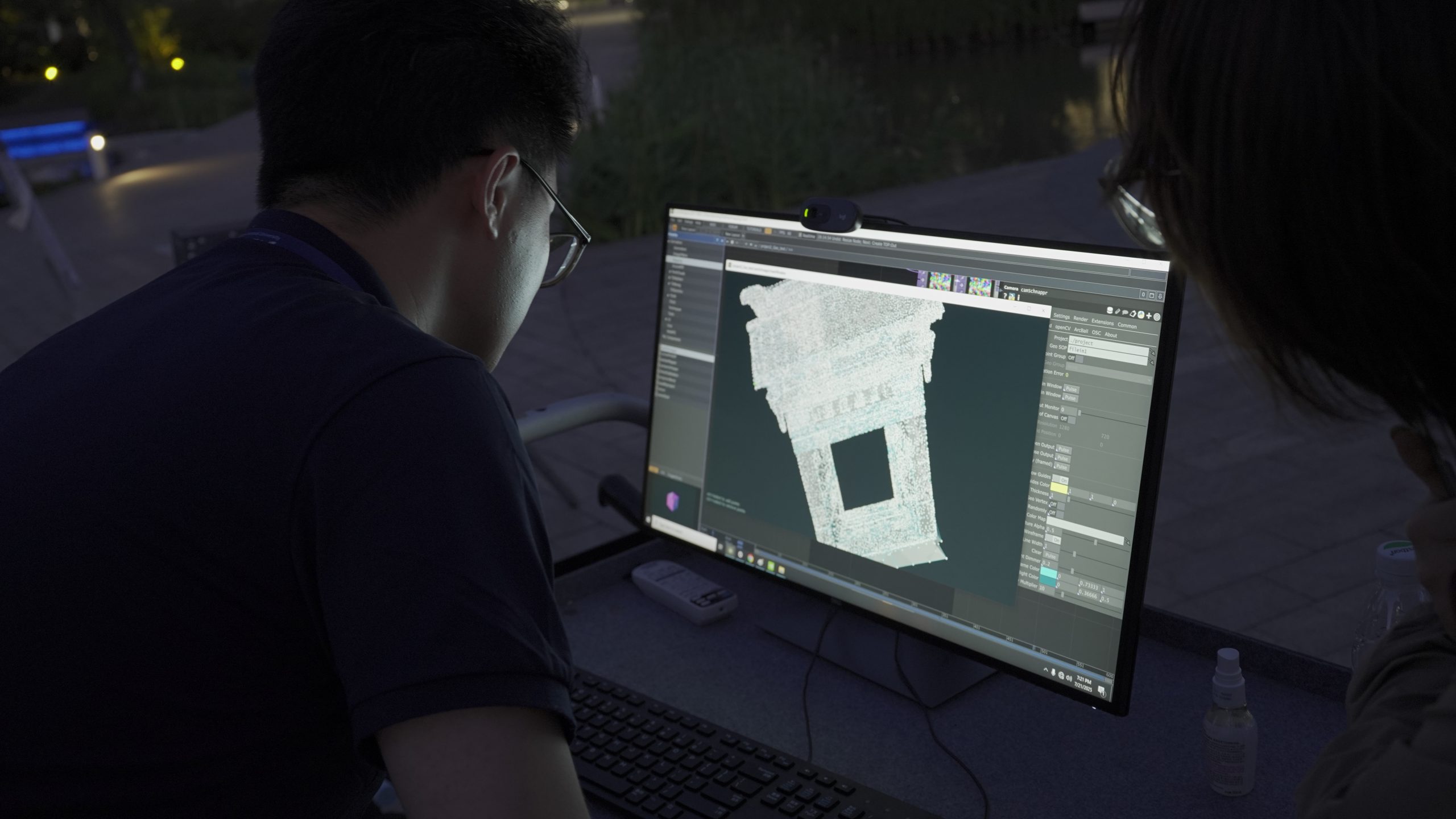
“Many effects that seem to work on a computer screen change once they are projected onto real brick surfaces, at real distances and under real lighting conditions,” says Leng. “Colour rendering, projection angles, material alignment and even interaction triggers all have to be rethought and adjusted on site.”
For the three students, one of the most important gains from the project was experiencing the full process from research and testing through to on-site realisation.
“Before this, many of our assignments existed only on screen,” says Yang. “This was the first time I truly felt the difference between something inside a computer and something becoming a three-dimensional presence in real space.”
“We had to do research, solve practical problems on site, keep adjusting things and revise our original ideas according to what actually happened in the space,” says Wang. “That process taught me a great deal and helped me better understand the possibilities of digital art in public environments.”
Reflecting on the creative process, Gao adds: “Coursework is usually about applying what you have already learned. This project was different because we started with an idea and a problem, and then had to find the methods and technical path to realise it. It also gave me the opportunity to work with equipment and media that we do not often use in class.”
Leng says the project reflects AFCT’s emphasis on interdisciplinarity, practice-based learning and research-led teaching.
“The students started from a research question, kept testing and refining their work in a real site, and brought together digital technology, spatial experimentation and cultural understanding,” he says. “The value of the project lies not only in the award itself, but also in the fact that the students experienced the full creative process from research to realisation.”
By Wenzhen Li
Photos courtesy of Tian Leng
11 May 2026