




Professor Andre Brown: It wasn’t a question of whether XJTLU would be successful. It was how successful

08 May 2026


When Professor Andre Brown arrived at Xi’an Jiaotong-Liverpool University (XJTLU) in 2014 to take on the role of Vice President of Academic Affairs, he wasn’t walking into unfamiliar territory.
As former head of the University of Liverpool’s School of Architecture, he had already spent years travelling between Liverpool and Suzhou to help establish XJTLU’s architecture degree, now a flagship offering.
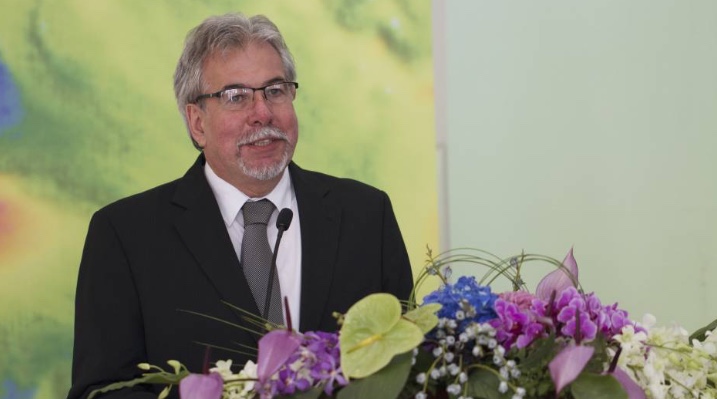
Professor Andre Brown at XJTLU’s 10th anniversary in 2016
Yet stepping into one of the institution’s most senior leadership roles was a different proposition.
“It was quite different to the roles I’d had before,” Professor Brown says. “I knew the campus, and I knew the people, but being VP of Academic Affairs meant understanding all the schools, all the areas, and how the whole University was being managed.”
One of the first things Professor Brown had to come to terms with was the sheer pace of life at the University.
He recalls XJTLU’s Executive President, Professor Youmin Xi, describing the expected work ethic as “7-11” – seven days a week, 11 hours a day. “You’d get maybe a couple of hours at the weekend,” Professor Brown says. “It was full on, long hours.”
Raising the bar
Professor Brown arrived at XJTLU with a clear mandate: to extend its already strong reputation for undergraduate teaching into the realm of postgraduate study and research.
“I was building on the foundations laid by the previous two VPAAs, Professor Jeremy Smith and Professor David Sadler,” he says.
The University had grown rapidly to become China’s largest Sino-foreign joint venture university by student numbers, and the quality of its intake was, in Professor Brown’s words, “not just pretty good – outstanding.”
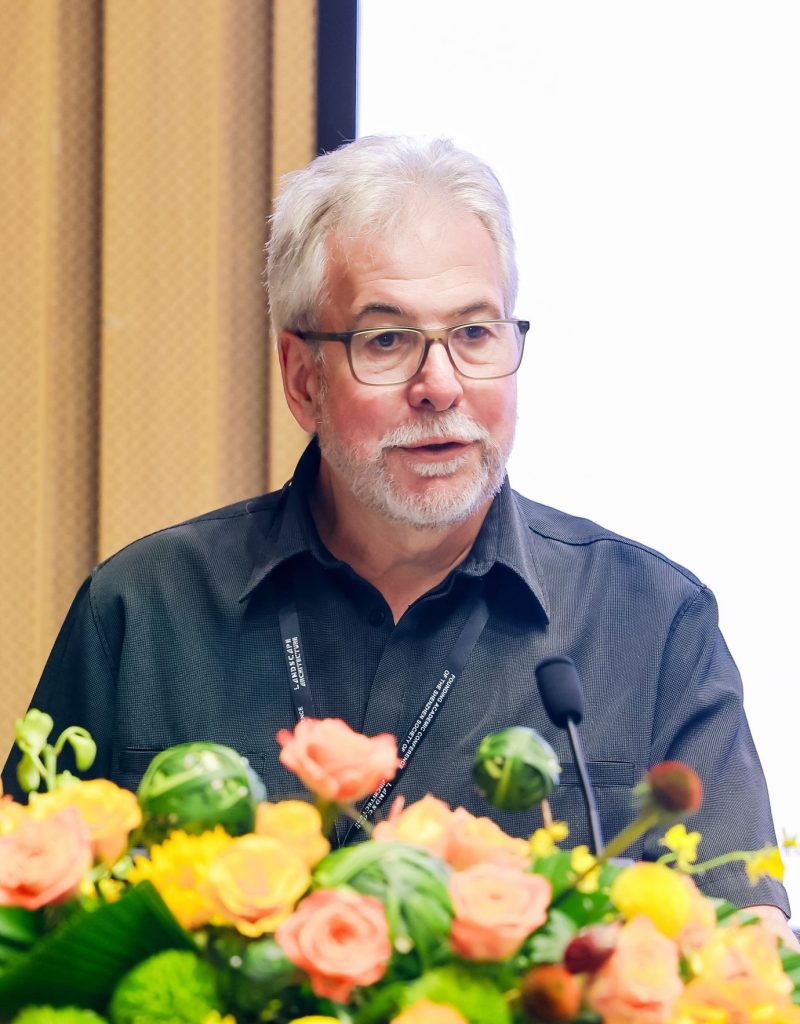
Professor Brown presenting a conference keynote in 2025
The ambition now was to build toward a genuine research university.
“The first PhD was being examined the year I arrived,” he says. “I oversaw the first six or seven examinations myself, so that I could reassure the University of Liverpool that the quality was right.”
His approach to growing research capacity was methodical. Rather than attempting to drive research activity across every department, he worked to understand which areas had genuine potential – the right staff, the right industry connections, and the right conditions to succeed.
Suzhou’s advanced industrial landscape made this easier than expected: schools such as electrical engineering already had emerging key laboratories; biosciences had links to the city’s thriving biotech cluster; and the business school had long-standing ties to an impressive range of international industries with a significant local presence.
“It was a matter of working out what the landscape was like, rather than trying to do everything with everyone all at once,” Professor Brown says.
Crucially, there was little friction over funding. China’s national talent recruitment schemes – the Thousand Talents and Hundred Talents programmes – made it relatively straightforward for internationally recognised academics based at XJTLU to secure research funding.
“If you were a professor from outside China with a reasonable reputation, you could get funding quite easily compared to other countries at that time,” Professor Brown notes. The University was also able to be relatively generous with internal funding for academic staff with research in promising areas.
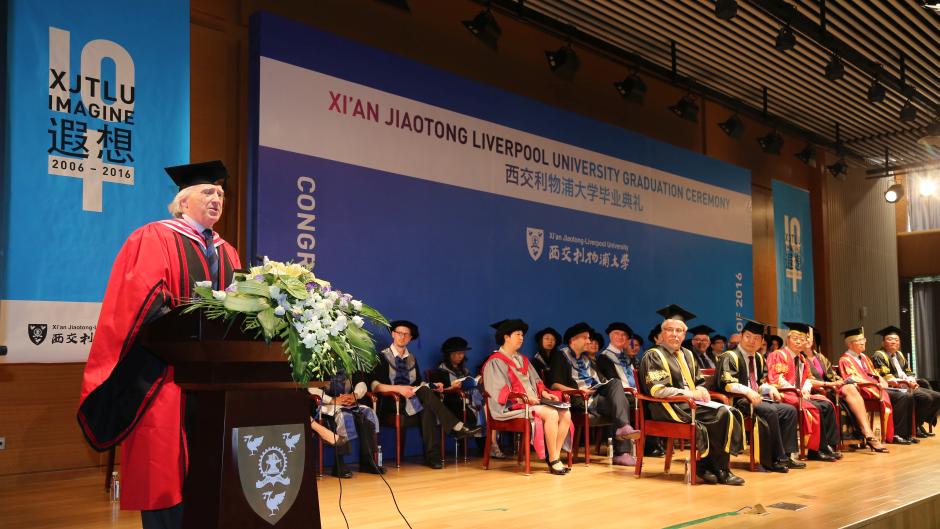
XJTLU’s first honorary degree awarded in 2016 to Sir Drummond Bone (left), former VC at the University of Liverpool
Milestone moment
When XJTLU celebrated its 10th anniversary in 2016, Professor Brown says the mood had shifted from the cautious optimism of the early years. “By that point, the question was no longer whether this was going to be a success. It was: how good can we be? How big can we be?”
Postgraduate enrolments were growing, and professional accreditations were arriving: the business school had earned the “gold standard” AACSB accreditation and was working towards Triple Crown status, while the architecture programme had secured RIBA Part 2 accreditation for its master’s degree.
And in a sign of its wider reputation, a UK government delegation led by Jo Johnson, then Minister for Universities and Science, visited XJTLU that year to showcase the best of British higher education in China.
“Other universities from around the world were visiting us to learn from what we were doing,” Professor Brown says. “By 2016 it was much more about blue sky thinking.”
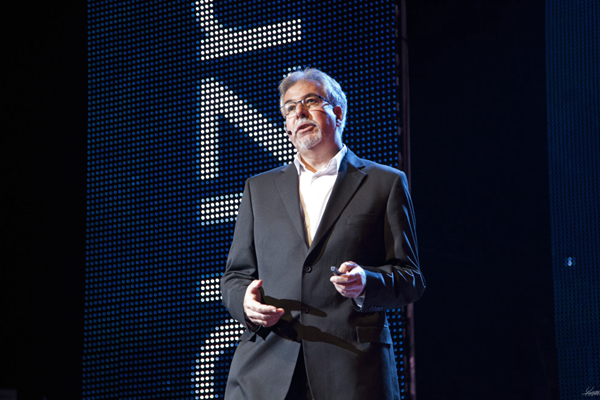
Professor Brown presenting at TEDx Suzhou
It was also around this time that Professor Brown proposed one of the anniversary’s most enduring gestures: a canal boat, gifted by the University of Liverpool, to symbolise the shared history of Liverpool and Suzhou. Historically, both cities grew prosperous through the trade carried on their waterways. The boat sits outside XJTLU’s Central Building as a permanent reminder of the partnership’s origins.
Professor Brown was also able to play a role in coordinating the final stages of XJTLU’s South Campus, an organic counterpoint to the more rectilinear plan of the Central Campus (formerly North Campus). The design, conceived by British architects BDP, was an expression of Professor Xi’s philosophy to create an educational environment inspired by natural systems, an "educational ecosystem", where ideas could grow and interconnect freely.
In addition to deciding which schools would move where, how discipline clusters could be optimised, and how the new facilities could best serve the University’s academic ambitions, Professor Brown was particularly enthusiastic about making the tunnel beneath the canal a space for student societies; a main route that encouraged greater interactions between different cultures, and to highlight the wide range of passions outside the academic curricula.
However, Professor Brown concedes that the opening ceremony for the South Campus did involve a degree of creative timing.
“We cheated a bit – some buildings were finished, some still needed finishing touches, because we had had heavy rains and the construction process had been disrupted. But we did it,” he says. “It put a big marker down: we had become a nationally and internationally known success, we had doubled in size, we had great facilities and outstanding students. It was all looking good.”
Forward momentum
Since ending his term as VP of Academic Affairs in 2017, Professor Brown has returned to China a handful of times, including for research toward his book “The Architecture of Suzhou”, published in 2026.
He says he is pleased that some of the ideas he championed at XJTLU – embedded language teaching across disciplines, stronger support structures for the language centre, more distributed senior academic leadership – have taken firm root.
“It was good to see that those things are pretty well established,” he says. “The language centre has a much more comprehensive remit now: modern languages, strategic research, conference publications. That’s good to see.”
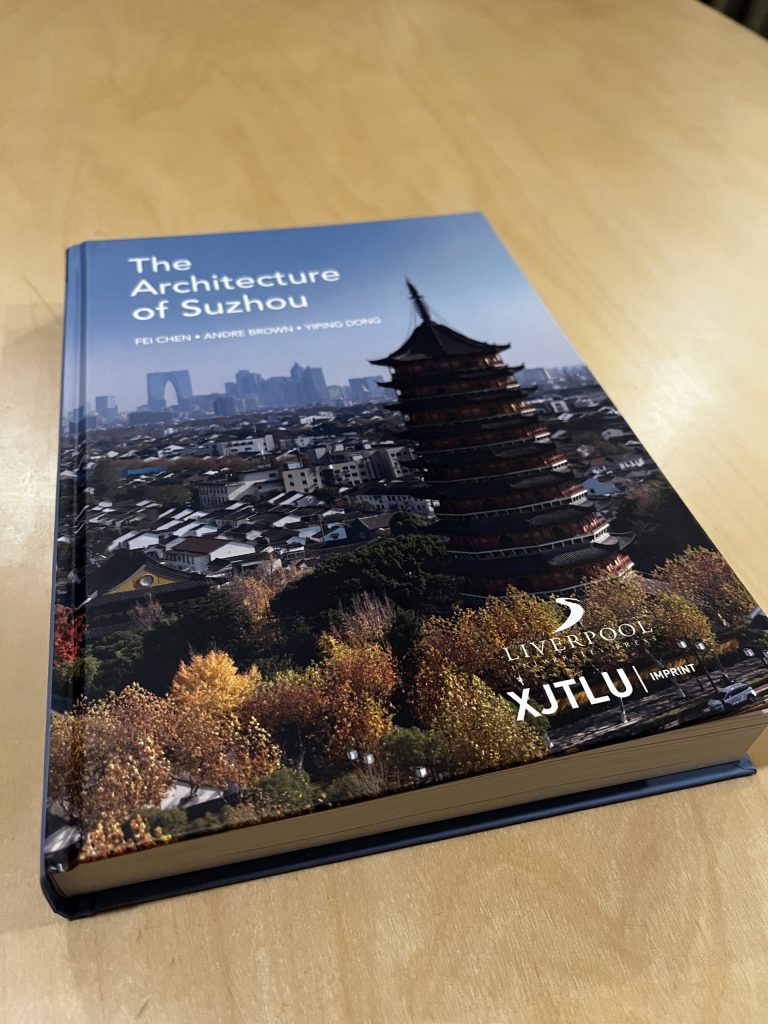
The Architecture of Suzhou, by Professor Fei Chen, Professor Andre Brown, and Dr Yiping Dong
Looking at the past 20 years, Professor Brown believes that the key to XJTLU’s success has been its ability to operate simultaneously at the local and the national level – to be responsive to Suzhou’s booming but carefully managed industrial and civic context, while maintaining strong relations with the central government.
Today, Professor Brown is mining his experience from leading a Sino-foreign partnership to build another one. In his current role, as Professor of Interdisciplinary Design and Associate Dean International at the Wellington School of Architecture, Victoria University of Wellington, New Zealand, he is leading academic management of a new joint education institute partnership with China’s Zhengzhou University.
Like the Liverpool partnership with the high-ranked and nationally esteemed Xi’an Jiaotong University, this partnership benefits from the partner being the only ‘double first class’ University in Henan province. The institute admitted its first cohort of students in September 2024.
His advice to anyone taking on a similar challenge is to invest in relationships before you need them, listen more than you speak, and resist the temptation to believe that what succeeds elsewhere will automatically work in your situation.
XJTLU was not a transplant of a British university onto Chinese soil – it was something entirely new.
For XJTLU's 20th anniversary, he says: “It was an immense privilege to serve as Vice President of Academic Affairs at the time of the 10th anniversary celebrations and the completion of the South Campus. It has been wonderful to witness the continued growth and successes in the subsequent years, for XJTLU to become a fantastically successful and innovative millennial child that has matured fully in the digital age.”
By staff writer
Edited by Patricia Pieterse
08 May 2026
RELATED NEWS
After growing with IBSS, Dean Eddy Fang is asking what comes next
At XJTLU’s International Business School Suzhou (IBSS), Professor Eddy Fang has been thinking less about whether the School is international enough and more ...
Learn more
From chromosomes to construction: Professor Jionglong Su on interdisciplinarity
A robotic dog patrols a construction site, carefully counting every single steel bar. This isn’t some scene from a virtual world – it’s an ongoing project by...
Learn more