





Research Output


Open-Source Projects and Models

Other Outcomes
1.Great-X
GREAT-X is a dedicated single-engine multimodal simulation platform for 6G ISAC research, featuring millisecond-level synchronization of image rendering and ray tracing, supporting full-scenario adaptability and multi-weather simulation, and building a high-fidelity data foundation for research.
2. DMS
The Driver Monitoring System (DMS) is designed to detect dangerous driving behaviors in real-time, including gaze distraction, fatigue, and distractions like phone usage, smoking, eating, or drinking. It integrates comprehensive facial functions—recognition, detection, and attribute analysis—with robust mask compatibility and multi-level voice alerts. Available in both RGB and NIR versions, the system ensures high-precision monitoring around the clock, even in low-light conditions.
Projects
In 2025, ILAI and its cross-disciplinary teams on campus actively undertook research tasks at various levels, focusing on core areas such as low-altitude perception, decision-making, communications, and policy.
As of January 2026, they had led or participated in a total of 15 low-altitude economy research projects at provincial, municipal, and institutional levels, including 5 provincial projects (e.g., Provincial Natural Science Foundation), 2 municipal government projects, and received support from corporate horizontal research initiatives.
The main projects are categorised as follows:
Publications
In 2025, the research team published over 40 papers in high-level journals and conferences, including IEEE Transactions series. A series of innovative achievements have been made in areas such as 6G low-altitude channel modelling, integrated sensing and communication, and UAV swarm intelligence. Representative outcomes include:
New publications in 2026:
The conceptual framework paper on Channel Foundation Models by Prof. Shugong Xu’s team, titled “6G Native Intelligence and Channel Foundation Models”, has been invited for publication in ZTE Communications. The paper systematically discusses the motivation and fundamental connotations of Channel Foundation Models in the context of 6G native intelligence, and is provided for reference by faculty, students, and researchers. (PDF download)
Open-Source Projects and Models
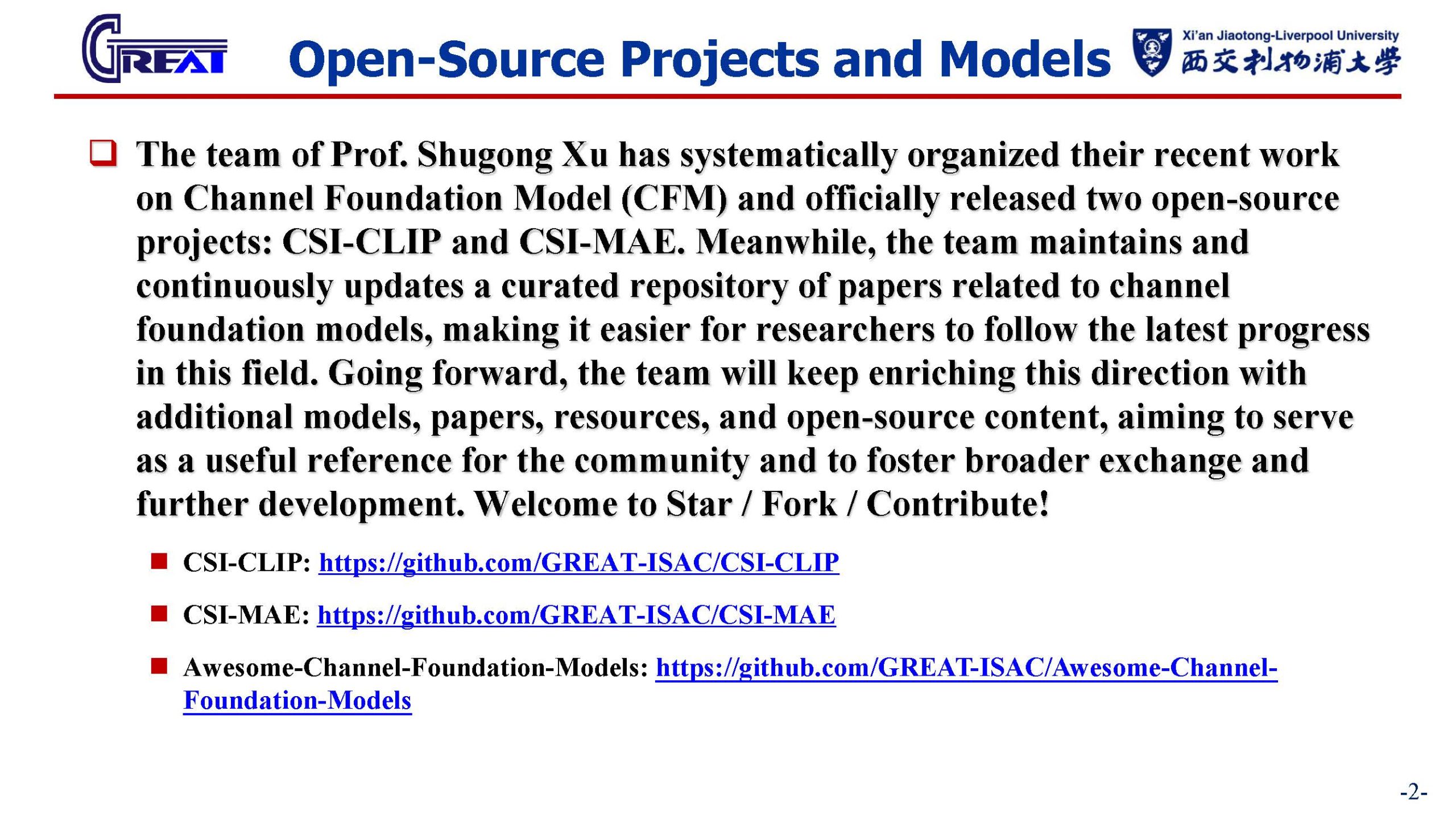
The team of Professor Shugong Xu has systematically organized their recent work on Channel Foundation Model (CFM) and officially released two open-source projects: CSI-CLIP and CSI-MAE. Meanwhile, the team maintains and continuously updates a curated repository of papers related to channel foundation models, making it easier for researchers to follow the latest progress in this field. Going forward, the team will keep enriching this direction with additional models, papers, resources, and open-source content, aiming to serve as a useful reference for the community and to foster broader exchange and further development. Welcome to Star / Fork / Contribute!