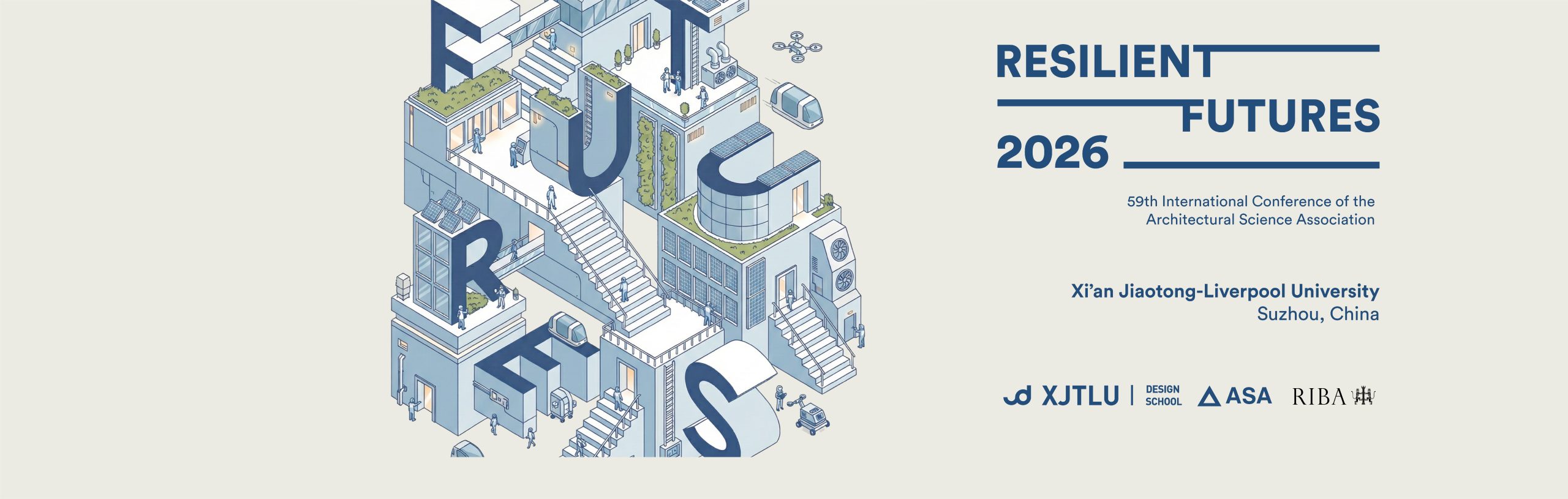
59th International Conference of the Architectural Science Association (ANZAScA)
Hosted by the Design School, Xi’an Jiaotong-Liverpool University (XJTLU)
25–28 November 2026
As the host institution for ASA 2026, the Design School, XJTLU is pleased to invite researchers, faculty members, and postgraduate students to submit research posters for presentation alongside the conference. This is an excellent opportunity to share original research related to the conference theme Resilient Futures with an international audience of scholars, practitioners, and industry partners in the built environment.
We welcome poster submissions that present:
Ongoing or completed research conducted by faculty, PhD researchers, or postgraduate students;
Preliminary findings, case studies, or methodological innovations aligned with the conference topics;
Research collaborations across disciplines or between early-career and senior researchers.
All submissions must clearly align with the conference theme and one or more of the tracks detailed below.
Conference Topics
Track 1. Architectural Science and Civil Engineering for a Changing Climate
Architecture, design, and environmental performance
Resilient and sustainable infrastructure systems
Structural resilience, disaster mitigation, and adaptive building codes
Building and energy simulation, prediction, and evaluation for extreme weather
Geotechnical and hydraulic engineering for climate adaptation
Life cycle analysis, circular economy, and regenerative design principles across projects of all scales
Indoor environmental quality and occupant well-being in a warming world
Track 2. The Intelligence-Augmented Design and Construction Frontier
Generative AI for sustainable design exploration, optimisation, and structural integrity
AI-driven building performance simulation and smart infrastructure control systems
Machine learning in urban analytics, transport planning, and outdoor environmental modelling
Digital fabrication, robotics, and mass customisation in architecture and civil engineering
BIM/CIM, digital twins, and AI for construction management and asset lifecycle
The ethics, philosophy, and societal impact of AI in architectural and engineering practice
Extended Reality for the simulation of the Design, Construction and Operation Environments
Track 3. Integrated Urban Systems and Social Equity
Resilient cities, Smart City, infrastructure networks, and adaptation planning
Socially just transitions and community-led design and development
Outdoor environmental quality, public space, and urban health
Practice, policy, and industry engagement for sustainable development
Architectural and civil engineering theory in the context of global challenges
Circular Economy in the Built Environment
Intelligent Built and Resilient Environment
Track 4. Materials, Innovation, and Cross-Disciplinary Education
Low-carbon and advanced construction materials (e.g., smart composites, bio-based materials)
Innovations in construction technologies and methods
Integrating resilience, AI, and SDGs into architectural and engineering andragogy
Novel methods in design education and transdisciplinary research
Community co-design and participatory action research
Exploring the new landscape of higher education in Architectural Science
Theory, philosophy and methodology in Architectural Science
Interconnectivity between research and industry
Track 5. Heritage and Conservation in Architectural Science
Heritage resilience, climate risk, and adaptation strategies for historic environments
Adaptive reuse as a resilient and circular pathway (life extension, embodied carbon, and regenerative redevelopment)
Digital heritage documentation: reality capture, photogrammetry, laser scanning, and semantic modelling
HBIM, digital twins, and data-driven conservation planning for asset lifecycle and maintenance
AI for condition assessment (damage detection, decay prediction, monitoring, and decision support)
Risk preparedness and post-disaster recovery for heritage sites and communities
Governance, ethics, and community values in conservation practice (identity, inclusivity, and social equity)
Accepted Poster Formats
We welcome traditional printed posters (portrait or landscape) as well as digital or interactive poster presentations (e.g., on-screen display or tablet-augmented). Posters should be suitable for academic dissemination and dialogue.
Submission Requirements
Please submit the poster itself (not a proposal). Each submission should include:
Poster file in PDF or high-resolution image format (e.g., JPG, PNG). Maximum file size: 20MB.
In the email body, please clearly state:
Title of the research
Authors and affiliations (names, roles, departmental affiliation)
Corresponding author’s email
Preferred poster format (printed or digital) and any technical requirements (e.g., power, internet, display size)
All posters will be reviewed based on their relevance to the conference theme, scientific merit, and clarity of presentation.





ASA 2026 Conference – “Resilient Futures”
59th International Conference of the Architectural Science Association (ANZAScA)
Hosted by the Design School, Xi’an Jiaotong-Liverpool University (XJTLU)
25–28 November 2026
As the host institution for ASA 2026, the Design School, XJTLU is pleased to invite researchers, faculty members, and postgraduate students to submit research posters for presentation alongside the conference. This is an excellent opportunity to share original research related to the conference theme Resilient Futures with an international audience of scholars, practitioners, and industry partners in the built environment.
We welcome poster submissions that present:
All submissions must clearly align with the conference theme and one or more of the tracks detailed below.
Conference Topics
Track 1. Architectural Science and Civil Engineering for a Changing Climate
Track 2. The Intelligence-Augmented Design and Construction Frontier
Track 3. Integrated Urban Systems and Social Equity
Track 4. Materials, Innovation, and Cross-Disciplinary Education
Track 5. Heritage and Conservation in Architectural Science
Accepted Poster Formats
We welcome traditional printed posters (portrait or landscape) as well as digital or interactive poster presentations (e.g., on-screen display or tablet-augmented). Posters should be suitable for academic dissemination and dialogue.
Submission Requirements
Please submit the poster itself (not a proposal). Each submission should include:
All posters will be reviewed based on their relevance to the conference theme, scientific merit, and clarity of presentation.
Submission Process
All submissions will be reviewed by the conference organising committee. Notifications of acceptance will be sent by 31st August 2026.
If you have any questions, please do not hesitate to contact Yitian.Ren@xjtlu.edu.cn + silvia.albano@xjtlu.edu.cn