




Global Media Highlights in February

01 Mar 2026


THE CONVERSATION
Headline: Alor’s healing plants: a treasure trove of medical knowledge and oral tradition
Published on: 15 January 2026
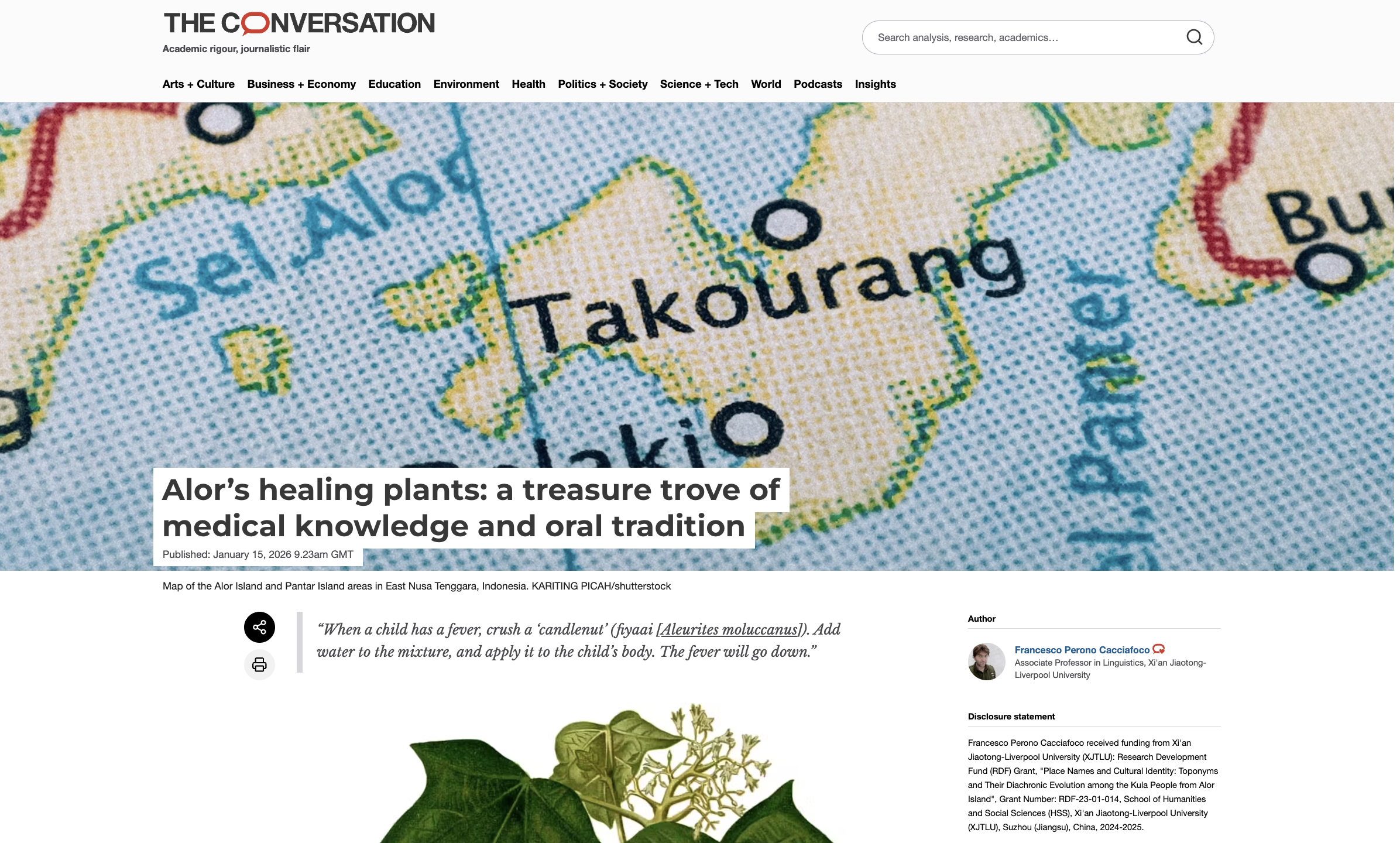
Summary: The Abui people of Alor, a small island in eastern Indonesia, have preserved vast amounts of ancient medicinal plant knowledge woven into their language, legends, and rituals – from treating childhood fevers with candlenut paste to using pigeon pea porridge in ceremonies said to reveal a husband’s infidelity and heal a sick child.
Dr Francesco Perono Cacciafoco, Associate Professor at XJTLU’s School of Humanities and Social Sciences, and his team have spent years researching this intersection of language and traditional medicine. He explained that their work has documented far more than just vocabulary, capturing medical knowledge, cultural history, and unrecorded oral traditions.
SOUTH CHINA MORNING POST
Headline: Academic innovation can help budding entrepreneurs overcome future challenges
Published on: 20 January 2026
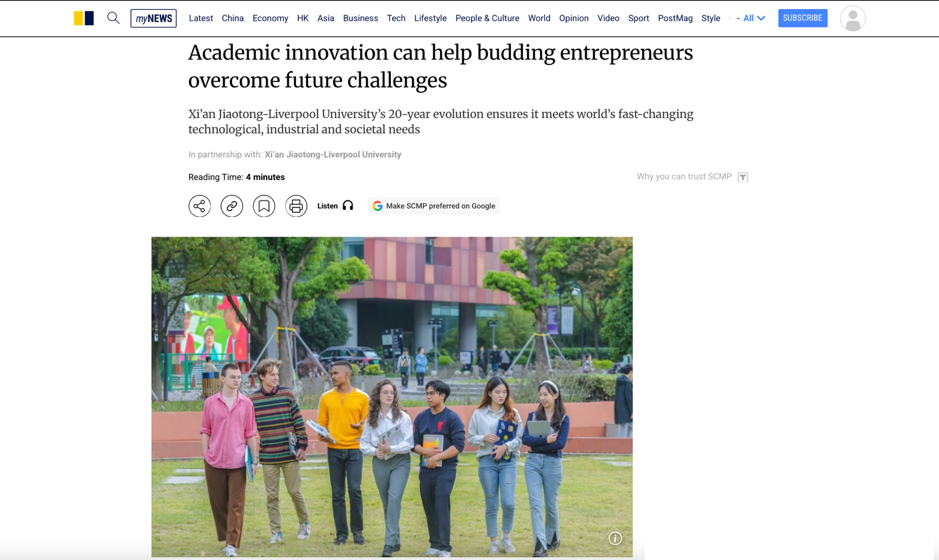
Summary: As XJTLU celebrates its 20th anniversary, the institution continues to pioneer academic innovation by integrating artificial intelligence (AI) into its curriculum and refining its “syntegrative education” strategy, which blends real-world industry projects with academic learning.
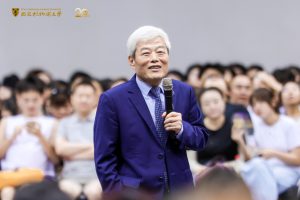
Professor Youmin Xi, Executive President of XJTLU, explains that the University’s evolving strategy focuses on finding the right balance to cater to both national needs and the digital age. Professor Stuart Perrin, Chief Officer of (Education) Ecology, oversees the interdisciplinary academies and programmes to help students develop the knowledge and attitudes necessary to become global citizens.
INTERESTING ENGINEERING
Headline: China’s new zinc‑air batteries offer stable cycling performance for 200 hours
Published on: 21 January 2025

Summary: Researchers from XJTLU and Central South University, China, have developed a new type of seawater zinc-air battery that maintains stable performance for 200 hours by using a specially designed catalyst with a five-coordinated square pyramidal structure that resists damage from chloride ions, solving a key problem that has limited the use of conventional batteries in marine environments.
ASIA RESEARCH NEWS
Headline: Breaking the bottlenecks in healthcare
Published on: 21 January 2026

Summary: Dr Qiuchen Dong, Dr Lifeng Ding, and Professor Minyan Yang, all at XJTLU’s School of Science, are developing innovative approaches to accelerate medical diagnosis, treatment, and disease prevention.
Dr Dong has created a non-invasive gas sensor test that uses machine learning to detect colorectal cancer biomarkers in just 10 minutes. Dr Ding uses computational models and machine learning to screen materials that capture radioactive organic iodides. And Professor Wang addresses the lack of effective migraine treatments by developing animal models to validate therapeutic targets, saving years of research time.
SCI-TECH NEWS TODAY
Headline: From XJTLU to Harvard: Jiayi Li’s research journey
Published on: 28 January 2026
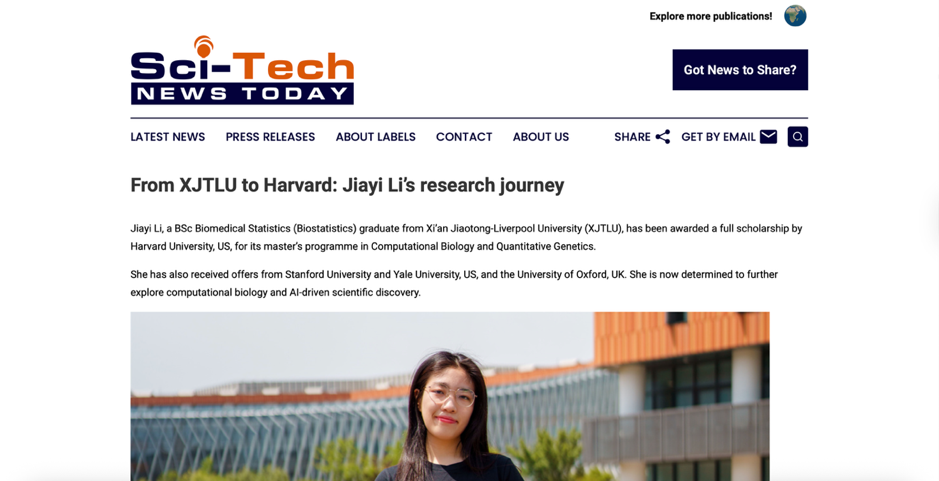
Summary: Jiayi Li, a graduate of XJTLU’s BSc Biomedical Statistics programme, has earned a full scholarship to Harvard University, US, as she pursues her passion for integrating computational methods with life sciences to drive AI-enabled scientific discovery.
EUREKALERT
Headline: Heat, Sweat, and Motion: A wearable hydrogel for real-time cardiorespiratory monitoring
Published on: 29 January 2026

Summary: XJTLU research team recently developed a new stretchable hydrogel sensor that can reliably monitor heart rate and breathing during intense exercise, even in hot and humid conditions. Unlike many current wearable devices that fail under sweat and motion, this skin-like sensor maintains stable performance by resisting dehydration and bacterial growth while remaining highly sensitive to body movements.
China Global Television Network (CGTN)
Headline: Kerjasama Robotik Malaysia-China, Pacu Daya Saing Industri Serantau (Malaysia-China robotics cooperation, driving regional industrial competitiveness)
Published on: 2 February 2026
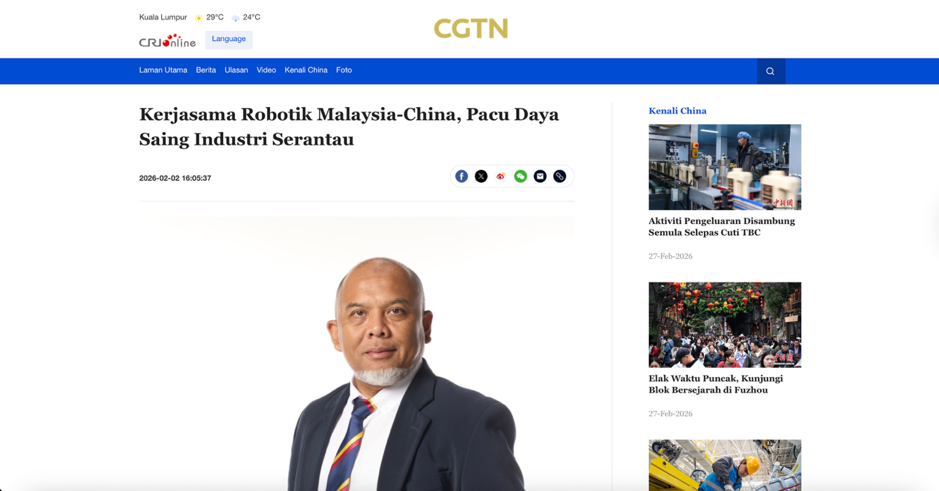
Summary: Professor Mohd Rizal Arshad, the Dean of XJTLU's School of Robotics, from Malaysia, noted that China’s robotics industry has reached an impressive level of maturity, supported by strong alignment between national policy, industry, and education. He believes Malaysia has a solid foundation to become a key player in regional robotics, but implementation must be accelerated through real-world industry projects.
CHINA ARTS AND ENTERTAINMENT DAILY
Headline: ‘Cyber panda’ to offer emotional support
Published on: 9 February 2026
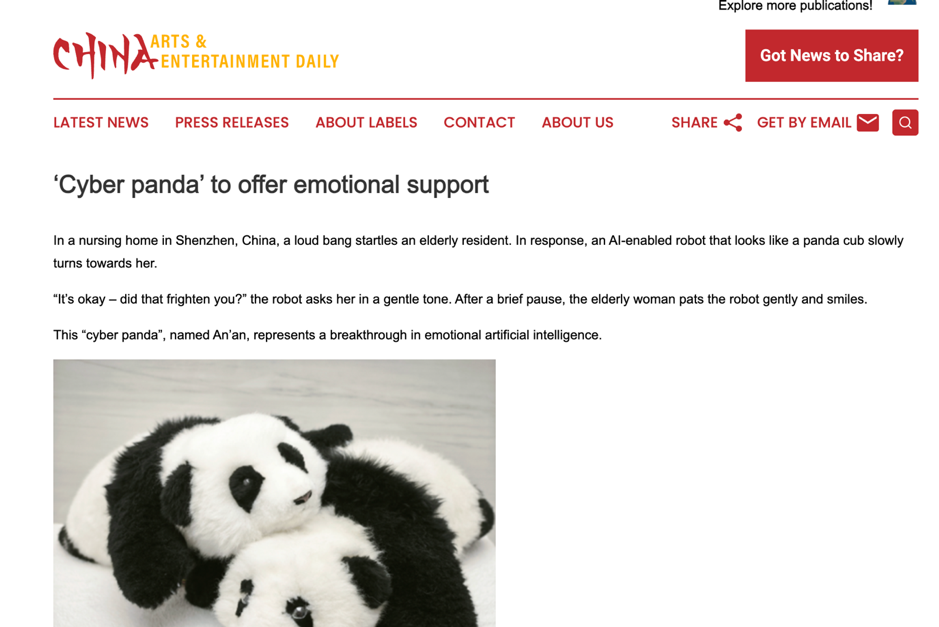
Summary: A new AI-powered robot named An’an, designed to look like a panda cub, is providing emotional support to elderly people and students with special needs. The robot can detect human emotions by analysing vocal tones and facial expressions, then respond with personalised, empathetic interactions like playing music or offering words of encouragement. Professor Jionglong Su at XJTLU’s School of AI and Advanced Computing, who leads the project, explains that An’an builds a unique emotional profile for each user, refining its communication over time.
TIMES HIGHER EDUCATION CAMPUS
Headline: Conversations with bots: teaching students how – and when – to use GenAI for academic writing
Published on: 12 February 2026
Summary: Joseph Tinsley at XJTLU’s Education Development Unit and Huimin He at the English Language Centre wrote a structured four-step approach to integrating generative AI into undergraduate academic writing courses. Their strategy covering purpose, idea generation, feedback and proofreading has shown that students benefit most when given the space to experiment with AI tools under guided practice.
TIMES HIGHER EDUCATION CAMPUS
Headline: What happens when we reframe accessibility as belonging?
Published on: 25 February 2026

Summary: In a piece exploring the gap between accessibility policy and classroom reality, Professor Angela Fitzgerald at XJTLU’s Department of Educational Studies makes the case that truly inclusive learning environments are built through deliberate design rather than reactive accommodation. Drawing on universal design for learning, she outlines how small, intentional choices in curriculum and assessment can significantly reduce barriers for neurodivergent students, first-generation learners, and those balancing study with work or care responsibilities.
By Kayla Foniel Johan
Edited by Vionna Fiducia Theja and Xinmin Han
01 Mar 2026
RELATED NEWS

Global Media Highlights in December
L’ANTIDIPLOMATICO Headline: How to Communicate with China - Alessandra Cappelletti (Sinologist) Published on: 4 November 2025 Summary: The rec...
Learn more
Global Media Highlights in January
CHINA BRIEFING Headline: Beyond Zero Tariffs – What Hainan’s New Customs Zone Means for Industry, Investors, and the Island Published on: 18 December 2...
Learn more